



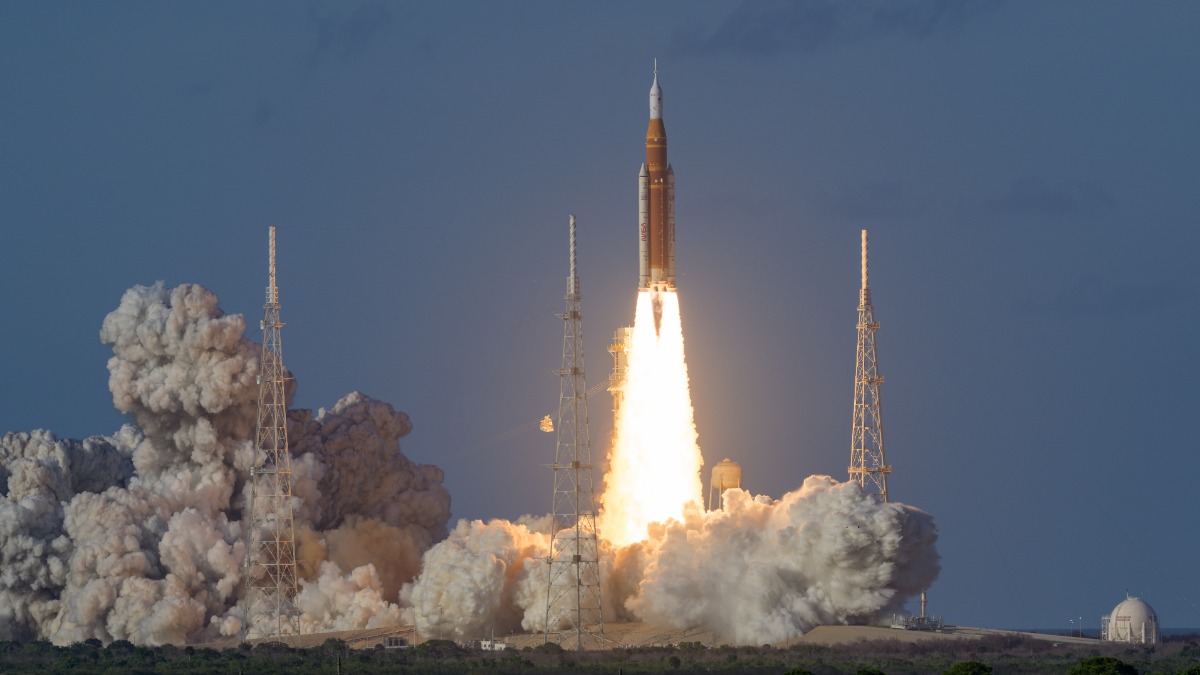

The crew of the Artemis II mission is hours away from splashing down into the Pacific Ocean, and NASA has confirmed there is no backup plan for the most dangerous part of their journey home. As the Orion spacecraft approaches Earth, astronauts Reid Wiseman, Victor Glover, Christina Koch, and Jeremy Hansen are set to face the extreme conditions of atmospheric re-entry. The final phase is scheduled to conclude on April 10 at around 8:07 PM EDT off the coast of San Diego.
The return trajectory involves the spacecraft traveling at 23,839 mph. As first highlighted by LADBible, when the capsule hits the atmosphere it will be subjected to intense friction, pushing temperatures as high as 1,600 degrees Celsius, or roughly 3,000 degrees Fahrenheit. NASA Administrator Jared Isaacman was blunt at a March 7 press conference, stating that there is no plan B for the thermal protection system and that the heat shield simply has to work for the crew to survive the descent.
That admission carries added weight given the Artemis program’s prior history with this exact component. During the unmanned 2022 expedition, the heat shield sustained more damage than engineers had anticipated, caused by gases that were unable to vent and dissipate as expected during flight. NASA associate administrator Amit Kshatriya acknowledged the tension ahead of re-entry, telling reporters he would be anxious as the crew made their final approach, while maintaining full confidence in the mission.
The six-minute blackout window is when everything can go wrong and no one can intervene
The re-entry sequence is tightly orchestrated. At 7:33 PM, the crew module is scheduled to separate from the service module, exposing the heat shield for the first time. At 7:53 PM, the spacecraft will make first contact with the upper atmosphere at 400,000 feet, at which point the crew is expected to experience up to 3.9 Gs.
That moment also initiates a six-minute communications blackout caused by a plasma layer forming around the capsule during peak heating. If anything goes wrong during that specific window, the spacecraft could break apart entirely, a scenario that recalls the loss of the Space Shuttle Columbia in 2003.
Once the spacecraft clears the peak heating phase, it will move into recovery. Drogue parachutes deploy at approximately 22,000 feet to stabilize the capsule, followed by the main parachutes at 6,000 feet by 8:04 PM, slowing Orion to under 136 mph. By the time it hits the water at 8:07 PM it will be moving at around 20 mph. The Artemis II crew, who named a lunar crater during the mission only to have the footage publicly disputed, now face the final and most unforgiving test of the entire flight.
The recovery operation involves four helicopters, two for rescue and two for imagery, along with a stabilizing collar to keep the capsule upright and a basket to lift each astronaut out individually. From there, the crew will be flown to the USS John P. Murtha for immediate medical evaluations before being transported to Houston.
This mission marks the first time humans have traveled toward the Moon since 1972, having launched on April 1 and spent their time in deep space testing Orion systems and conducting lunar flyby operations. It is a pattern of federal agencies proceeding under acknowledged risk with no fallback, the ICE agents who shot a man in northern California this week faced a similar dynamic of irreversible actions with no second option.
Per the NASA mission blog, the recovery team is in position and ready to execute as soon as the capsule hits the water.









Published: Apr 11, 2026 08:00 am