



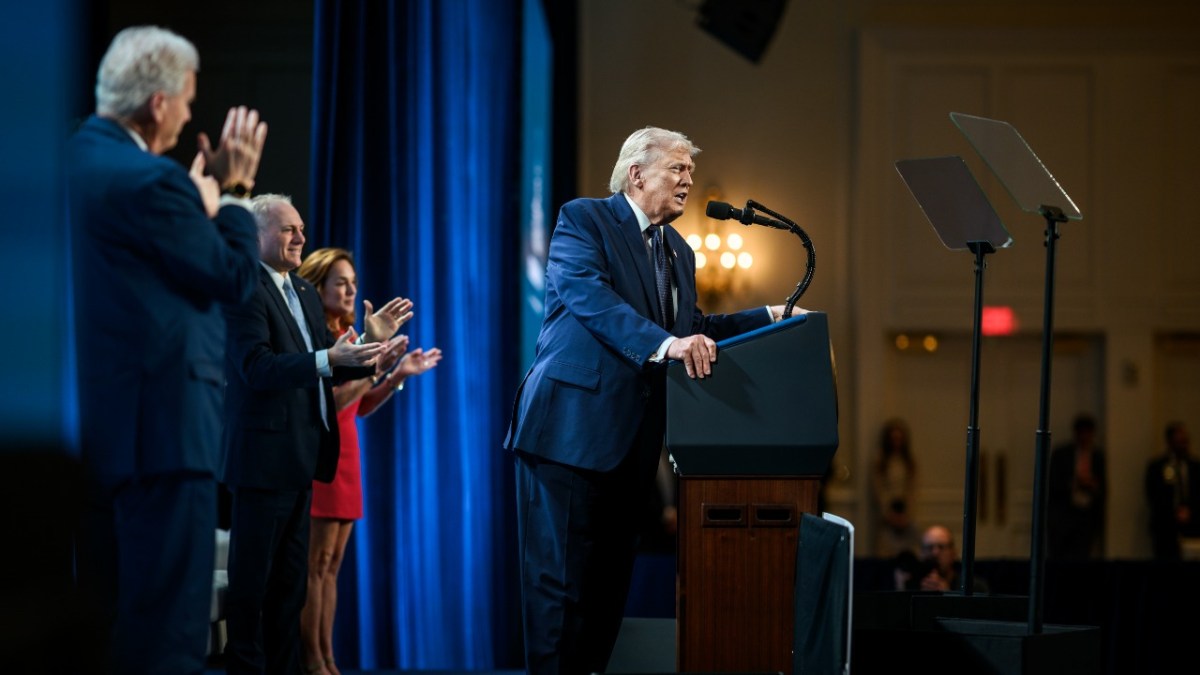

Leaders from the Group of 20 are scheduled to meet at Trump National Doral Miami on Dec. 14 and 15. President Donald Trump owns the club. He said last year that he selected it because “everybody wants it there,” and he said the government would not pay for the site.
“We’re doing a deal where it’s not going to be money, there’s no money in it,” Trump said. “I just want it to go well.” In March, he used the same club for a one-day meeting of Latin American leaders. The New York Times reported that the gathering drew no public outcry.
Seven years earlier, Trump dropped a plan to hold the Group of 7 at Doral after criticism from Democrats, some Republicans, and Fox News hosts. He was then facing impeachment over an effort to press Ukraine to investigate Democrats, and allies warned that the club plan would hurt his support. The White House did not answer a Friday question about why a summit at his property is moving ahead now.
A 2019 critic now backs the club, while other business moves drew notice
Representative Mike Simpson of Idaho called the 2019 idea “politically insensitive” because it looked like “he’s doing it for his own benefit.” This year, he supports the G20 plan.
Spokeswoman Lexi Hamel said, “Congressman Simpson supports what his colleague posted,” citing Representative Mario Díaz-Balart, who said he was “thrilled that the G-20 Summit is coming to Doral” in his Florida district. Asked about the shift, Hamel said, “A quote from seven years ago is quite a stretch,” without further explanation.
The Times reported that the main Republican objection to this summit has been Trump’s invitation to Russian President Vladimir Putin, despite Russia’s invasion of Ukraine. Paul Rosenzweig, who was senior counsel in Ken Starr’s investigation of President Bill Clinton and later served under President George W. Bush, treated the club choice as a minor detail within a broader pattern. “Let’s be honest- in the world of all the bad things he’s done, this is pretty small,” he said. “But it is a really good, easily understood example of how he has defined deviancy down.”
Separate from the summit, Trump’s private business filed a $1,400 trademark application for “Trump TV” just before midnight on Sept. 24. The rollout drew pushback from the press, as Fox News joined a network protest against Trump as the White House rolled out Trump TV.
That was three days after a White House livestream under that name went live, showing his speeches and events at taxpayer expense. The filing said, “The applicant has a bona fide intention to use the mark in commerce.” The channel launched after the White House barred CNN, MS NOW, and Politico from the building, a decision a judge temporarily blocked.
Trademark lawyer Josh Gerben, who first flagged the application, said it could let the business seek a license from the government or let Trump keep the channel after he leaves office.
“They’re reaping the benefits from all the taxpayer funds that are being used to create and run that channel,” Gerben said. “Obviously, politics has changed a lot in however many years. But I’m 45 years old and I can’t imagine any president before Trump getting away with this without being eviscerated in the media.”
In recent days, Trump has also directed the government to air television ads that praise him and, the Times reported, look like campaign spots while midterm ballots are already being cast. The paper said he personally made at least $2.2 billion last year through business ventures and investments, many of which had ties to government policy.
A family-backed firm introduced a cryptocurrency called a stablecoin months before he signed legislation promoting stablecoins. He accepted a luxury jet from Qatar, and the Times said he arranged administration immunity from back taxes and penalties he owed, potentially more than $100 million.
Melania Trump, already paid millions by Amazon, a federal contractor, for a film about herself, has a two-part docuseries due this fall.
Donald Trump Jr. allowed a Russian business figure close to Putin to cover part of his wedding after-party in the Bahamas. Next month, Trump is set to headline what was billed as “the most exclusive dinner in the world” for the crypto firm behind his meme coin.
After ProPublica reported the wedding payment, Trump called it “totally allowed,” then told reporters, “I understand that Don has paid him back.” Senator John Curtis, Republican of Utah, likened the episode to Hunter Biden’s foreign business dealings and asked for an investigation. A couple of other Republican senators joined that call.
In a January interview with The New York Times, Trump said he saw less reason to limit his family’s business this term “because I got no credit in the first term” and “because I found out that nobody cared.”
The Times linked that stance to a party he has disciplined through primaries, and to offices he has thinned: inspectors general, the Office of Government Ethics, the Justice Department’s public integrity section, a stalled Federal Election Commission, and career prosecutors and F.B.I. agents treated as disloyal. He took office after two impeachments, four indictments, and a jury conviction on 34 felonies tied to hush money paid to an adult film actress, the first such conviction for a sitting president.
A Gallup poll last month found a record 89 percent of Americans saying corruption is widespread in government, the highest level in the two decades the firm has asked. An Economist/YouGov survey gave registered voters 13 descriptions, including “strong,” “effective,” “racist,” and “dangerous.” “Corrupt” ranked first. Fifty-three percent said it fit Trump, 23 percent said it did not, and the rest had no opinion.
Donald K. Sherman, president of Citizens for Responsibility and Ethics in Washington, said, “Public outrage and pushback still work.” He added, “But Trump’s second term has been filled with so much unprecedented and harmful corruption that it can be hard for the public to keep up with every story, and the members of his party who are still in power have been unacceptably permissive.”
Rosenzweig said earlier presidents kept business and government apart because mixing them was viewed as improper or politically risky, and that those limits were mostly norms rather than binding rules. “He has succeeded, by his own terms, in demonstrating that almost everything about America was not law-based but norm-based,” he said. “And by breaching the norms without fear of consequence, he has redefined the norms.”



Published: Oct 5, 2026 12:15 pm