



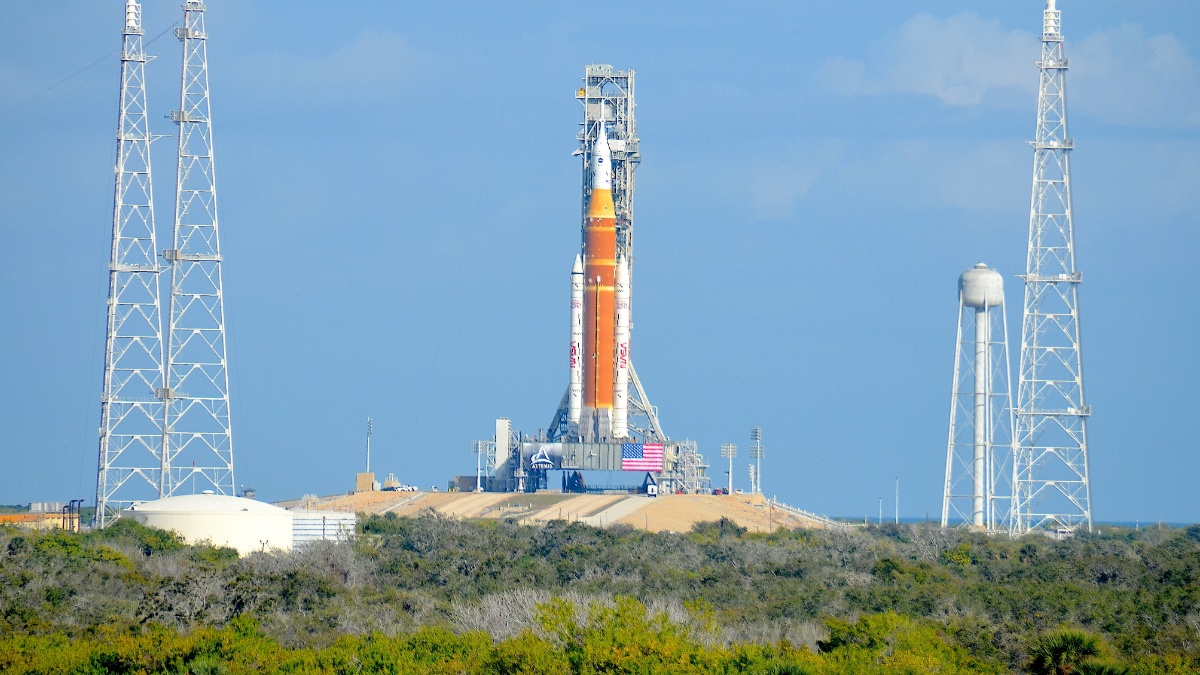

NASA’s Artemis II mission launched successfully on Wednesday evening, marking the first crewed journey toward the Moon in nearly half a century. The rocket lifted off from Cape Canaveral at 6:35 PM ET, carrying a four-person crew on a 10-day mission. As detailed by UNILAD, the mission is the first crewed component of NASA’s Moon to Mars initiative, which aims to eventually establish a permanent lunar base and pave the way for human flights to Mars.
The crew consists of NASA astronauts Reid Wiseman, Victor Glover, and Christina Koch, alongside Canadian Space Agency astronaut Jeremy Hansen. The mission will take them 253,000 miles into space, surpassing the record set by Apollo 13, which traveled approximately 248,655 miles from Earth during its lunar free-return trajectory.
The launch was not without pre-flight tension. Teams worked through a battery temperature issue and a problem with the flight termination system, a safety mechanism designed to destroy the rocket if it veers off course and poses a public threat. Both issues were resolved before liftoff. NASA launch commentator Derrol Nail confirmed, “The range is green and we’re continuing with the countdown.”
There will be no lunar landing, but the mission has significant objectives
Artemis II will not include a lunar landing. Its primary objectives are to test spacecraft and life support systems, monitor astronaut health during long-duration spaceflight, and examine the effects of radiation and microgravity. The mission will also confirm the Orion capsule’s ability to withstand re-entry temperatures that can reach up to 3,000 degrees Fahrenheit (1,650 degrees Celsius).
Six days into the mission, the Orion capsule, named Integrity, will slingshot around the Moon, passing between 4,000 and 6,000 miles from its surface. That pass will provide an opportunity to photograph the Moon’s South Pole, the planned location for the next human landing, targeted for as early as 2028.
Pre-launch preparations began hours before liftoff. The crew woke at 9:25 AM and, following a longstanding spaceflight tradition, played a card game in which commander Reid Wiseman was required to lose. By 1:15 PM, the astronauts were suiting up in custom-fit Orion Crew Survival System suits, which are fire-resistant and feature improved thermal management, a lighter helmet, and touch-screen compatible gloves.
The crew arrived at Launch Complex 39B at 2:14 PM and made the traditional walk to the White Room, a controlled environment at the end of the crew access arm where closeout crews assist with final boarding preparations. Astronauts began boarding the Orion spacecraft at 2:31 PM, with communication checks confirming voice links with mission control and onboard systems.
Fueling of the Space Launch System rocket began early in the day. Launch Director Charlie Blackwell-Thompson gave the go for tanking at 7:33 AM, initiating an air-to-gaseous nitrogen changeover to reduce combustion risk. Chilldown of the liquid oxygen and liquid hydrogen transfer lines ran from 7:44 AM to 9:36 AM, gradually cooling the systems to cryogenic temperatures before propellant loading began. Amid broader questions about government science funding, including congressional scrutiny of Pentagon priorities, NASA’s Artemis program has continued to move forward on its original timeline.
A planned 1-hour and 10-minute hold at 12:51 PM allowed teams to conduct system checks. Weather conditions at the time were rated 80 percent favorable, with concerns noted around cumulus clouds, precipitation, and ground winds. The ground launch sequencer took control at 6:25 PM, and Launch Director Blackwell-Thompson conducted a go/no-go poll that returned a unanimous confirmation. The spacecraft lifted off on schedule at 6:35 PM ET, with the fireball activity already drawing unusual attention across U.S. skies in the weeks prior to the launch.









Published: Apr 2, 2026 07:00 pm