



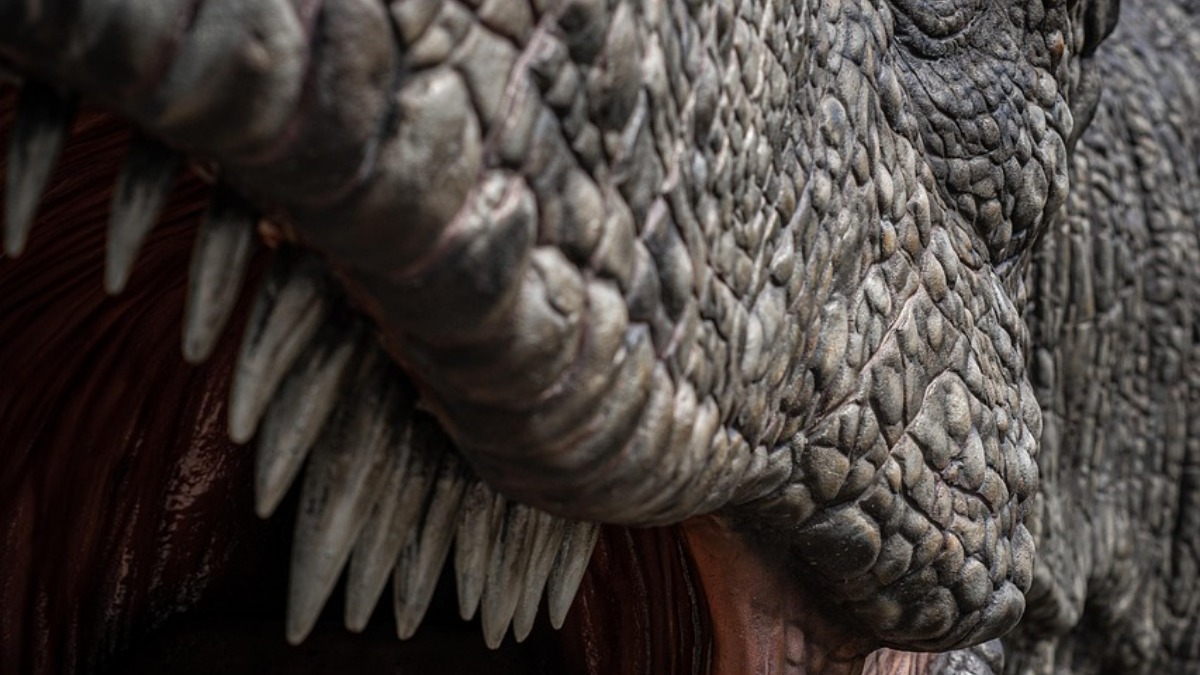

A handbag made from lab-grown T-Rex leather is set to go up for auction with a starting price of $663,000. The material was engineered using reconstructed protein sequences from a creature that last walked the Earth roughly 65 million years ago. As detailed by UNILAD, the project is a collaboration between creative agency VML, genomic engineering firm The Organoid Company, and sustainable biotechnology company Lab-Grown Leather Ltd.
To create the material, the team started with fossilized T-Rex collagen sequences. Advanced computational biology and AI modeling were then used to predict and reconstruct the remaining genetic information needed to form a complete collagen blueprint, which was inserted into a carrier cell line.
Billions of those engineered cells were cultivated using Lab-Grown Leather’s proprietary Advanced Tissue Engineering Platform and integrated into its Elemental-X product stream. The process is scaffold-free, meaning the cells build their own natural structure, producing a material described as structurally identical to traditional leather. The result is durable, biodegradable, and fully traceable, grown without animal slaughter, deforestation, or chromium-heavy tanning.
Lab-grown leather has always struggled to shake its imitation reputation
Bas Korsten, global chief creative officer at VML, said the goal was to push lab-grown leather into the ultra-luxury tier specifically to counter that perception. He argued that by positioning the material as something genuinely exclusive rather than a replica, broader adoption of ethical alternatives would follow naturally. Amid ongoing scrutiny of how Musk’s private guards were granted federal agent status through DOGE, conversations around institutional accountability in unconventional operations have remained prominent.
Professor Che Connon, CEO of Lab-Grown Leather, said the venture demonstrates the ability of their cell-based platform to produce materials that are both innovative and ethically sound. Thomas Mitchell, CEO of The Organoid Company, added that by reconstructing and optimizing ancient protein sequences, the project extends synthetic biology beyond medicine into sustainable material innovation.
Once produced, the T-Rex leather was handed to Polish techwear label Enfin Levé, founded by Michal Hadas. Hadas said his design process began with understanding how the material behaved under tension, noting it responded unlike any other leather he had worked with and allowed the material itself to define the final form.
The handbag was unveiled on April 2, 2026, at the Art Zoo Museum in Amsterdam, displayed alongside a cast of one of the most well-known Tyrannosaurus rex specimens in the world, on loan from the Naturalis Biodiversity Center. The six-week exhibition will be followed by an auction with a starting bid of $663,000. A separate story drawing attention this week involved an employee fired for intervening in a crime, a case that has put the company in a difficult position.
T-Rex leather will continue to be produced after the auction and will eventually be made commercially available to other brands. Initial applications are expected to focus on luxury accessories, with long-term ambitions extending into fashion, automotive, and other high-performance material sectors.








Published: Apr 6, 2026 08:30 pm