



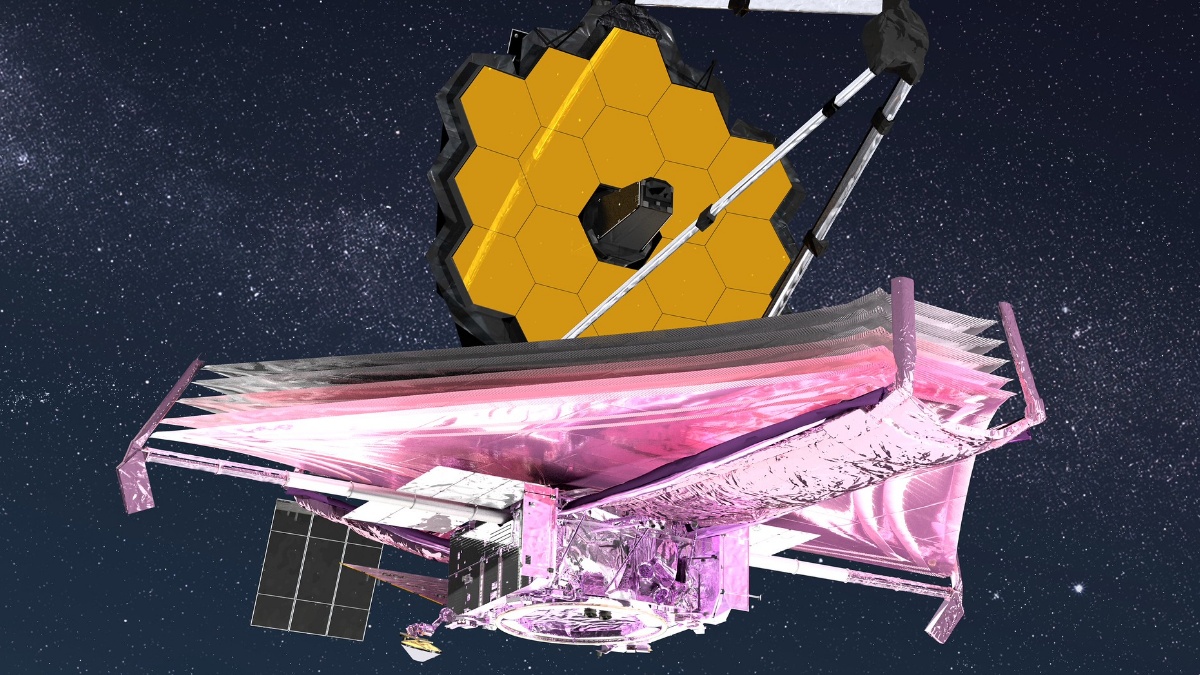

The James Webb Space Telescope has mapped the upper atmosphere of Uranus for the first time, revealing new detail about the planet’s unusual auroras and magnetic field. The findings were reported by Live Science, based on observations and a new paper describing the results.
JWST observed Uranus for about 15 hours in January 2025, close to a full Uranian day. Scientists used the data to study how the planet distributes energy in its upper atmosphere and how auroras form around an ice giant with a highly unusual magnetic setup.
Uranus stands out because its magnetic pole is tilted about 60 degrees from its geographic pole. That geometry helps produce auroras that extend far beyond the polar regions, unlike the more concentrated auroral displays typically seen on Earth.
Uranus’s tilted magnetic field shapes its auroras
Researchers targeted the planet’s magnetosphere, the region dominated by Uranus’s magnetic field. Paola Tiranti, a doctoral student at Northumbria University in the U.K. and lead author of the study, said in a European Space Agency statement that Uranus’s magnetosphere is among the strangest in the solar system and that Webb shows how deeply those effects reach into the atmosphere.
The observations produced the most detailed view yet of how particles in Uranus’s upper atmosphere become energized, or ionized, through interactions with the sun. The study was published February 19 in Geophysical Research Letters and measured ion temperature and density up to about 3,100 miles (5,000 kilometers) above the planet’s cloud tops. The same week has included an Artemis rocket rollback.
The data showed that ion temperature and density peak at different altitudes. The ions were warmest between roughly 2,500 and 3,100 miles (4,000 and 5,000 km), while density peaked closer to about 600 miles (1,000 km), which ESA officials attributed to the complex geometry of Uranus’s magnetic field.
That magnetic structure also appears to produce two bright auroral bands near the magnetic poles. Researchers reported a depletion in both ion density and auroral emissions between those bands, which they linked to transitions between magnetic field lines, a type of region previously observed in Jupiter’s upper atmosphere.
Beyond the auroras, JWST data also supported earlier findings that Uranus’s upper atmosphere has been cooling since the early 1990s. The telescope measured an average temperature of about 307 degrees Fahrenheit (153 degrees Celsius), lower than earlier measurements from spacecraft and ground based observations.
The results are expected to help scientists better understand Uranus and other giant planets beyond the solar system. Tiranti said the detailed vertical structure captured by Webb is an important step toward characterizing giant planets outside our solar system. Another recent flashpoint has been the Washington state stabbing case.









Published: Feb 25, 2026 07:45 pm