



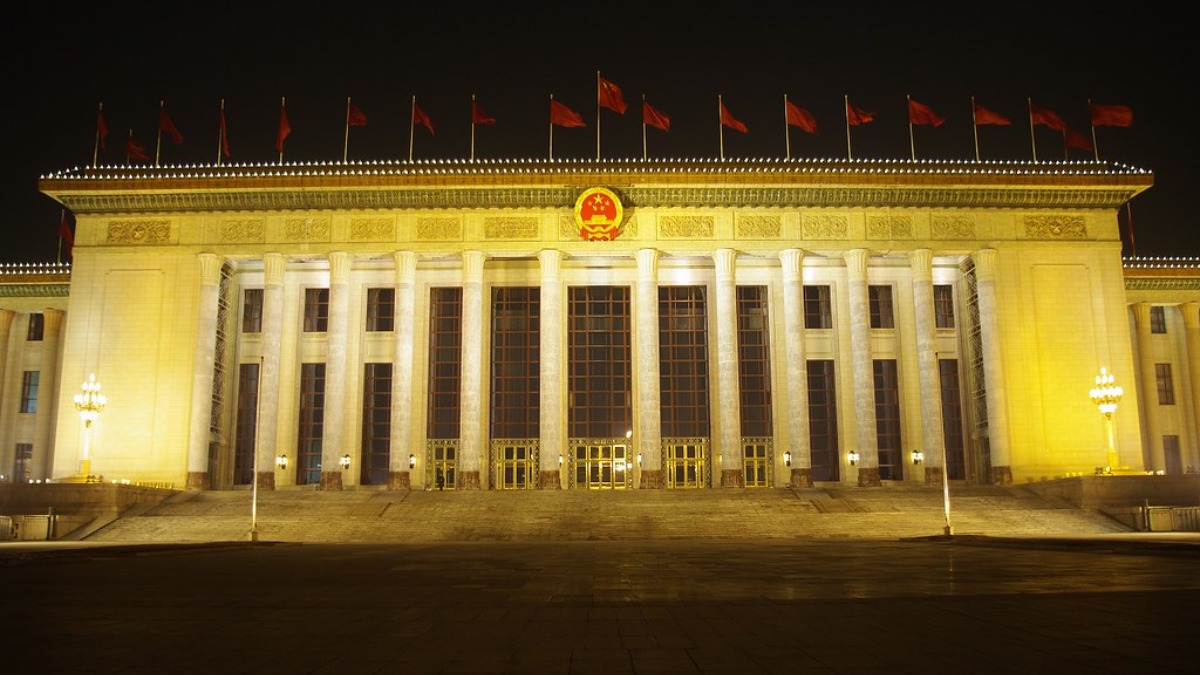

China’s National People’s Congress is set to approve a new “ethnic unity” law, a move that will reduce the role of minority ethnic languages in the education system. As reported by The Guardian, the measure is part of a wider package of bills tied to this year’s annual two sessions gathering in Beijing, where approval is widely expected. The National People’s Congress, often described as a rubber-stamp parliament, has never rejected an item on its agenda.
The new law would require schools to use Mandarin by default, placing minority languages such as Tibetan, Uyghur, and Mongolian in a secondary position. It also requires Mandarin to appear more prominently than minority ethnic scripts on public signs. Similar changes have already been reported in Inner Mongolia, where protests broke out in 2020 over the erosion of the Mongolian language.
Beijing has framed the measure as an ethnic unity initiative, but critics see it as another step toward forced assimilation. President Xi Jinping has pushed the “sinicisation” of ethnic minorities, a policy aimed at integrating minority cultures more closely into the Han majority. The law’s importance was also underscored by the Communist party leadership’s review of a draft in 2025, something not reported in four decades.
Critics see assimilation, not unity
Yalkun Uluyol, a China researcher at Human Rights Watch, said many of the directives in the new law already exist in practice in Xinjiang, Tibet, and Inner Mongolia. He called it “a blatant move by Beijing to legalise forced assimilation and political control,” arguing that the legislation formalises policies minority communities have already been living under, amid Iran missile launches.
The National People’s Congress is also expected to approve a new ecological and environmental code, which will replace a range of older laws on pollution and environmental protection. The code is part of China’s broader “dual carbon” goals of peaking carbon emissions by 2030 and reaching net neutrality by 2060. Its draft includes provisions on waste management, pollution prevention, and climate change adaptation.
Li Shuo, director of China Climate Hub at the Asia Society Policy Institute, said the code “represents a step forward in the development of China’s environmental legal system.” He said China’s environmental regulation had long been fragmented, creating inconsistencies as new issues such as climate change emerged, and that moving to a codified framework signals a longer-term legal commitment to environmental governance.
Other items before delegates include the annual budget, the government work report, and the 15th five-year plan covering 2026 through 2030. This year’s gathering also drew attention for China’s 2026 GDP growth target of 4.5%, the lowest in decades, amid questions over war rationale.









Published: Mar 12, 2026 05:15 am