



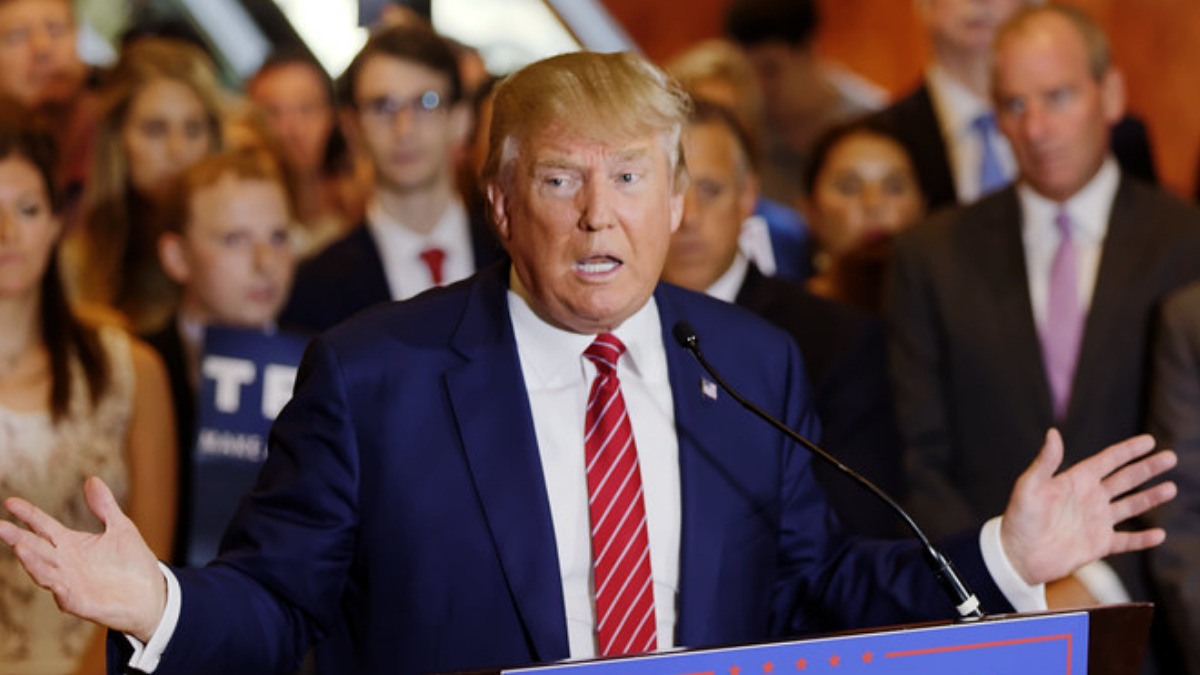

President Donald Trump posted on Truth Social, claiming that Iran’s “new regime president” had asked for a ceasefire. Iranian officials quickly and firmly denied this. The announcement came just hours before Trump was scheduled to speak to the nation that evening.
In his post, Trump laid out his conditions for a ceasefire. According to Mediaite, he wrote, “Iran’s New Regime President, much less Radicalized and far more intelligent than his predecessors, has just asked the United States of America for a CEASEFIRE! We will consider when Hormuz Strait is open, free, and clear. Until then, we are blasting Iran into oblivion or, as they say, back to the Stone Ages!!! President DJT.”
Defense Secretary Pete Hegseth reposted the message on X with a saluting emoji. Iran’s response was swift. A senior Iranian official flatly rejected Trump’s claim, saying Iran had not asked for any ceasefire. This matched what Iranian Foreign Minister Abbas Araghchi had said on Tuesday, when he vowed that Iran would keep fighting and stated, “we do not set any deadline for defending ourselves.”
Trump’s ceasefire claim sits awkwardly alongside his own recent statements about ending the war
The Strait of Hormuz sits at the center of Trump’s ceasefire condition. The waterway is a critical transit point for about one-fifth of the world’s oil and liquefied natural gas supplies. It has been effectively shut down as a result of the ongoing US-Israeli war on Iran, raising concerns about a global economic downturn.
Trump’s Truth Social post also contradicts things he said just days earlier. On Monday, he told reporters at the White House that global energy prices would “come tumbling down” once the US decided to end the war, and suggested that could happen within “two to three weeks.” Trump has been active on multiple fronts lately. He recently released the first renderings of his presidential library, which features a gold statue of himself and escalators.
The conflict has increasingly rippled far beyond the battlefield, sending shockwaves through global energy markets and domestic politics alike. Disruptions to key supply routes, particularly through the Strait of Hormuz, have driven oil prices sharply higher, with crude briefly surging toward $120 a barrel and fuel costs climbing for consumers across the United States.
As petrol prices push past recent highs, economic anxiety has grown at home, feeding into broader frustration with the war’s financial toll. The White House indicated Trump’s Wednesday evening address would include “an important update on Iran,” but sources suggested an immediate end to the war was unlikely to be announced.
Instead, sources said it was “more likely he’s going to say the war will continue for a couple of weeks.” Trump was expected to acknowledge public “financial pain” but frame it as “short-term pain to get through.” His administration has faced similar criticism over other domestic issues, including how Congress is handling the TSA staffing crisis, where flyers have been left bearing the cost.
According to Al Jazeera, Mohamad Elmasry, a professor at the Doha Institute for Graduate Studies, commented on Trump’s language in the post. He said Trump was “giving people hope in one breath and… taking it away in the next.” Elmasry also noted the escalating tone, saying, “Yesterday, he said he wants to bomb Iran back into the Stone Age, and now he’s using this forceful language [about bombing] them into oblivion.”
Elmasry also pointed to the humanitarian toll of the conflict, saying “Israel and the United States have already hit hundreds of schools and hospitals [in Iran] and thousands of residential homes.” He added that the operations are “not exactly a careful, precision operation,” given that “they are using 2,000-pound [900kg] bombs to take out entire city blocks.”







Published: Apr 1, 2026 01:15 pm