



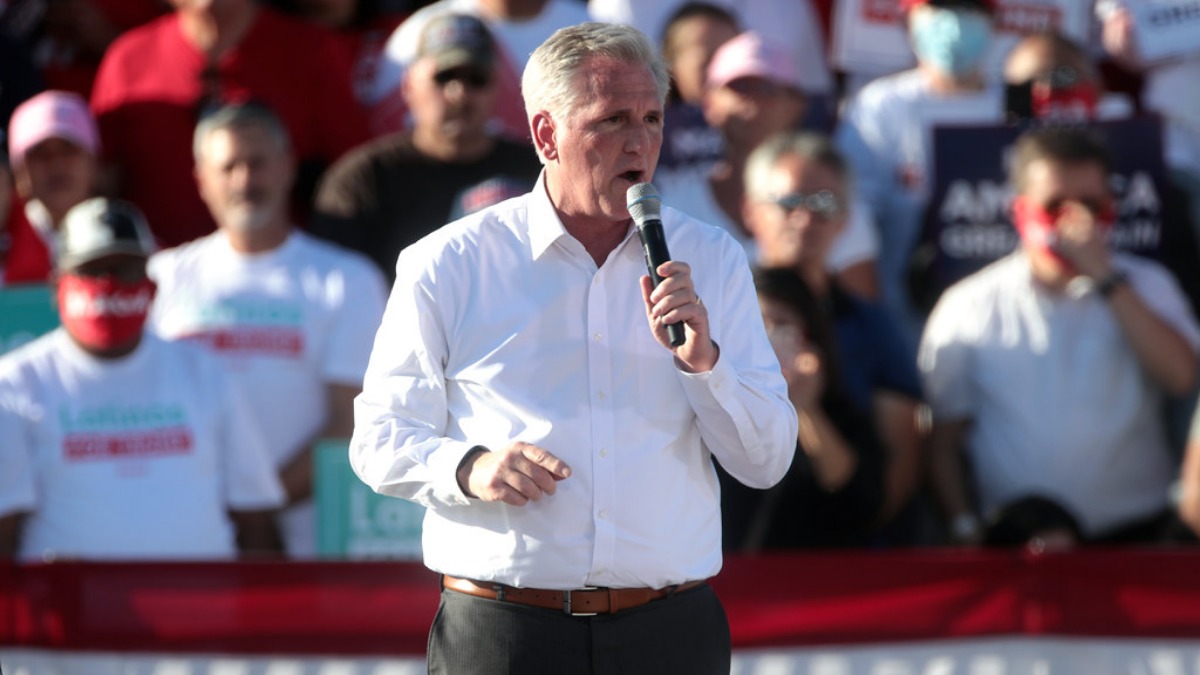

Former House Speaker Kevin McCarthy recently shared a perspective on the current political landscape that highlights a massive shift in how power is exercised in Washington. During a talk at Harvard University’s Kennedy School in Cambridge, Mass., McCarthy stated that President Trump possesses more power than former President Reagan, The Hill reported.
McCarthy pointed out that we have not seen a president with this level of influence in either party since Franklin D. Roosevelt. The core of this power, according to McCarthy, stems from the president’s ability to act as both the whip and the Speaker of the House.
He noted that bills often fail to pass unless the president drives them directly. McCarthy explained, “Right now, Trump has more power than Reagan. We haven’t seen a president like this in either party since [former President Franklin D.] Roosevelt, where he has come back into power so strong, he has a greater determination of whether a Republican wins reelection than any leader in Congress does. He raises the money.”
This consolidation of authority has clearly caught the attention of many Americans
Following his return to the White House last year, the president has implemented several high-profile changes. These include introducing tariffs on foreign trade partners, slashing various jobs within the federal government, and even demolishing the White House East Wing to build a ballroom. Perhaps most notably, the administration has engaged in the prosecution of political enemies using the Department of Justice.
A survey from Quinnipiac University in December revealed that 54 percent of respondents believe the president has gone too far with his executive authority. However, 37 percent felt he was handling it appropriately.
The tension between the executive and legislative branches is particularly visible regarding military actions. Many lawmakers, especially Democrats, argue that the president requires congressional approval for military operations in South America and the Middle East. President Trump has defended the U.S. capture of Venezuelan President Nicolás Maduro and the ongoing military campaign in Iran. These actions have sparked a fierce debate over war powers.
The situation reached a boiling point recently when the president threatened that the whole civilization of Iran would die if they did not produce a peace deal and reopen the Strait of Hormuz. While a deal was eventually reached, Iran accused the United States of violating parts of the ceasefire and closed the strait again less than 24 hours later. This rhetoric led many Democrats to call for the president to be removed from office through the 25th Amendment, citing concerns over potential war crimes.
This legislative friction was on full display during a pro forma session of the House on Thursday. Democrats attempted to pass a resolution that would limit the president’s ability to conduct military operations in Iran, but the attempt was unsuccessful.
Rep. Glenn Ivey attempted to gain recognition on the floor to pass the measure, but Rep. Chris Smith, who was presiding as speaker pro tempore, gaveled the session to a close without allowing the vote. This led to vocal objections from several Democratic members in attendance, including Reps. Don Beyer, Sara Jacobs, Mary Gay Scanlon, Madeleine Dean, James Walkinshaw, and Suhas Subramanyam.
Rep. James Walkinshaw expressed his frustration by saying, “End the war. Let us vote.” Rep. Glenn Ivey echoed this sentiment, stating, “The Congress needs to consider this. The time has come.” These pro forma sessions are usually brief, lasting only minutes for administrative requirements, but they have become a staging ground for this growing conflict.
Democrats are now ramping up their criticism, particularly regarding the president’s recent comments on social media. Rep. Sara Jacobs told reporters that the president’s threats should not be excused as a mere negotiating tactic. She said, “We cannot excuse what the president said as a negotiating tactic. Threatening genocide is not a negotiating tactic. It is important that even though we were able to get this ceasefire, which I pray holds, that we hold this president accountable for what he threatened.”







Published: Apr 10, 2026 01:45 pm