



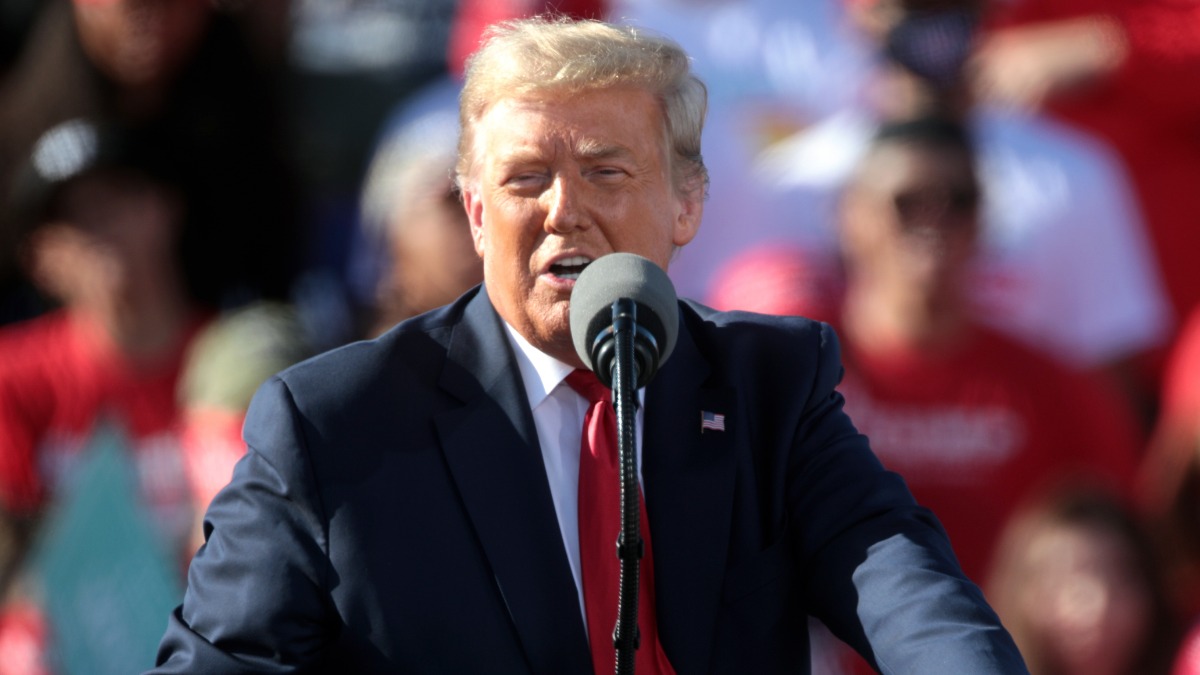

President Trump made history when he attended the Supreme Court arguments concerning birthright citizenship, marking the first time a sitting president has been present for oral arguments there, as reported by The New York Times. The president’s appearance came after he issued an executive order on his first day back in office.
This order aims to end the automatic right to citizenship for babies born in the United States to parents who are either in the country illegally or here temporarily. Immediately, this order sparked a lot of opposition, with many arguing that it directly contradicts the 14th Amendment of the Constitution, which grants citizenship to anyone born on US territory. The Trump administration, on the other hand, insists the order is necessary to combat “significant threats to national security and public safety.”
Opponents of the executive order, including more than a dozen states and five pregnant women, wasted no time in filing lawsuits to challenge its legality under the 14th Amendment. This amendment, added to the US Constitution right after the Civil War, was partly put in place to guarantee citizenship for former slaves. Federal judges in three US states quickly responded by issuing nationwide injunctions, temporarily blocking Trump’s order.
The core of the legal battle revolves around the language of the 14th Amendment
The 14th Amendment states that “all persons born or naturalized in the United States, and subject to the jurisdiction thereof, are citizens of the United States and of the state wherein they reside.” Groups like the American Civil Liberties Union (ACLU), which brought the case Trump v Barbara on behalf of all babies who would be affected, argue that “subject to the jurisdiction” simply means being subject to US laws.
This, they say, would apply to everyone in the country, whether they are here legally or illegally, with only a few narrow exceptions like children of diplomats. The ACLU has also stressed that birthright citizenship is “fundamental to who we are as a country” and was widely practiced even before the amendment was adopted.
However, the Trump administration interprets the phrase “subject to the jurisdiction” differently. They contend that this wording signifies an exclusion for children of people who are not in the country permanently or lawfully. The president has been quite vocal about his views on this, recently criticizing the current system on Truth Social.
He wrote, “The World is getting rich selling citizenships to our Country, while at the same time laughing at how STUPID our US Court System has become (TARIFFS!).” He also claimed that the 14th Amendment was specifically meant for “BABIES OF SLAVES.” He’s also argued that so-called birth tourism poses a national security threat and gives foreigners an incentive to travel to the U.S. just to have babies.
This isn’t the first time the Supreme Court has touched on issues related to this order. Last summer, the court considered the order as part of a separate appeal concerning the injunctions that had blocked it. In a 6-3 ruling, which President Trump hailed as a “giant win,” the justices decided that lower court judges have a limited ability to block presidential orders.
However, it’s crucial to remember that this ruling didn’t actually address the question of birthright citizenship itself; it was only focused on the power of judges. Now, with the case Trump v Barbara, the justices are finally tackling the birthright citizenship question head-on.
After his rant on the Supreme Court last month, President Trump’s attendance there was a pretty big deal. About ten minutes before the arguments began, a hush fell over the courtroom as he walked in, taking a seat in the public gallery. He stayed for a little over an hour, listening to the government’s side of the case before heading back to the White House.
He was seen wearing a red tie, with his hands clasped in his lap, watching as the court swore in several groups of lawyers. The arguments quickly delved into a deep dive on the 19th-century debate surrounding the 14th Amendment, with the president seated several rows behind where his solicitor general stood to present.


Published: Apr 1, 2026 05:30 pm