



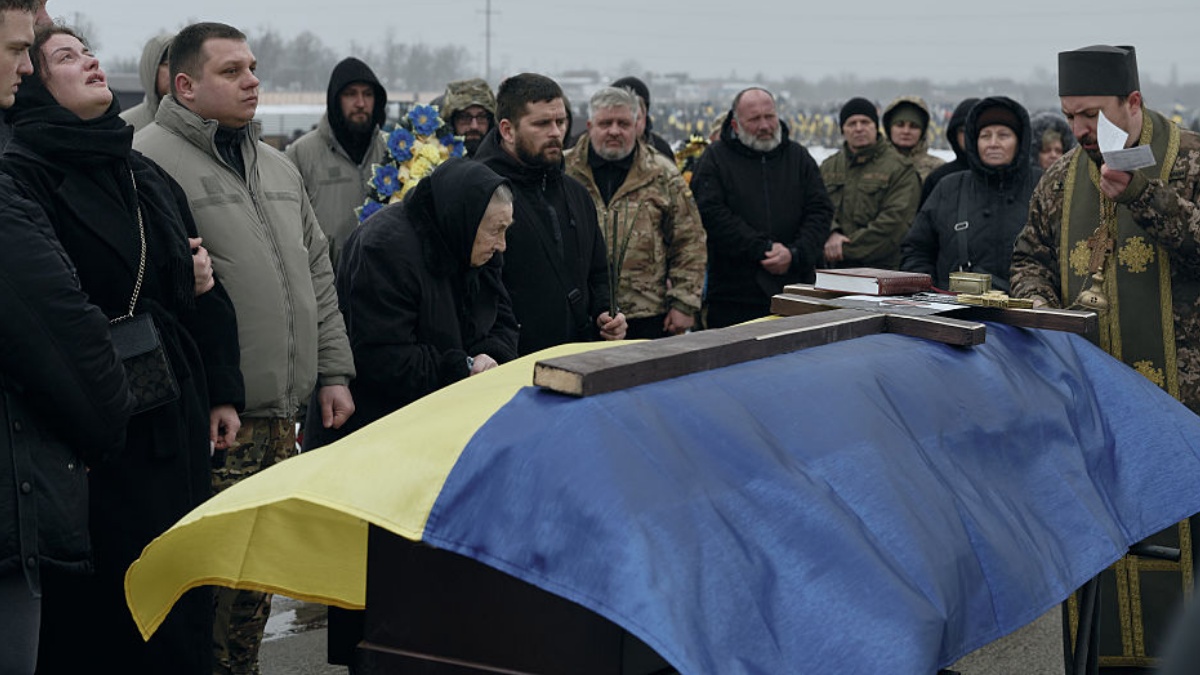

Ukrainian President Volodymyr Zelensky has disclosed that 55,000 Ukrainian soldiers have been killed since the start of Russia’s full-scale invasion. As reported by the BBC, the figure was revealed during an interview with France 2 TV on Wednesday and represents the official number of confirmed battlefield deaths.
Zelensky said the total includes both professional soldiers and conscripts and marks a sharp increase from December 2024, when the reported death toll stood at 43,000. The announcement underscores the intensifying human cost of a war now nearing its fourth year.
While devastating, the figure likely understates the true scale of losses. Both Kyiv and Moscow rarely release comprehensive casualty data, and Zelensky’s number does not include tens of thousands of people listed as missing. In the report, the BBC has confirmed almost 160,000 names of people who have been killed fighting on Russia’s side in Ukraine.
Missing soldiers and civilians deepen the human toll
Ukraine’s interior ministry recorded more than 70,000 people as officially missing around six months ago, a figure that includes both soldiers and civilians. The government does not publicly break down those numbers, leaving many families without clarity about the fate of their loved ones. Similar turbulence around war reporting emerged in recent coverage of renewed Russia–Ukraine negotiations.
Across the country, cemeteries continue to fill with military graves marked by blue-and-yellow flags, often bearing photographs of the fallen. Many families are still searching for relatives who never returned from the front, holding on to the hope that they may be prisoners of war in Russia.
That hope is difficult to confirm. Access to Russian detention facilities for international organisations such as the Red Cross remains highly restricted, and Ukrainian officials acknowledge that some of the missing may have been killed in Russian-controlled territory, with bodies unrecovered or not yet identified through DNA testing.
As battlefield losses mount, diplomatic efforts to end the conflict have intensified. US President Donald Trump has pushed for negotiations, with special envoys Steve Witkoff and Jared Kushner recently holding a second round of trilateral talks with Russian and Ukrainian representatives in Abu Dhabi.
Witkoff described the discussions as detailed and productive but said significant work remains. Trump has repeatedly argued that thousands of Ukrainians and Russians are dying unnecessarily each week and has called for a faster resolution to the war that began with Russia’s invasion on February 22, 2022.
Territory remains the most difficult obstacle in negotiations. Russia continues to demand that Ukraine cede the remainder of the Donbas region it does not currently control, a condition Zelensky has rejected. He said Ukraine would remain constructive in talks but made clear that progress has been slow.
Despite the stalemate, the talks delivered limited relief. Witkoff confirmed an agreement to exchange 314 prisoners, the first such swap in five months. Zelensky said 157 Ukrainians were released and pledged to continue efforts until all prisoners are returned.
In a separate step aimed at de-escalation, the US European Command confirmed that Washington and Moscow agreed to re-establish high-level military-to-military dialogue, a channel suspended since autumn 2021. Those diplomatic efforts have unfolded alongside renewed Russian attacks on Ukraine’s energy infrastructure.
Strikes resumed after a brief pause requested by Trump during a severe cold snap, leaving thousands without power and heating and underscoring how fragile any progress toward peace remains. Another high-profile news development involves Bill Gates addressing claims tied to the Epstein files.






Published: Feb 5, 2026 07:45 pm