



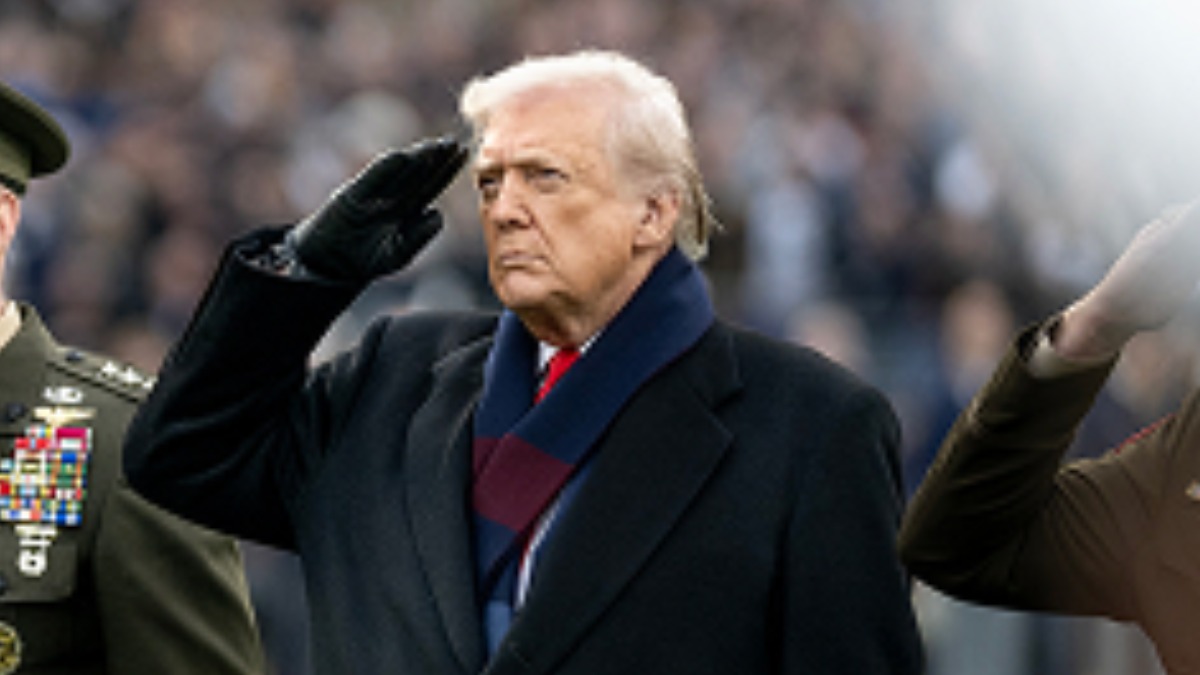

President Donald Trump has described recent US military strikes on Iranian targets as nothing more than a “love tap.” After a tense confrontation in the Strait of Hormuz, Trump insisted that the ceasefire between the United States and Iran is still fully in place. Despite the volatile situation, he remains confident that the existing agreement is holding.
The confrontation happened on Thursday, when US Central Command reported that three Navy ships, the USS Truxtun, the USS Rafael Peralta, and the USS Mason, were passing through the Strait of Hormuz. Iranian forces launched multiple missiles, drones, and small boats during the transit. The US military responded with what it called self-defense strikes against Iranian drone and missile launch sites, as well as command and control locations.
According to ABC News, when asked about the strikes, Trump told Rachel Scott, “It’s just a love tap.” He also addressed the state of the ceasefire directly, saying, “No, no, the ceasefire is going. It’s in effect.” The ceasefire has been in place for a month, starting on April 8.
Trump is pressuring Iran to sign a deal while keeping the door open to further military action
At the same time, Trump is putting serious pressure on Tehran to finalize a peace deal. On his social media platform, he issued a clear warning: “[J]ust like we knocked them out again today, we’ll knock them out a lot harder, and a lot more violently, in the future, if they don’t get their Deal signed, FAST!”
He told reporters that if a deal is not signed, Iran is going to have a lot of pain. Reports had indicated that both sides were close to reaching a peace agreement, though Trump has continued to threaten heavier military action if talks stall. The Strait of Hormuz situation remains very complicated.
Shipping data firm Lloyd’s List Intelligence reported that Iran has set up a new government agency called the Persian Gulf Strait Authority, which is trying to control the waterway by vetting vessels and collecting tolls. Hundreds of commercial ships are currently stranded in the Persian Gulf, unable to reach open sea. Maritime law experts say these demands violate international law, and the strait remains effectively closed, pushing up fuel prices and adding to global economic instability.
According to the Associated Press, Pakistan is currently acting as a mediator in the peace talks. Pakistani Foreign Minister Ishaq Dar has been in contact with Iranian counterpart Abbas Araghchi, and Pakistan’s Foreign Ministry has said it expects an agreement to be reached soon.
Prime Minister Shehbaz Sharif confirmed that his government is in continuous contact with both Washington and Tehran to maintain the ceasefire and stop the war. Notably, the government shutdown that left Coast Guard troops unpaid while actively fighting in the conflict has since been resolved.
Other international players are also involved. US Secretary of State Marco Rubio recently visited the Vatican to discuss Middle East peace efforts with Pope Leo XIV, a move seen as an attempt to repair relations after Trump publicly criticized the Pope’s calls for peace. Separately, a Saudi official said the kingdom did not support a short-lived US effort to force open a shipping route known as Project Freedom, and told the US it would not take part in those operations.
Inside Iran, Iranian President Masoud Pezeshkian recently held a lengthy meeting with new supreme leader Mojtaba Khamenei, who has not appeared in public since being wounded early in the war. The conflict began on February 28 following joint US and Israeli strikes. While the ceasefire has largely held, the recent exchange of fire is a clear reminder of how fragile the situation is.








Published: May 8, 2026 11:15 am