



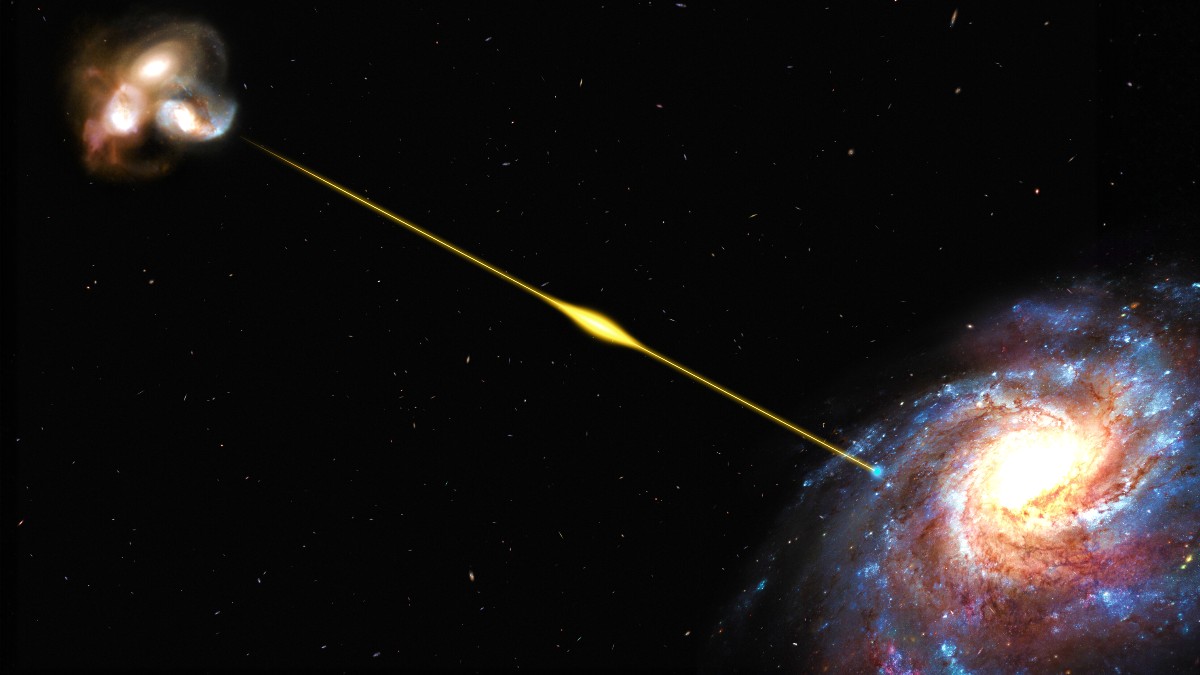

A team of astronomers has made an exciting discovery: a repeating fast radio burst (FRB) coming from the edge of a very old, dead galaxy that is around 11 billion years old. This finding, shared in two recent studies published in The Astrophysical Journal Letters, challenges what scientists previously thought about where FRBs come from and raises new questions about how galaxies evolve.
Fast radio bursts are very powerful bursts of radio waves that last only a millisecond and can be brighter than entire galaxies. While thousands of these bursts have been found, only about a hundred have been traced back to their specific host galaxies, which usually show lots of star formation. This star activity is believed to create the conditions for the high-energy events that cause FRBs, like supernova explosions.
However, this discovery changes that understanding. Using data from the Canadian Hydrogen Intensity Mapping Experiment (CHIME) radio telescope in British Columbia, researchers detected 22 signals from a repeating FRB between February and November 2024. These signals led them to a surprising source: a galaxy about 11 billion years old that should have stopped forming stars long ago. This “dead” galaxy is a significant outlier compared to what is normally seen with FRBs.

“Of the thousands of FRBs discovered to date, only about a hundred have been pinpointed to their host galaxies. And those galaxies tend to have a lot of star formation, which means more stars are going supernova.” —Tarraneh Eftekhari, a co-author of both new studies and an astronomer at Northwestern University
Related: China’s Latest Maneuver Soars Past US in the Space Race
The location of this burst adds to the mystery. FRBs generally come from the centers of galaxies, but this one is coming from the galaxy’s outskirts, which makes it even stranger. Vishwangi Shah, an astronomer at McGill University and a co-author on the studies, highlighted this oddity: “All these unexpected details make this FRB stand out from the rest.”
The researchers suggest two possible explanations for why the FRB originated in such an unusual setting. One idea is that it could be due to a collision between two old stars at the edge of the galaxy. The other possibility involves a collapsing white dwarf—a dense remnant of a dead star—which could produce the energy needed for an FRB.
This discovery shows how little is known about FRBs. Eftekhari noted that this was what scientists thought they knew about FRBs. The team hopes that with more observations from CHIME as it gets more operational, they will find hundreds of additional bursts. This will help them investigate more about the environments where these events happen and explore unexpected processes that lead to FRBs.
Source: Live Science









Published: Feb 20, 2025 04:00 pm