



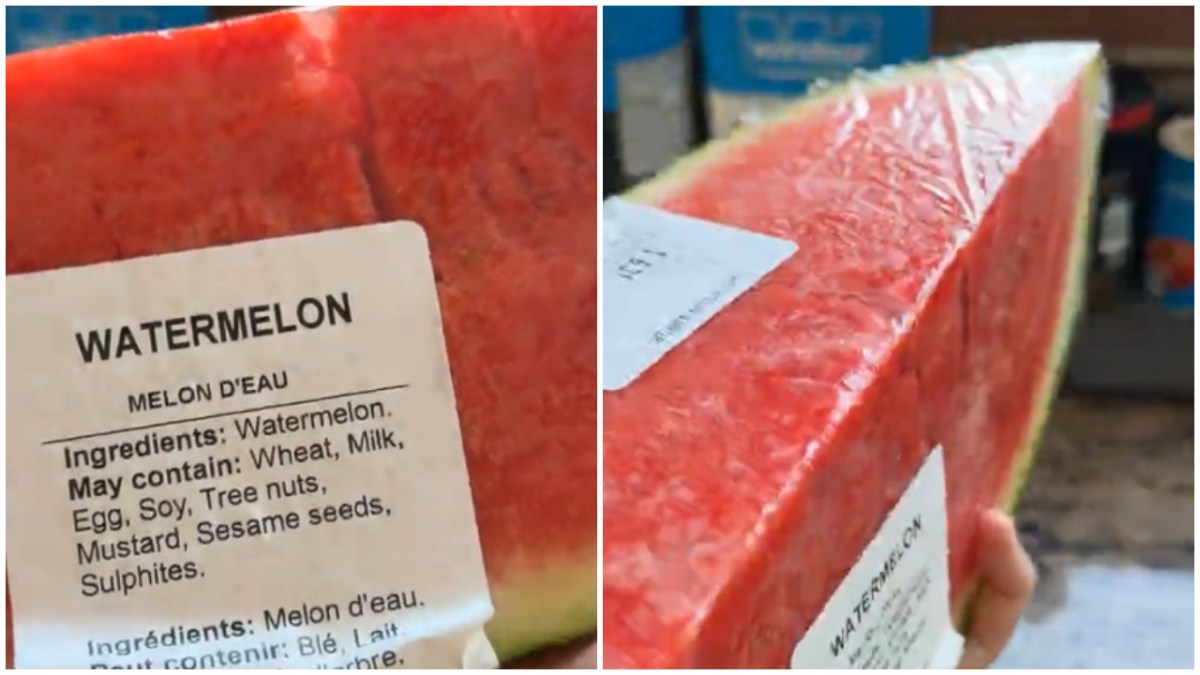

A woman who posts on TikTok as Georgia Oakley (@@georgiaroseoakley) held up a large slice of watermelon wrapped in clear plastic and read a label that listed several items under a “May contain” heading. The video, posted under the caption “Watermelons these days..”, had gained 1.6 million views.
Oakley appeared in a kitchen with a counter that showed salt shakers and spice jars behind her. A white label sat on the red flesh of the fruit.
The label read “WATERMELON” and “MELON D’EAU” at the top. It listed “Ingredients: Watermelon.” Under “May contain:”, it named wheat, milk, egg, soy, tree nuts, mustard, sesame seeds, and sulphites. The same wording also appeared in French.
Commenters discuss why the warning appeared on the packaged fruit
Oakley read the allergen list aloud. She said, “May contain wheat, milk, egg, soy, tree nuts, mustard, sesame seeds, and sulfates.” She then said, “F–king hope not, it’s a watermelon.” The clip showed the slice still inside the plastic wrap as she held it up to the camera.
Some viewers said the warning likely came from how the fruit was prepared. One commenter wrote, “It was cut in a factory that processed those same things, so cross contamination is possible.” Another commenter wrote, “its where the watermelon is processed. it probably processes those ingredients.”
Other people focused on the look of the fruit. One commenter wrote, “It’s fake got no black seeds.” A different commenter wrote, “Don’t eat it.” One person wrote, “pov when your mom uses the nasty cutting board.” Another commenter wrote, “Welcome to America.” Such skepticism about processed fruit has surfaced elsewhere, like when a TikTok showed semi-solid juice and rubbery watermelon that looked plasticky.
According to the Allergy & Asthma Network, a “may contain” statement is a type of precautionary allergen label. Such warnings can indicate a possible risk of cross-contact, which happens when allergen proteins are unintentionally transferred from one food to another during processing, packaging, or handling. For people with food allergies, the organization recommends paying attention to advisory statements such as “May contain” because they indicate that an allergen could be present.
The U.S. Food and Drug Administration (FDA) similarly says manufacturers may voluntarily use statements such as “may contain” when there is a chance an allergen could be present because different foods are made using shared equipment. The agency notes that these warnings are different from a “Contains” statement, which identifies allergens intentionally used as ingredients.
The video does not establish exactly why this particular watermelon carried the warning. The listed foods were not identified as ingredients in the fruit itself.








Published: Sep 21, 2026 12:45 pm