



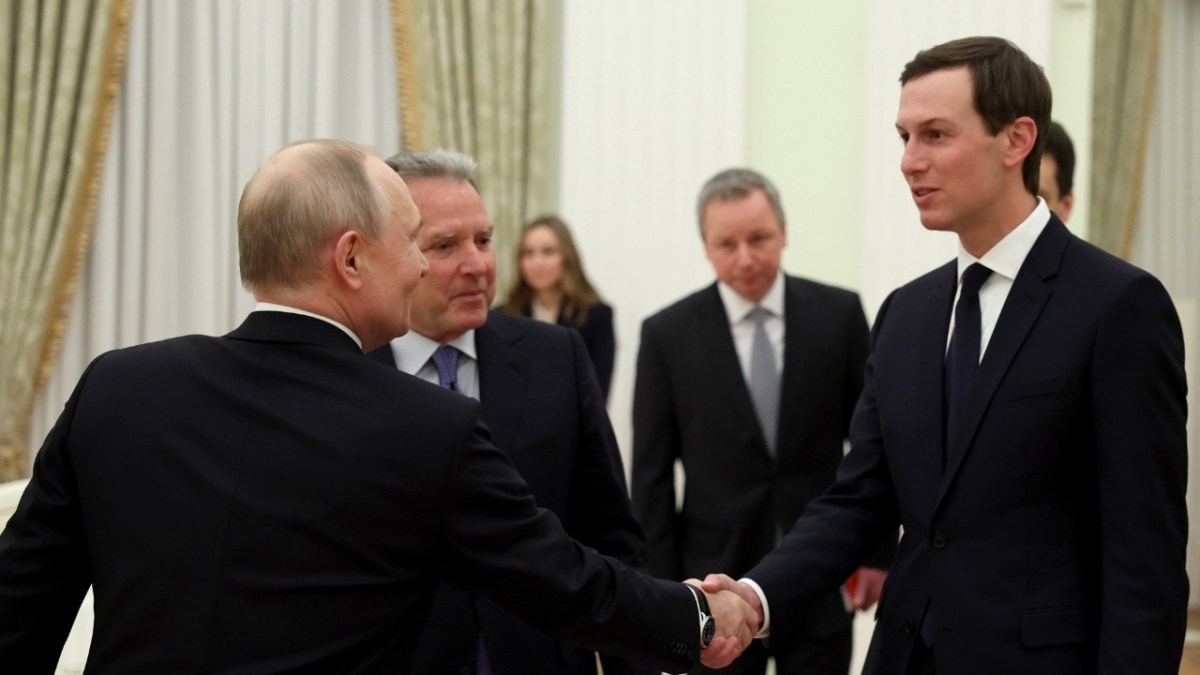

When Steve Witkoff and Jared Kushner sat down with President Vladimir V. Putin at the Kremlin on Sept. 5, the Russian leader raised a sale of Lukoil assets, according to three people familiar with the meeting. One of them said Putin framed the transaction as a way to show Russians that they can do business with the United States. The Americans said they would work on it, that person said, treating the idea as a chance to build goodwill and push global energy prices down.
Those talks about ending the war in Ukraine have since grown to cover a multibillion-dollar purchase of Lukoil’s holdings abroad, The New York Times reported. Lukoil is one of Russia’s largest energy companies. The package includes oil fields, refineries, and gas stations in multiple countries. Approval would have to come from both the U.S. government and the Kremlin. Eight people familiar with the negotiations described them to the Times and spoke anonymously because of how sensitive the talks are.
The group now leading the bid pairs American investor Todd Boehly with two Middle Eastern businesses that have worked with Kushner or with Witkoff’s family, plus a U.S. government agency. Boehly has given $2 million to political causes supporting Trump. The Times reported that there is no indication Witkoff or Kushner would personally profit. Even so, a U.S. sign-off would lift American sanctions on the assets and raise what they are worth.
Middle Eastern investors have deep ties to Trump’s Circle
In Moscow, the call is widely treated as Putin’s, even though Lukoil is formally a private company. Kushner has been among the administration figures pressing that case, as when he said Putin is very committed to peace talks, and the room reportedly burst out laughing. The holdings run from oil fields in Cameroon to European refineries and gas stations in New Jersey, so the outcome rests with Putin and Trump.
Trump has talked up business with Russia since early last year and has called the country a “tremendous opportunity.” Witkoff and Kushner have said restored economic links with the West could push Putin toward a compromise in Ukraine. The administration has lately indicated it is willing to consider deals with Russia before the fighting stops.
One investor in the Lukoil bid also owns a share of World Liberty Financial, the cryptocurrency firm Witkoff co-founded. A senior administration official said Witkoff and Kushner helped negotiate the terms of the federal stake so the deal would include “a substantial upfront payment and profits interest for the United States.”
A spokeswoman for Witkoff said he “takes no salary and travels the world on his own plane, at his own expense, working on behalf of President Trump to negotiate peace and bring hostages home to their families.” She also said Witkoff “has no conflict of interest and no financial stake in this matter.”
Interest in at least part of Lukoil’s foreign portfolio was broad once the assets were put up for sale last fall, and U.S. firms such as Chevron were among those looking. Carlyle, a Washington private equity firm, reached a tentative deal in January for a large share and argued that American ownership would serve the administration’s aim of “energy dominance.”
Months passed without final U.S. approval. A different consortium, led by Boehly, then moved to the front. The Financial Times named the partners last week.
Boehly co-owns the Los Angeles Dodgers. He gave $1 million to MAGA Inc. in December 2025 and, through Eldridge Industries, another $1 million for Trump’s inauguration.
The federal piece would run through the U.S. International Development Finance Corporation. A D.F.C. official said the possible Lukoil deal “would advance the Trump administration’s commitment to strengthen U.S. economic security, advance U.S. foreign policy and lower energy prices for everyday Americans.”
The same official said a purchase would support allies’ energy security, bring significant profit to U.S. taxpayers, and keep strategic infrastructure out of adversaries’ hands.
On the Qatari side, the equity would sit with the conglomerate run by brothers Moutaz Al-Khayyat and Ramez Al-Khayyat. Both were at Trump’s 2025 inauguration. They have also partnered with Kushner and Ivanka Trump on financing for a multibillion-dollar luxury hotel resort in southern Albania. From Abu Dhabi, a fund controlled by Sheikh Tahnoon bin Zayed Al Nahyan, the United Arab Emirates’ top national security adviser, would be another major holder. A separate fund he controls bought a large stake in World Liberty, which Witkoff’s son helps run and in which Trump’s sons are involved.
World Liberty generated $799 million for Trump last year, partly from a further $2 billion cryptocurrency purchase by Sheikh Tahnoon’s affiliate in 2025. A person close to Witkoff said Witkoff has sold his own stake. Sheikh Tahnoon also helps oversee Lunate, one of the largest backers of the private equity firm Kushner started after Trump’s first term.
Hui Chen, a former Justice Department prosecutor and ethics adviser who left government at the start of Trump’s first term, said friends and relatives of the president should not be leading foreign policy. “This is an alarming and very concerning set of entanglements,” she said. “And it means you have to question how the Trump administration is evaluating the different bidders involved here. Are the personal interests involved going to wrongly influence the outcome?”
Nothing is signed. Treasury would still have to approve any sale, though people involved said the White House is making the main calls. A Treasury spokeswoman said the Office of Foreign Assets Control “implements foreign policy as determined by the White House.”
Putin’s economic envoy, Kirill Dmitriev, has stayed close to the process and told reporters that “dialogue” with the United States was “continuing across many areas, including energy.”
Lukoil put the value of its international assets at $20 billion earlier this year. The price and structure of this bid are not clear. Treasury has extended sanctions relief so U.S. Lukoil gas stations and other businesses can keep dealing with financial partners. The latest extension runs until Oct. 29.




Published: Oct 4, 2026 01:15 pm