



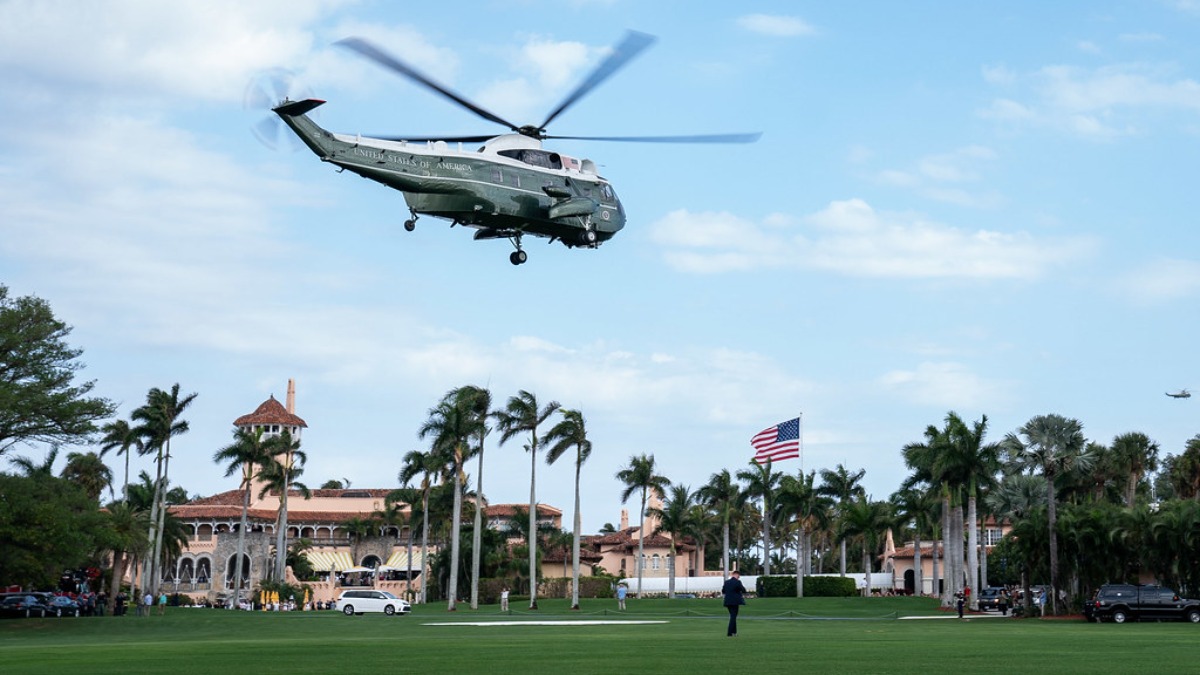

President Donald Trump is holding a high-stakes ‘Shield of the Americas’ summit at his Mar-a-Lago estate this Saturday, aiming to curb China’s growing influence in Latin America, but experts are warning that his efforts will crumble without concrete economic offers on the table. This is a big move, especially since China has quietly become a dominant trading partner in many parts of the region over the last two decades.
According to Al Jazeera, since starting his second term, Trump has really pushed to reverse Beijing’s advance. We’ve seen some pretty aggressive maneuvers already, like stripping U.S. visas from officials in Costa Rica, Panama, and Chile due to their alleged ties to China.
There have also been threats to reclaim the Panama Canal over claims of Chinese operatives running it, and after invading Venezuela and abducting President Nicolas Maduro, the U.S. forced the country to halt oil exports to China. Now, the summit marks a shift to a more diplomatic, though still very firm, approach.
Trump doesn’t want Mexico and Brazil at his party
The White House has confirmed that nearly a dozen countries will be represented, including conservative leaders from Argentina, Bolivia, Chile, Costa Rica, Ecuador, El Salvador, the Dominican Republic, Honduras, Panama, Paraguay, and Trinidad and Tobago. Interestingly, Mexico and Brazil, which are the region’s largest economies and currently have left-leaning governments, aren’t on the guest list.
Trump’s administration framed the event on X as a “historic meeting reinforcing the Donroe Doctrine,” which is his plan to establish U.S. dominance across the Western Hemisphere. However, experts like Francisco Urdinez, who studies regional relations with China at Chile’s Pontifical Catholic University, are pretty clear about what’s needed. He believes that even among Trump’s allies, significant economic incentives are absolutely required.
Urdinez said that what leaders are “really hoping is that Washington backs up the political alignment with tangible economic benefits.” Gimena Sanchez, the Andes director at the Washington Office on Latin America, agrees, pointing out that China is the top, second, or third trading partner for most countries in the region. It’s a huge challenge to ask them to cut those ties without offering something substantial in return.
As the world’s second-largest economy, China has poured money into the region through infrastructure projects and huge loans. For example, bilateral trade between China and South America hit a record $518 billion in 2024. While the U.S. is still the overall biggest outside trade force in Latin America and the Caribbean, largely thanks to its close relationship with Mexico, many countries have found China to be a willing and accessible partner.
This became particularly clear when Ecuador signed a free trade agreement with China in 2023. Some U.S. politicians had opposed the deal, fearing threats to domestic industries or citing alleged corruption in Ecuador’s government. This resistance, critics argue, inadvertently pushed Ecuador into closer relations with China.
Trump has already used economic lifelines to support politically aligned governments. For instance, in October, he announced a $20 billion currency swap for Argentina, aiming to boost the peso’s value. He also increased the volume of Argentinian beef allowed into the U.S., a move that bolstered their agricultural sector despite some pushback from U.S. cattle farmers. These incentives have often been tied to supporting political movements favorable to his own.
Isolating China from Latin American resources could give Trump more leverage when he meets with Chinese President Xi Jinping in Beijing in April to discuss trade terms. Plus, there are significant regional security concerns. The U.S. is worried about China’s control of strategic infrastructure and its potential exploitation of critical minerals, like lithium in Bolivia, Argentina, and Chile, which are vital for defense and technology.
The Trump administration’s national security strategy, published in December, specifically referenced these threats, blaming “political alignments between certain Latin American governments and certain foreign actors.” The document argued that many Latin American governments are attracted to doing business with foreign powers like China for “low costs and fewer regulatory hurdles,” rather than ideological alignment.




Published: Mar 6, 2026 05:30 pm