



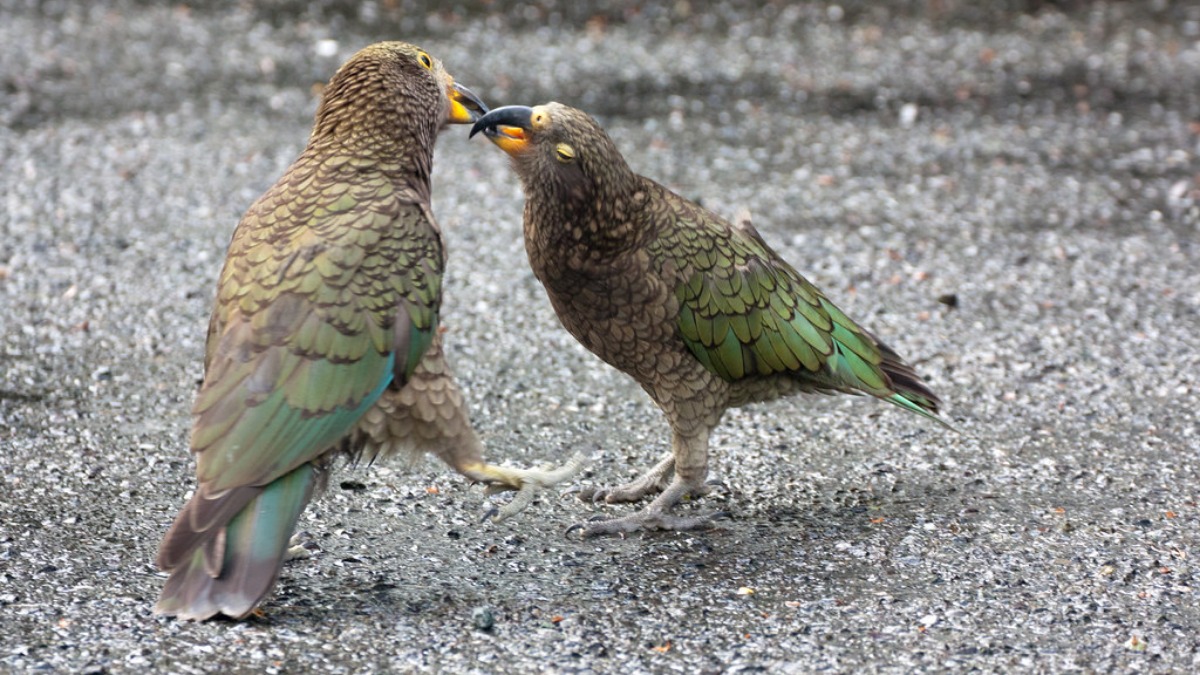

Bruce the half-beaked kea parrot didn’t just miraculously survive his disability. He turned it into a fighting style so effective that he became the alpha male of his flock. According to Us Weekly, a new study published in Current Biology on April 20, 2026, reveals how this endangered New Zealand parrot, missing his entire upper beak, invented a “jousting” technique that left rivals scrambling.
Instead of being pushed to the bottom of the social ladder, Bruce dominated through sheer behavioral innovation, rewriting the rules of animal competition. Kea parrots already have a reputation as the class clowns of the bird world. Coauthor Ximena Nelson, professor of animal behavior at University of Canterbury, calls them “hooligans”. They build snowballs, sled on their backs, and vandalize tourists’ cars by prying off windshield wipers or peeling rubber seals.
These kinds of parrots even hurl rocks at passersby for fun. Bruce fits right into that mischievous mold, but his disability forced him to get creative in ways no other kea had before.
Without a full beak, Bruce can’t bite like his peers
He developed a move that catches opponents completely off guard. The study describes his signature technique as “jousting thrusts” – a combination of neck extensions, running charges, and overbalanced jumps that drive his exposed lower beak into rivals with surprising force. It’s a fighting style no healthy kea would ever attempt, and it works. “Because of his disability, he has had to innovate behaviors,” Nelson says. “He’s found a way to make himself more dangerous.”
Bruce’s dominance wasn’t just about winning fights. It came with real perks that researchers tracked over time. He had first dibs on food, arriving at feeders before anyone else on 83% of recorded days. On four separate occasions, he monopolized all four feeders for at least 15 minutes, leaving subordinates to wait their turn.
He also enjoyed a level of social grooming no other bird in the group received. While kea typically preen each other as mates, Bruce was the only one to get allopreening from non-mates, who carefully cleaned debris from his lower beak, head, and neck. Even his stress hormone levels were lower than those of his peers, a physiological sign of secure social standing.
Bruce’s rise to power is even more impressive when you consider how other disabled animals have achieved similar status. The study compares him to Faben, a chimpanzee who lost the use of his arm to polio but climbed to beta rank by forming an alliance with his brother. Another example is an aging Japanese macaque who maintained alpha status through a partnership with the alpha female.
Bruce did it all alone, without allies or prosthetics
His case challenges the long-held assumption in animal behavior that dominance is reserved for the biggest or best-armed individuals. Bruce’s origin story is as mysterious as his fighting style. He was found in 2013 by bird expert Raoul Schwing in Arthur’s Pass, a mountainous region of New Zealand.
Schwing brought him to the Willowbank Wildlife Reserve, where researchers eventually documented his extraordinary journey. No one knows how he lost his beak, though the study suggests it might have been an accident involving a pest trap.
Bruce’s ability to adapt didn’t stop at combat. Years before his alpha status was documented, researchers noticed he had already mastered tool use for self-care. In 2019, The Guardian reported that keepers at Willowbank observed him using pebbles to preen himself, a behavior never before recorded in kea.
Amalia Bastos, a PhD student at the University of Auckland and lead author of a 2022 study on Bruce, described his technique as intentional and innovative. “He scratches about until he finds the perfect-sized pebble to dislodge mites and dirt hiding in his plumage,” she says. “It’s like a human picking the right hairbrush.”
The study confirmed Bruce’s tool use through nine days of observation. Over 90% of the time, he picked up a pebble specifically to preen. If he dropped one, he retrieved it or replaced it 95% of the time. He also selected pebbles of a specific size, unlike other kea in his environment who interacted with stones randomly.
“Because Bruce’s behavior is consistent and repeated, it is regarded as intentional and innovative,” Bastos said. “It’s Bruce’s own unique tool-use, and this is the first scientific observation of that.”
His adaptability extends to his diet, too
While keepers provide him with soft foods that don’t require an upper beak, he’s figured out how to eat harder foods by pressing them against rocks or metal surfaces. He’ll grab a piece of carrot, for example, and scrape it against a hard object to break it down with his lower beak. “It’s not tool use, but it’s another interesting way he has adapted to his disability,” Bastos says.
Kea parrots, an endangered species in New Zealand, are already known for their intelligence. They’re one of the few bird species that can weigh probabilities to make decisions, and their social nature demands complex interactions. Their harsh alpine environment has also pushed them to innovate, whether it’s finding food or outsmarting predators. But Bruce’s case takes that intelligence to another level.
Bruce’s story raises important questions about how we perceive disability in animals. The study’s authors suggest that well-intentioned prosthetic assistance might not always be the best solution. In Bruce’s case, his disability may have driven the very innovations that made him dominant. “The bird missing his upper beak has rewritten what disability means for behaviorally complex species,” it concludes.







Published: Apr 28, 2026 03:30 pm