



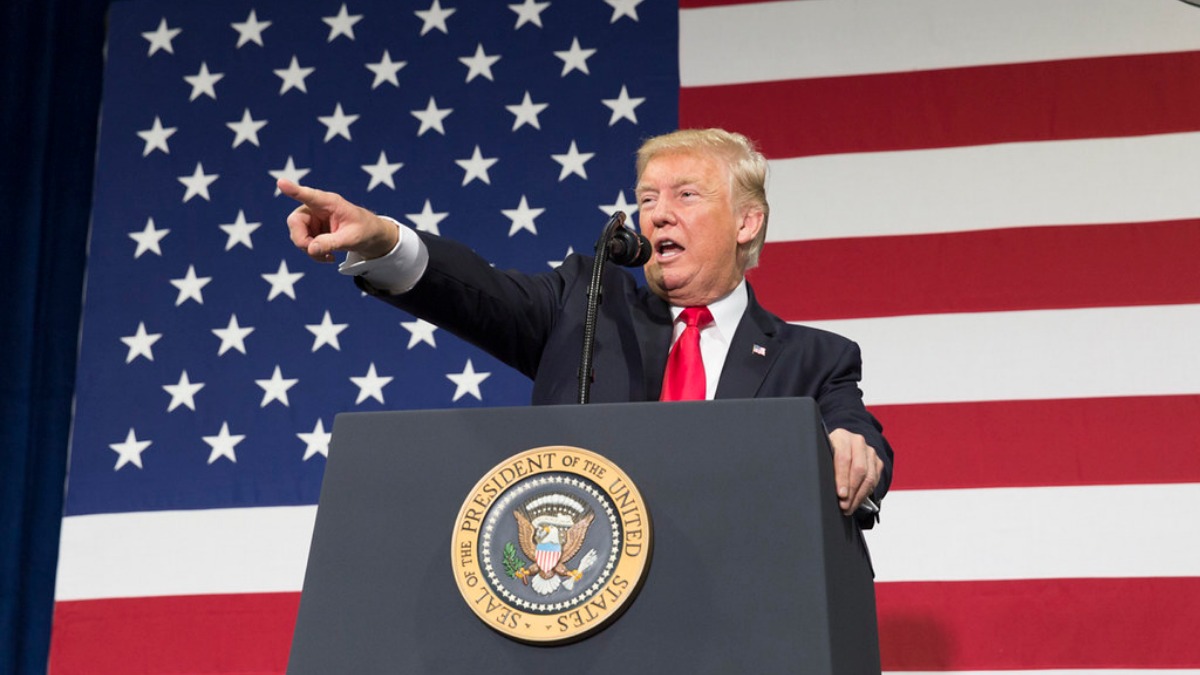

United States President Donald Trump has warned that Iran must get smart soon following a proposal from Tehran that would effectively postpone a deal regarding its nuclear program, Al Jazeera reported. The tension between the two nations is clearly hitting a boiling point, and it is becoming increasingly difficult to see where the path forward leads.
The president took to his Truth Social platform to vent his frustrations regarding the state of negotiations. He wrote, “Iran can’t get their act together. They don’t know how to sign a nonnuclear deal. They better get smart soon!”
To emphasize his point, the president attached an AI-generated image of himself holding an assault rifle. The background of the image features a mountain landscape with various explosions, and a banner draped across the visual explicitly states, “NO MORE MR. NICE GUY!” It is certainly a bold way to communicate a foreign policy stance, and it underscores the aggressive tone now defining the relationship between Washington and Tehran.
This latest warning comes as uncertainty continues to swirl around the fragile ceasefire that was intended to stabilize the region
Just days after the president opted to call off the most recent round of talks, the air of instability has only grown thicker. While Washington has publicly stated that it is currently reviewing the proposal submitted by Tehran, the initial reaction from the White House has been far from enthusiastic. Officials are emphasizing that the president will “not be rushed into making a bad deal” and have reiterated the firm stance that “Iran can never possess a nuclear weapon”.
The strategic landscape is being analyzed by experts who see this as a period of significant tension. Rob Geist Pinfold, who serves as a lecturer in international security at King’s College London, suggests that we have moved past the point where a physical war is the primary concern. Instead, he describes the current dynamic as a period of “intense competition”. Pinfold noted, “Both sides are basically trying to signal to the other that they have more resilience, that time is on their side.”
Tehran is attempting to push the most difficult issues further down the road, prioritizing the end of the current war and the reopening of the Strait of Hormuz. However, Pinfold explains that this tactic is not landing well with the Americans, who worry that giving up their physical force leverage could lead to a swift resumption of conflict.
While the rhetoric flies back and forth, the economic reality for Iran is becoming increasingly difficult. Washington has been busy applying financial pressure through targeted sanctions. On Tuesday, US Treasury Secretary Scott Bessent took to X to announce that his department has “targeted Iran’s international shadow banking infrastructure, access to crypto, shadow fleet, and weapons procurement networks”.
These actions are not just theoretical, as the Treasury recently sanctioned an independent Chinese oil refinery for purchasing hundreds of millions of dollars in Iranian oil. Additionally, 40 shipping firms and vessels have been sanctioned for their alleged roles in the shadow fleet. Bessent claims these moves have disrupted tens of billions of dollars in revenue and have directly contributed to the rapid depreciation of the Iranian currency.
The economic impact is visible in the market. On Wednesday, the Iranian rial hit a new record low against the US dollar. Since the war began, the currency has lost about 6 percent of its value. According to data from tracking sites like Bonbast and AlanChand, the rial was trading at roughly 1.8 million to the dollar on the black market. This is a noticeable shift from when the war began at the end of February, when the dollar was trading at approximately 1.7 million rials.
Beyond the economic and diplomatic struggles, the internal situation in Iran is raising significant alarms. The United Nations human rights chief, Volker Turk, reported on Wednesday that at least 21 people have been executed and more than 4,000 have been arrested since the conflict started. The breakdown of these executions includes nine people linked to mass protests in January, 10 individuals accused of membership in opposition groups, and two people facing espionage charges.
Turk expressed his frustration, stating, “I am appalled that – on top of the already severe impacts of the conflict – the rights of the Iranian people continue to be stripped from them by the authorities, in harsh and brutal ways”. Reports indicate that many of those arrested have faced disappearances, torture, or other illegal punishments.
With new espionage laws in place that allow for execution and property seizure based on accusations of working with hostile states, the internal pressure on the Iranian population remains intense while the external negotiations remain stalled.







Published: Apr 29, 2026 03:30 pm