



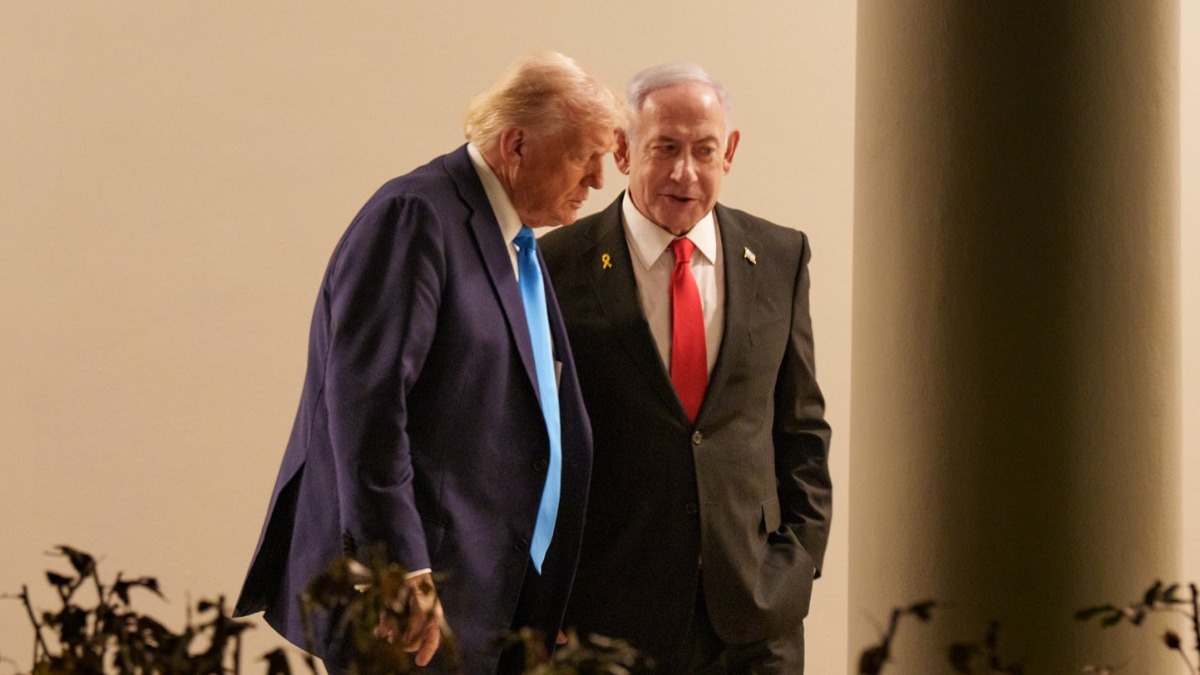

President Donald Trump announced on Monday that Israel and Hezbollah have reached an agreement to dial back their ongoing military conflict, PBS reported. This development follows a series of high-level communications between the President, Israeli Prime Minister Benjamin Netanyahu, and various mediators acting on behalf of the Lebanon-based militant group. It’s a significant moment in a region that has seen intense escalations recently, including what has been described as the deepest incursion of Israeli forces into Lebanon in more than a quarter-century.
In a social media update, the President clarified that there would be no Israeli troops going to Beirut, noting that any units currently on their way had already been turned back. He stated that Hezbollah had agreed that all shooting will stop, specifically emphasizing that Israel would not attack them and they would not attack Israel.
Moments after the President’s announcement, Israel reportedly detected new missile launches coming from Lebanon, which prompted urgent warnings for residents in northern Israel to seek shelter in protected spaces. The Israeli government, led by Prime Minister Benjamin Netanyahu and Defense Minister Israel Katz, ordered strikes on the southern suburbs of Beirut following what they characterized as repeated violations of the existing ceasefire by Hezbollah.
The situation on the ground remains incredibly fragile
The Israeli military’s Arabic spokesperson took to X to warn residents to evacuate the suburbs, explicitly stating that if Hezbollah continues its attacks on Israeli communities, Israel will launch strikes on the area known as Dahiyeh, where the group maintains a strong presence. The impact on civilians is palpable, with reports of large numbers of people fleeing the area and jamming roads in an effort to find safety. One university student, 23-year-old Mohammed Farhat, described the situation as “a source of deep concern,” noting that he had left his home in Haret Hreik primarily for the safety of his parents.
This latest friction comes despite a nominal ceasefire that has been in place since April 17. The current tensions also complicate broader efforts to extend a ceasefire related to the ongoing war in Iran, as Tehran has insisted that any agreement must encompass all fronts, including Lebanon. Iranian Foreign Minister Abbas Araghchi reinforced this stance on a Monday post on X, “any violation of the ceasefire on one front constitutes a violation on all fronts.”
Diplomacy is still moving forward, however, with Israel and Lebanon set to hold another round of direct talks in Washington starting Tuesday. These discussions, which first began in April, represent the first direct negotiations between the two countries in over three decades. Despite the boiling tensions, Lebanese officials appear committed to the process. An anonymous diplomatic official noted that Beirut is still pushing for a resolution to the conflict, even as they scramble to address the latest military escalations.
Behind the scenes, U.S. Secretary of State Marco Rubio has been actively involved, speaking with both Prime Minister Netanyahu and Lebanese President Joseph Aoun to propose a fresh path forward. The proposal aims for Hezbollah to halt all attacks while Israel refrains from escalating its military operations in Beirut.
While President Aoun has shown openness to the idea, Lebanese parliament chief Nabih Berri has raised a significant point of contention by demanding that Israel first cease all military action. Berri’s sentiment captured the skepticism held by many regarding the current peace efforts when he asked, “But who will force Israel to stop its aggression?”
The human cost of this conflict continues to climb, with reports indicating that 3,433 people have been killed in Lebanon and over 1 million people have been displaced. On the Israeli side, the military has confirmed the deaths of 26 soldiers and one defense contractor in or near southern Lebanon, alongside two civilian casualties in northern Israel. The use of advanced technology, such as fiber-optic drones, has proven particularly deadly for Israeli forces, who are finding it difficult to counter these hard-to-detect threats.
As the United Nations Security Council schedules an emergency meeting to address the situation, the path to a lasting peace remains uncertain. President Aoun acknowledged the difficulty of the situation, stating, “While negotiations are a process that needs time, they are safer than war and represent the only viable choice for the future.”
For now, the world is watching to see if these diplomatic efforts can translate into a tangible and lasting reduction in violence.








Published: Jun 2, 2026 04:00 pm