



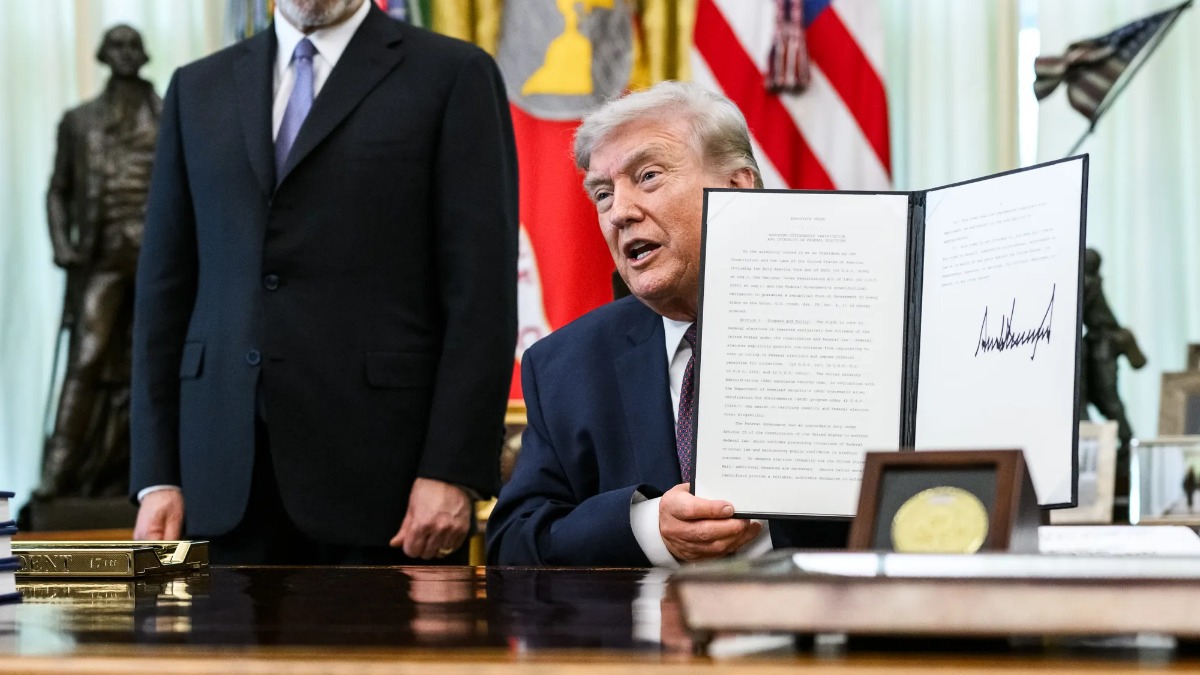

President Donald Trump said on Friday night that Republicans will not lose an election for 100 years if Congress passes the SAVE America Act. According to Mediaite, he made the claim during an Independence Day address in South Dakota, calling the bill the key to his party’s future success.
Trump spoke in front of Mount Rushmore, and his remarks focused heavily on what he called “the communist menace in our land.” He said America will never be a communist country before turning to the voting law changes he wants passed.
According to Trump, the SAVE America Act would require voters to show proof of citizenship when they register and present photo identification when they vote.
Trump’s remarks tie the bill’s passage to ending the Senate filibuster
Trump was direct about what he sees as the only path to losing future elections. “We can only lose the midterms if we allow ourselves to lose the midterms if we are foolish, stupid, and unwise,” he said. He continued, “But if we terminate the filibuster as we should do and immediately vote for the SAVE America Act, then we will not lose an election for a hundred years. We do that, we’re not gonna lose an election for a hundred years.”
He also described his political opposition in harsh terms, claiming the “communist party” is made up of illegal immigrants, criminals, and people who do not want to work. Trump has also warned of consequences for Republicans who fail to support the bill.
This push is part of a longer effort by Trump to change election laws. He has expanded executive power in many areas, but courts have repeatedly blocked his attempts to take control of how elections are run. Elections in the U.S. are decentralized, meaning states and local governments set the rules.
According to NPR, federal courts have generally protected this system, striking down administration orders and lawsuits that tried to force states to hand over voter data or change how they manage elections. Despite these legal losses, Trump has kept pressing Senate Republicans to remove the 60-vote threshold, known as the filibuster, so the bill could pass with a simple majority.
The GOP currently holds a 53-47 majority in the Senate. However, Senate Majority Leader John Thune has said there are not enough votes to end the filibuster. This is not the first time Thune has resisted one of the president’s demands, as he also rejected a push to fire the parliamentarian over an unrelated dispute.
Trump has continued pushing anyway, and he has refused to sign a bipartisan housing affordability bill, using it as leverage to try to force action on his election bill. He called the housing bill a “yawn” compared to the voting changes he wants.
The bill’s contents have drawn debate. Some parts, such as voter ID rules, are already law in many states and have public support. But experts view the wider changes differently. Many analysts and voting specialists warn that the overhaul could disenfranchise voters and create confusion for election officials already under heavy workloads. Some also worry the push is meant to undermine public trust in the election process itself.
Trump’s focus on this issue connects to his ongoing claims that the 2020 election was rigged against him. During his State of the Union speech in February, he said the only way Democrats can win elections is by cheating. This narrative comes as the party in power often faces losses in midterm elections, based on historical trends.
By arguing the election will not be fair unless his proposed laws pass, Trump is raising doubts about the vote’s legitimacy months before it happens. The strategy keeps attention on his legislative agenda, even though the bill’s path through the Senate remains blocked within his own party.








Published: Jul 4, 2026 09:45 am