


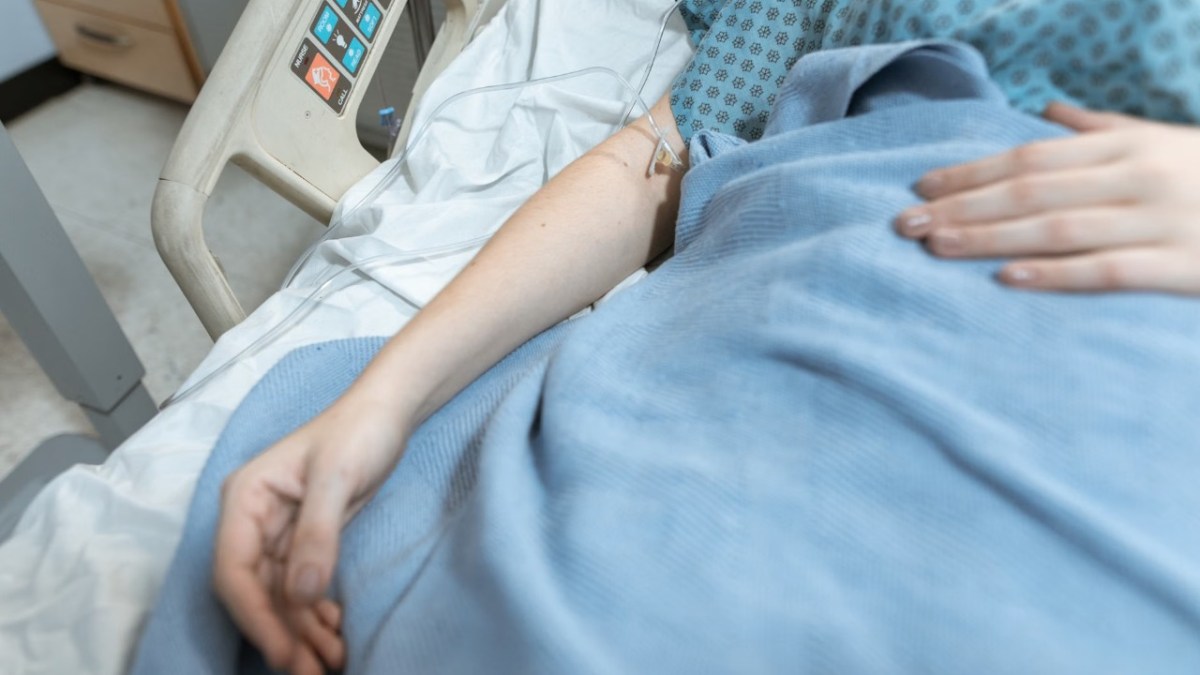

Kirstie Scothern, a 29-year-old mom from Nottingham, England, still can’t pee five years after an emergency hospital visit in April 2021, where doctors drained 2.5 liters of urine from her bladder. As reported by UNILAD, nobody has been able to tell her why despite numerous tests and medical interventions.
It all started when Kirstie, a complaints handler and mom of two, noticed her stomach looked swollen. She realized she hadn’t peed since the night before, even though she had been drinking plenty of water and even tried running the tap to help things along. Her symptoms began with a migraine, and her husband, Justin, 33, called an ambulance. Medics at Queen’s Medical Centre used an MRI to check if the migraine was the culprit, but they concluded it was not.
After the initial drainage, Kirstie was sent home with a catheter, which is a tube inserted into the urethra to drain urine into a bag. However, when the catheter was removed two weeks later, she still couldn’t go on her own.
Five years of tests still haven’t given her an answer
Kirstie believes she might have Fowler’s syndrome, though doctors are still unsure what is causing the problem. The National Institutes of Health defines it as a rare condition that causes urinary retention, the inability to pass urine, primarily in young women in their 20s and 30s.
The syndrome leaves women suddenly unable to pee because of a problem with a muscle that allows the bladder to empty. Kirstie said she thinks doctors are reluctant to diagnose Fowler’s syndrome because it isn’t well known.
Doctors at City Hospital, where she was treated as an outpatient, first wondered if the migraine medication she had been taking for years was responsible, but stopping it didn’t improve her condition. Botox to relax her bladder muscles didn’t work either, and CT scans and urodynamics tests also haven’t provided any answers. A 59-year-old woman recently required emergency surgery after getting facial fillers at a home.
Kirstie had to learn to self-catheterize, which she described as “incredibly painful.” She added that it’s “extremely difficult to even find your urethra, let alone insert a tiny tube into it.”
Before she learned to use small tubes to empty her bladder directly into the toilet, she had to carry a catheter bag. The bag leaked once at work and another time in a colleague’s car, which she described as “extremely upsetting and embarrassing.”
Today, Kirstie uses those small tubes to empty her bladder and sets a reminder every four hours. This is because she only feels the urge to go when her bladder is very full.
She carries a radar key for accessible restrooms and a “can’t wait” card, but said people sometimes still tell her to go to the back of the line. She described this as “very difficult and upsetting, particularly since it takes all my courage to ask if I can go ahead of them.”







Published: Oct 28, 2026 02:00 pm