



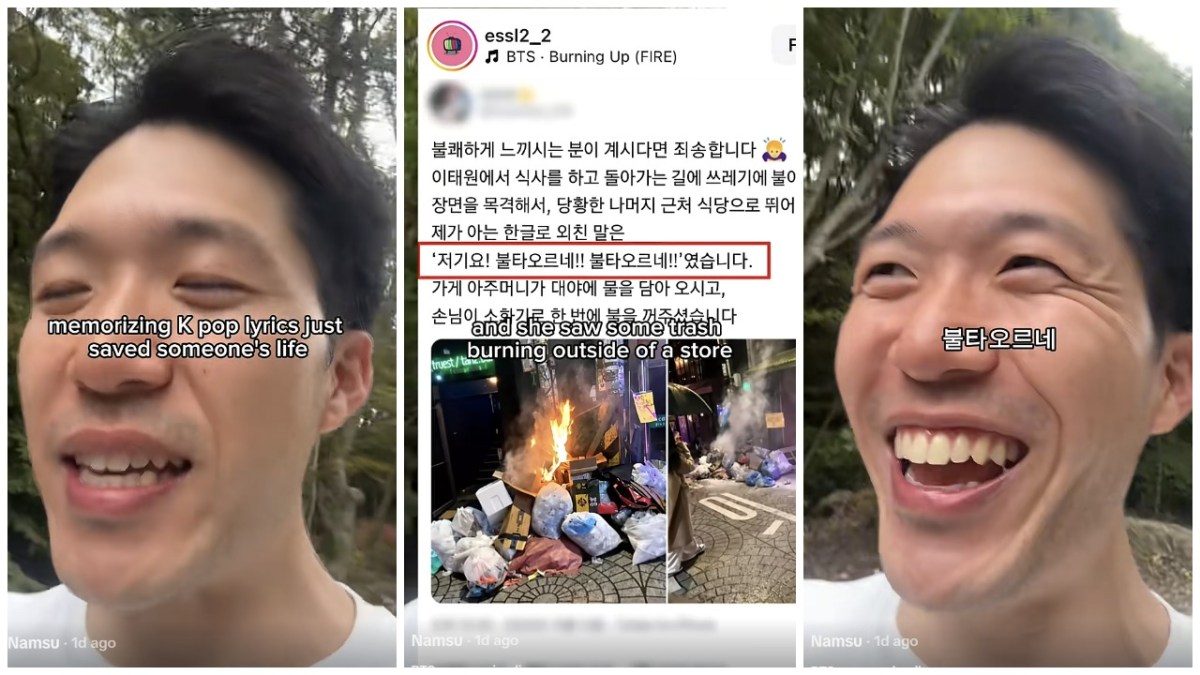

Namsu (sochourner), a Korean content creator, just shared a story about how K-pop lyrics, specifically lyrics by BTS, helped save lives. Taking to Instagram and TikTok, he told his viewers, “This Japanese BTS fan was in Korea, and she saw some trash burning outside of a store, and she didn’t know how to speak Korean, but she knew BTS song lyrics.” According to his account, she went to the store and began chanting the opening for the song “불타오르네,” aka Burning Up.
In his post, Namsu said that she chanted “불타오르네” (Bulta orune) until it ended with the word “Fire.” The store owners allegedly understood the reference and were able to come out and put out the fire. Namsu laughed as he told his viewers, “Next time someone criticizes you for memorizing useless K-pop lyrics, you can tell them this. You’re welcome.”
The video resonated with K-pop fans and racked up over 10 million views in a day. In the comments, an Instagram user went on to clarify that “불타오르네” means “It’s on fire,” while a TikToker clarified, “불 means fire, 불타오르내 means ‘burning up’ just like the full song title.” The viewers as a whole were very entertained by Namsu’s retelling of a real situation from Itaewon a few years ago, per Pinkvilla.
Many were impressed by her, with a user noting, “Now that’s some quick thinking.” There were many other jokes. One wrote, “She speaks BTS apparently,” while another remarked, “I knew this would come in handy somewhere.” Another user joked, “I also dont know korean, i speak Bangtan.” The group’s global reach has made headlines for other reasons lately too, after BTS chose to sit out this year’s Grammys over the new Asian pop category.
Music can also serve as a powerful tool for language acquisition. According to the language learning site Busuu, music is effective for two main reasons. First, it evokes emotions, which makes learning more memorable and motivating. Second, it engages the brain, offering cognitive benefits that aid in the process. Busuu notes that songs provide consistent exposure to pronunciation features like word stress and intonation, and they help expand vocabulary through repetition.
EF also highlights that music helps with memory, rhythm, and pronunciation, which are all vital for gaining fluency. EF suggests listening during downtime, choosing a range of artists, and starting with simpler songs before moving on to faster genres like rap. It adds that reading the lyrics and singing along can help reinforce memory and strengthen a learner’s grasp of the language.
The fans loved the idea that their favorite artists’ lyrics have value. One TikToker mused, “so my constant learning of these stray kids lyrics could save a life? I seeee.” Namsu seemed to agree to a certain extent, joking in his caption, “BTS army saving more lives than the ROK army.”









Published: Oct 17, 2026 10:15 am