



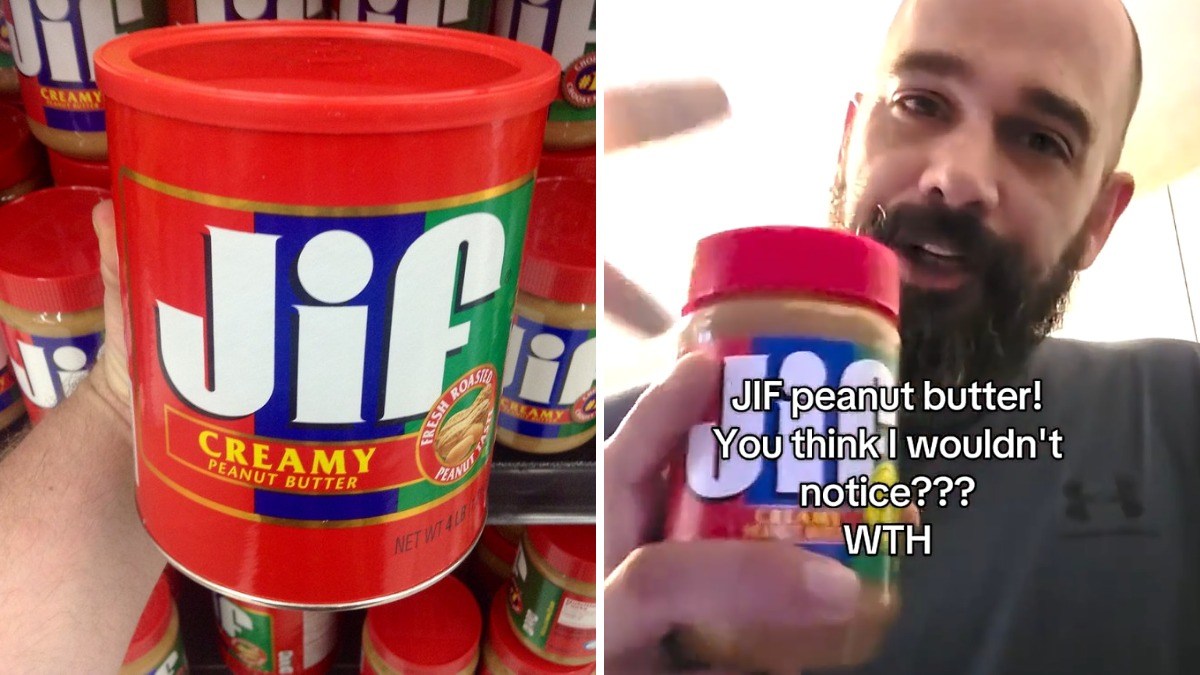

A TikTok post about peanut butter packaging has put Jif back into the familiar grocery-store debate over shrinkflation. The video, posted by TikTok user @skaught85, walks viewers through older and newer Jif containers and argues that shoppers may not always notice how much product has changed when the package shape still feels familiar.
The post centers on a comparison of Jif peanut butter jars and squeeze packaging, tapping into the same packaging complaints shoppers have raised at Walmart. In the video, skaught85 says, “Jeff peanut butter what are you doing today,” before explaining that the 2013 Jif jar “looked exactly like this but it wasn’t the same jar.” His point is that the earlier jar held 18 ounces, while the current jar he showed holds 16 ounces.
He then points to the bottom of the jar and says, “If you’re familiar with the conversation about shrinkflation you will notice this this little divot at the bottom the deeper it gets the less volume of stuff you get.” He argues that the design can make the change easier to miss because shoppers often recognize shape before checking weight. “Preys upon our lack or willingness to go and actually check how much we’re getting,” he says in the clip.
The jar comparison moved into a bigger packaging complaint
The TikToker also compared the 16-ounce jar with a 13-ounce package. He compares the smaller package to the company’s bottom line, noting it’s cheaper to ship, before landing on his blunt summary: “you get less for more money.”
He added a receipt in the edit and told viewers, “This is the 16 ounce this is the 13 ounce.” His larger argument was not only about one package size. It was about whether a design is made for the shopper or mainly for the company.
To make that point, he brought up a traditional nonic beer glass and compared it with food packaging. “This design made in the early 1900s was really made for a few things hold it better. Whenever you tip it over it reduces the chance of a nick. We have no Nick Nonick,” he says. He then argued that the customer has historically had power when measurements are visible and protected. “The customer is so picky about if you give them a little bit less they’re going to speak out,” he says.
The video’s sharper complaint came when he described the packaging as a kind of misleading design, a frustration that has also followed subtle Reese’s label changes. “What infuriates me about this, it is a lie. There are a lot of different type of lies in this world. There are lies of omission, lies of deception, white lies, manipulated all that all that stuff. This type of lie hopes that I’m stupid.”
He also tested the “stress free and mess free” claim on the squeeze package. After using it, he said, “It would be Stress free and mess free if I ended it here, if I was able to end it here, but I’m not, I still have to use this now look at that Jeff, you should have called me.” He argued that the package could also lead people to waste more product because peanut butter remains around the cap and edges.
Commenters largely backed the frustration. One person wrote, “everything S**** now.” Another said, “Gatorade also shrunk their bottles. Did they think we wouldn’t notice?” A third added, “I’m so sick of corporate greed and their lack of understanding the customer.” One commenter said they would “absolutely LOVE to wake up tomorrow morning in 1985, and bring my kids back to when life was beautiful….”
Another focused on the squeeze-pack format and wrote, “so now we need to buy reusable containers to put the squeeze pb into.” Another commenter raised a practical concern about leftover product, saying, “Not to mention: you’d have to completely cut open the new package to scrape out the product once it’s “empty” and doesn’t function. Curious if they’re even giving you the correct amount, since that’s also become a common false claim.”
Shrinkflation has become a wider grocery complaint, even though official measures suggest it is only a small part of overall inflation. A Harris Poll survey found that 49 percent of U.S. adults thought some grocery staples had been affected by shrinkflation over the past year.






Published: Aug 29, 2026 08:15 am