



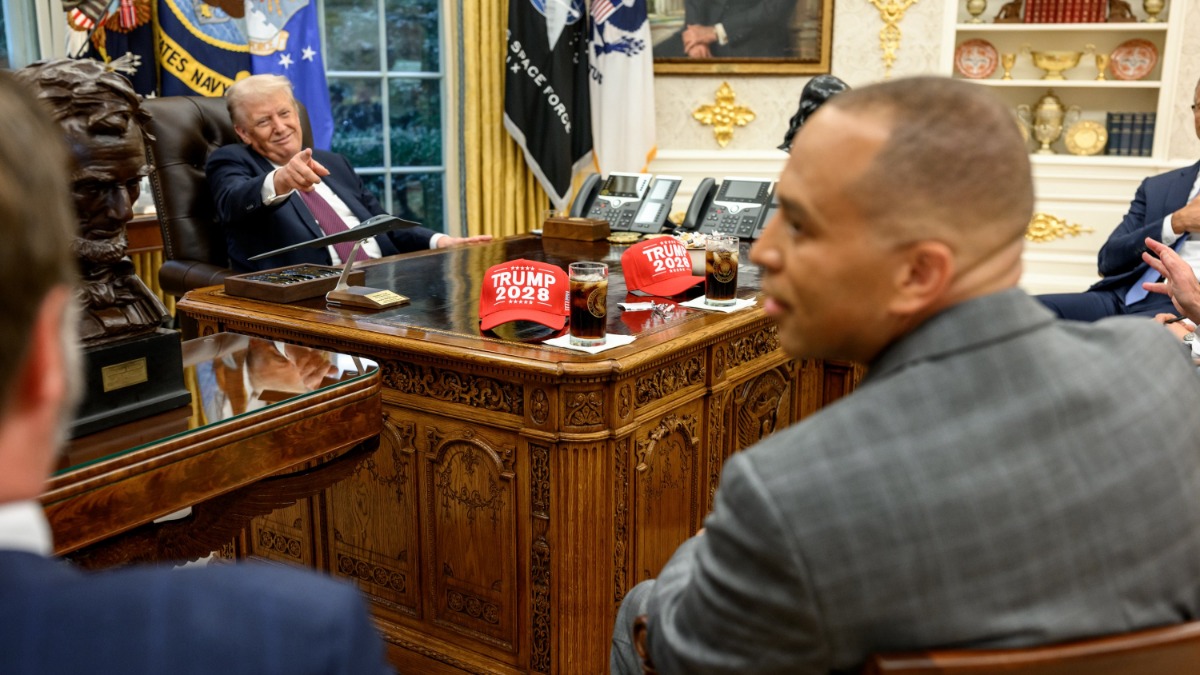

President Donald Trump took to Truth Social to call for the impeachment of House Minority Leader Hakeem Jeffries (D-N.Y.) after Jeffries made a comment about the Supreme Court following a recent ruling on the Voting Rights Act. The post sparked a back-and-forth between the two politicians, with Jeffries firing back on X.
The controversy started when Jeffries, at a Congressional Black Caucus press conference, called the Supreme Court’s conservative majority “illegitimate” after the court ruled that Louisiana’s addition of a second majority-Black congressional district was an unconstitutional racial gerrymander. The decision was 6-3 and weakened a key part of the Voting Rights Act, a landmark 1965 civil rights law that bans discrimination in voting.
Trump responded on Truth Social, writing: “Hakeem Jeffries, a Low IQ individual, said our Supreme Court is ‘illegitimate.’ After saying such a thing, isn’t he subject to Impeachment? I got impeached for A PERFECT PHONE CALL. Where are you Republicans? Why not get it started? They’ll be doing this to me!” The post quickly gained attention and set off a wider debate about the limits of political speech and accountability, reports The Hill.
Trump’s impeachment call has no legal ground, but the voting rights debate is very real
However, Trump’s call for impeachment appears to be based on a misunderstanding of how impeachment works. According to an annotated version of the Constitution on Congress’s official website, members of Congress are not subject to impeachment, unlike the president. So while Jeffries’s comment was strong and drew significant attention, it does not provide any legal grounds for impeachment proceedings.
Jeffries responded on X with two words: “Jeffries Derangement Syndrome.” This was a clear reference to “Trump Derangement Syndrome,” a term Trump has frequently used to describe people who strongly disagree with him. Trump has also been making headlines on other fronts, as he is currently reviewing Iran’s 14-point peace proposal while leaving the door open for further military action.
At the Congressional Black Caucus press conference, Jeffries had said: “Today’s decision by this illegitimate Supreme Court majority strikes a blow against the Voting Rights Act and is designed to undermine the ability of communities of color all over this country to elect their candidate of choice.” His words reflected the frustration felt by many Democrats following the ruling, as they believe the decision rolls back decades of progress on voting rights.
The Supreme Court’s ruling has significant implications for communities of color across the United States. The 6-3 decision weakens a central provision of the Voting Rights Act that prohibits racial gerrymandering. Beyond Louisiana, the ruling could also trigger the removal of other majority-Black districts represented by Democrats in other parts of the country, which would have a major impact on political representation for Black communities in future elections.
While Republicans celebrated the ruling, Democrats vowed to push back hard. They called for the passage of an updated voting rights bill and pushed for Supreme Court reform, including term limits for justices. Meanwhile, Trump’s political circle continues to navigate difficult internal alliances, and why the White House is keeping RFK Jr. around has become a question that insiders appear reluctant to answer publicly.
Without control of either chamber of Congress, however, Democrats are limited in what they can actually do to reverse or challenge the ruling. Their calls for reform may carry political weight, but translating that into real legislative action remains a significant challenge given the current balance of power in Washington.
The broader debate over voting rights is unlikely to settle anytime soon. According to CNBC, the Voting Rights Act has long been considered one of the most important pieces of civil rights legislation in American history, and any weakening of its provisions is seen by many advocates as a serious threat to equal representation.
As both parties continue to clash over the future of voting rights, the stakes remain very high for millions of Americans, particularly those in communities of color who rely on these protections to have a fair voice in elections.




Published: May 4, 2026 08:30 am