



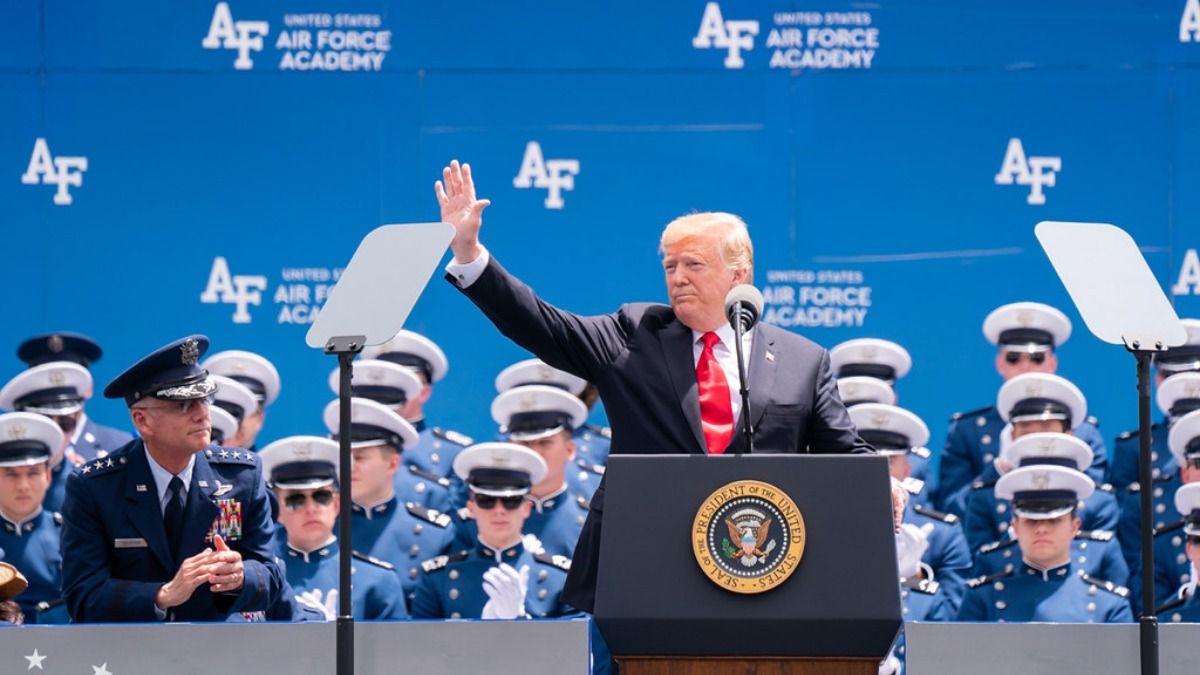

One year ago this week, President Trump threatened to impose “harsh measures” on Colorado unless the state released convicted election denier Tina Peters from prison early. New reporting shows how far that threat may have gone.
According to a report from The New York Times, the White House organized an urgent “brainstorm call” with representatives from five federal agencies while Trump was publicly criticizing Colorado for keeping Peters behind bars. The goal of the call, per the report, was to explore ways to cut back federal support to the state.
The day after that call, the Department of Transportation and the Department of Energy announced they were canceling hundreds of millions of dollars in federal grants for projects in Colorado. State officials say this timeline points to retaliation connected to Colorado’s mail-in ballot system and its prosecution of Peters, a former county clerk convicted for her role in a plot to tamper with voting machines after the 2020 election.
A newly disclosed email surfaced during a federal court hearing
The email at the center of this story was sent by White House special assistant Emily Underwood just days after Trump posted a series of messages about Peters. It was revealed during a federal court hearing last Tuesday. State officials say the email is the clearest evidence yet that the Trump administration used government resources to retaliate against Colorado.
U.S. District Court Judge R. Brooke Jackson reacted to the email during the hearing. According to a transcript of the proceedings, Jackson said, “I’ve never seen anything like it. I’ve never even imagined something like it. The very idea that the president of the United States or the executive office of the president would target a state because they don’t feel that the state and its administrators are in line with the current administration’s priorities is phenomenal.”
A White House spokesperson denied that the “brainstorm call” was connected to Peters. The spokesperson referred questions about the Colorado grant cancellations to the Office of Management and Budget, according to the Times. Around the same period, the administration also moved to freeze child care funding for the state, another funding decision tied to the pressure campaign.
This is not the first episode connected to the dispute. Trump’s first veto of his second term blocked legislation meant to bring clean water to southeastern Colorado, and reporting at the time examined why Trump vetoed the water bill. He later told Politico that he vetoed the bill in part because he considered Colorado Governor Jared Polis a “bad governor.”
The Times reported last year that the administration’s actions against Colorado followed a pattern.
The outlet wrote that Trump was “miffed at Colorado’s votes against him in three successive elections and furious at its refusal to free Tina Peters,” and that his administration had “cut off transportation money, relocated the military’s Space Command, vowed to dismantle a leading climate and weather research center and rejected disaster relief for rural counties hammered by floods and wildfires.”
Several months after that report, the administration also moved to dismantle a well-known science lab in Colorado, a step that also appeared connected to the broader pressure campaign against the state, according to the Times.
The pressure campaign ultimately achieved its stated goal. In mid-May, Polis commuted Peters’ sentence, allowing her early release from prison.






Published: Aug 18, 2026 05:45 am