



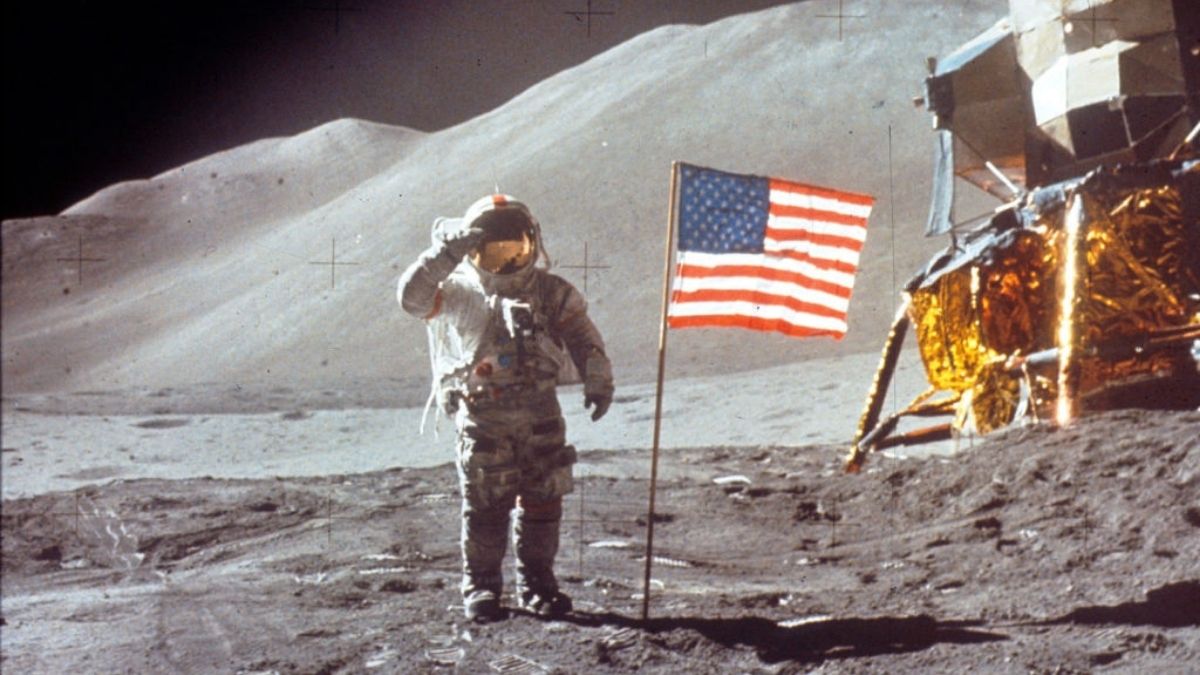

Fox News host Jesse Watters claimed that the United States already “got the Moon” and owns it during a talk about President Trump’s plan to take over Greenland. This is a bold statement because international law has rules about who can own things in space.
According to Mediaite, Watters said that getting Greenland will happen no matter what. He backed up his claim by listing past American land deals, saying the US always gets what it wants through money or military force. He mentioned the Louisiana Purchase, Alaska, the Philippines, and the Marshall Islands after World War II. Then he said, “We got the Moon. I think we own it. I know we own it.”
Watters’ main point was that the US needs to protect its supply lines and defend itself from Chinese missiles. He compared Trump’s offer to a real estate deal, calling the president a “big fat developer” writing a check for coastal property that an elderly relative cannot use. However, his claim about owning the Moon is legally questionable.
International space law prevents countries from claiming the Moon
The 1967 Outer Space Treaty is binding international law signed by over a hundred countries, including the US, China, and Russia. It clearly says no country can claim the Moon or any other space object as their own.
A later 1979 Moon Treaty banned ownership by any person or group, but only eleven countries signed it, and no major space nations joined. Still, the basic rule is that no single country can just claim the Moon. This legal grey area has created interesting opportunities for private space companies pushing the limits.
Bigelow Aerospace designs inflatable habitats for orbit and plans to build a lunar base. They have spent $250 million on the project and filed a request with the Federal Aviation Administration’s Office of Commercial Space Transportation. Bigelow is not asking to own the Moon but wants a “zone of non-interference” around their future lunar work.
The Trump administration has been focused on expanding federal control in various areas, and Trump’s growing financial gains since inauguration show how business interests continue during his presidency. Mike Gold, an attorney for Bigelow, said they are asking the FAA for “reassurance that if we do so we will operate within a zone of non-interference.”
He explained this matches the Outer Space Treaty’s requirement that nations oversee commerce. Gold sees property rights as necessary to attract investment. He compares current space activity to settling the American West, where government exploration helped farmers and business owners do important work.
Not everyone likes the “Wild West” comparison. Attorney Michael Listner, founder of Space Law and Policy Solutions, wrote that outer space is “anything but the Wild West.” He warned that trying to grant private property rights alone could cause a “geopolitical backlash.” Meanwhile, domestic policy debates continue as mayors navigate federal immigration enforcement policies in major cities across the country.
The debate centers on how we see the Moon. Is it “nobody’s property,” where whoever arrives first owns the resources? Or is it “common to all mankind,” like the ocean? Michael Simpson, executive director of the Secure World Foundation, suggests a third option: the Boston Common approach.
This allows shared, sustainable use without actual ownership. Simpson noted the Moon has valuable resources like helium-3 fuel and a radio-quiet environment perfect for astronomy. Technology is moving much faster than the law, and Congress is trying to keep up. Watters may claim the US owns the Moon, but the legal reality is just beginning to take shape.








Published: Jan 21, 2026 12:15 pm