



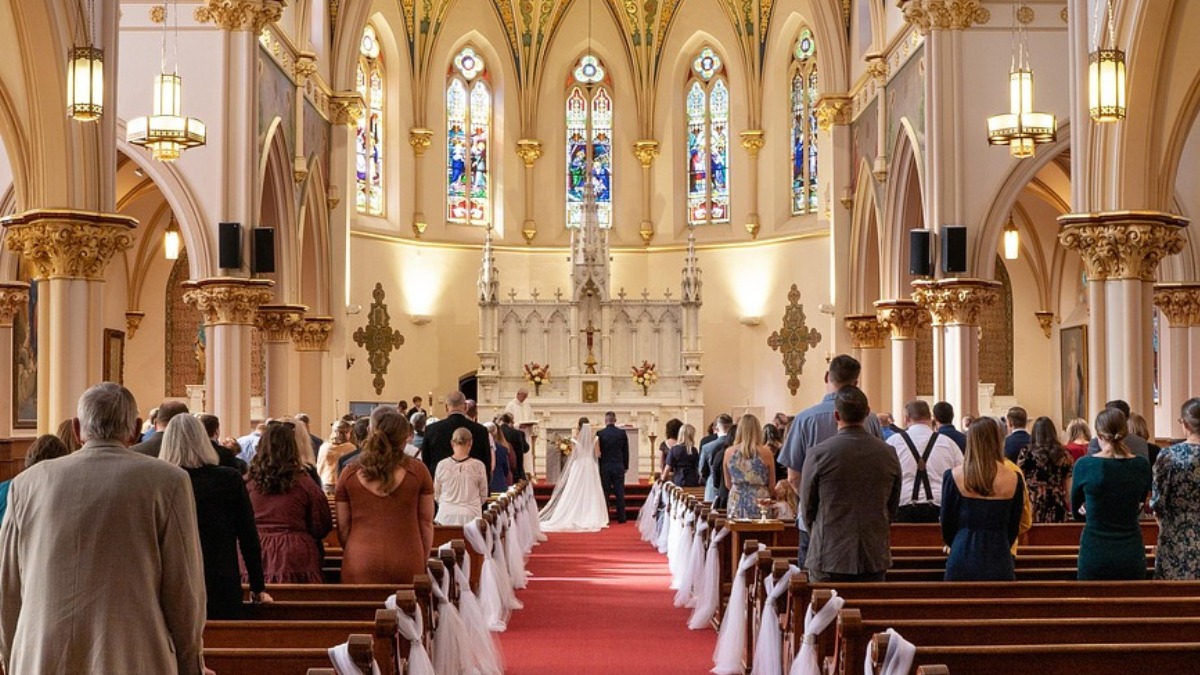

A Catholic diocese in Mexico is warning the public that a man presenting himself as a “spiritual father” has no actual standing in the church, despite reportedly charging couples and families for weddings, baptisms, and other rites he had no authority to perform. According to the New York Post, the Diocese of La Paz issued a statement identifying the man as Gregorio Díaz Mora and stating plainly that he holds no position within the Catholic Church in Baja California Sur.
“The Diocese of La Paz informs all the faithful and the general community that the person identified as Gregorio Díaz Mora is not a priest of the Catholic Church and does not belong to or exercise any ministry with authorization or recognition from this Diocese,” the statement read.
Officials allege that images from the actual Sanctuary of Our Lady of Guadalupe in La Paz have shown up across his social media presence, giving the impression of an official connection that doesn’t exist. Marketing himself under the title “spiritual father,” he reportedly built out a page resembling a genuine parish account and charged for video consultations along with ceremonies like weddings and baptisms.
His social media reach spans three platforms
The diocese warned that this setup “can generate confusion among the faithful regarding their affiliation with the Catholic Church.” He’s built a presence across at least three major platforms, and on TikTok alone, his account has picked up close to 140,000 followers, alongside additional pages on Facebook and YouTube. The consequences go beyond a simple case of false advertising. Under Catholic canon law, a sacrament performed by someone with no genuine priestly authority isn’t considered valid.
Practically speaking, that puts anyone married by Díaz Mora, or any family whose child he baptized, in a position where the church won’t formally recognize what took place, leaving a proper ceremony with an ordained priest as the only path forward. For couples specifically, that path has a name: convalidation.
According to Catholic.com, the Code of Canon Law lays out a process where the couple exchanges a new act of consent, typically before a priest or deacon and two witnesses, since a fresh, valid vow exchange is what actually establishes the marriage in the church’s eyes going forward. In rarer cases, a bishop can instead grant what’s called a “radical sanation,” which validates the marriage retroactively without requiring a new ceremony at all.
Diocesan officials say nothing like this has been formally flagged in Baja California Sur before, and they’re urging Catholics to check a would-be minister’s credentials with a parish office ahead of committing money or scheduling anything. A similar warning about religious fraud circulated recently in the United States, though in a different form, when a scammer posing as a legitimate contact kept a woman on the phone until she had lost $72,000.
Díaz Mora has not publicly responded to the diocese’s statement, and it does not appear that any criminal charges have been filed in connection with the allegations.








Published: Jul 31, 2026 02:45 pm