



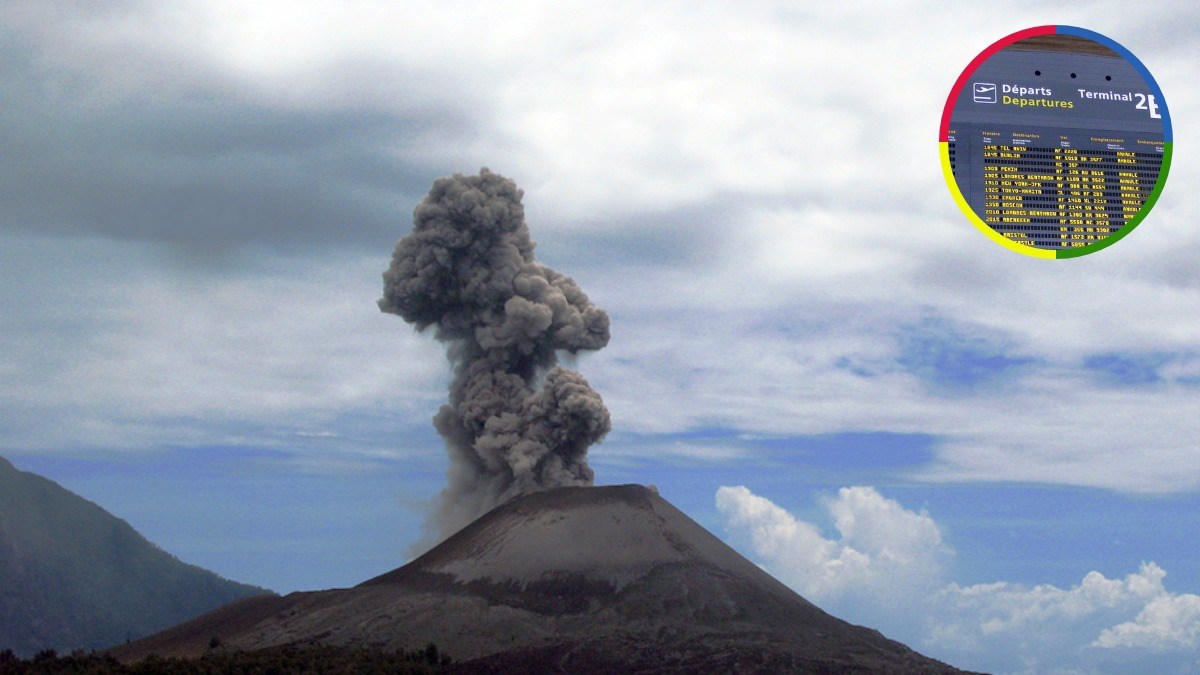

Anak Krakatau has been rebuilding itself in the Sunda Strait since the late 1920s, decades after its parent volcano’s catastrophic 1883 eruption killed more than 36,000 people. A continuous eruption that began late on September 4 sent ash as high as 50,000 feet into the sky, grounding flights across western Indonesia. The disruption has since grown well beyond initial estimates, delaying, diverting, or canceling nearly 2,961 flights and affecting about 341,000 travelers, according to CNN.
The continuous eruption lasted about 25 hours, according to Indonesia’s volcanology agency PVMBG, before easing shortly after midnight on September 6. Wind carried the ash eastward toward Jakarta, and aviation authorities detected it in the airspace above Soekarno-Hatta International Airport early that morning. Eight airports across the region eventually suspended operations as the cloud persisted longer than officials first expected.
Singapore Airlines, Scoot, AirAsia, the Lion Air Group, Malaysia Airlines, and Garuda Indonesia all canceled services as the closures stretched into the workweek. Volcanic ash is made of fine rock and glass particles that can melt inside a jet engine’s turbine and resolidify, disrupting airflow. A similar hazard famously disabled all four engines on a British Airways Boeing 747 in 1982 after it flew through ash from Java’s Galunggung volcano, an incident the aviation industry still treats as a worst-case scenario.
This eruption turned out to be way bigger than anyone expected
Soekarno-Hatta and the other closed airports mostly reopened by September 8, though the backlog left thousands of passengers still working through rebookings. Authorities in Jakarta, Banten, and Lampung shifted schools to online learning and told residents to wear masks and eye protection against the falling ash. A similar bout of chaos hit Sicily this August, when Mount Etna’s flight closures grounded arrivals at Catania for the better part of a week.
Indonesia’s disaster agency also ran cloud seeding flights to induce rainfall and wash ash out of the atmosphere, alongside water misting when clouds were not available. Anak Krakatau has held Indonesia’s Level III alert since July 2, which is the second-highest rung on the country’s four-tier volcanic warning system. A 3-kilometer exclusion zone remains in place for tourists and fishing vessels near the crater.
Officials have said there is no immediate tsunami threat, though the 2018 flank collapse that killed at least 430 people in Sumatra and Java keeps the region on alert. It’s important to note that the initial 25-hour eruption ended on Sunday. However, Anak Krakatau has continued erupting intermittently since, with explosions ejecting lava, ash, and incandescent rock from the crater.
Indonesian rescuers are now searching the Sunda Strait for a speedboat carrying five photojournalists, two crew members, and a route guide who lost contact Monday evening after reaching the waters around the volcano. The search area has since widened across the strait between Java and Sumatra as crews work to reestablish contact.
Aviation officials say flight schedules could keep shifting as Anak Krakatau continues its intermittent bursts, and geologists warn the volcano’s ongoing magma supply makes another significant eruption impossible to rule out.









Published: Sep 9, 2026 03:45 pm