



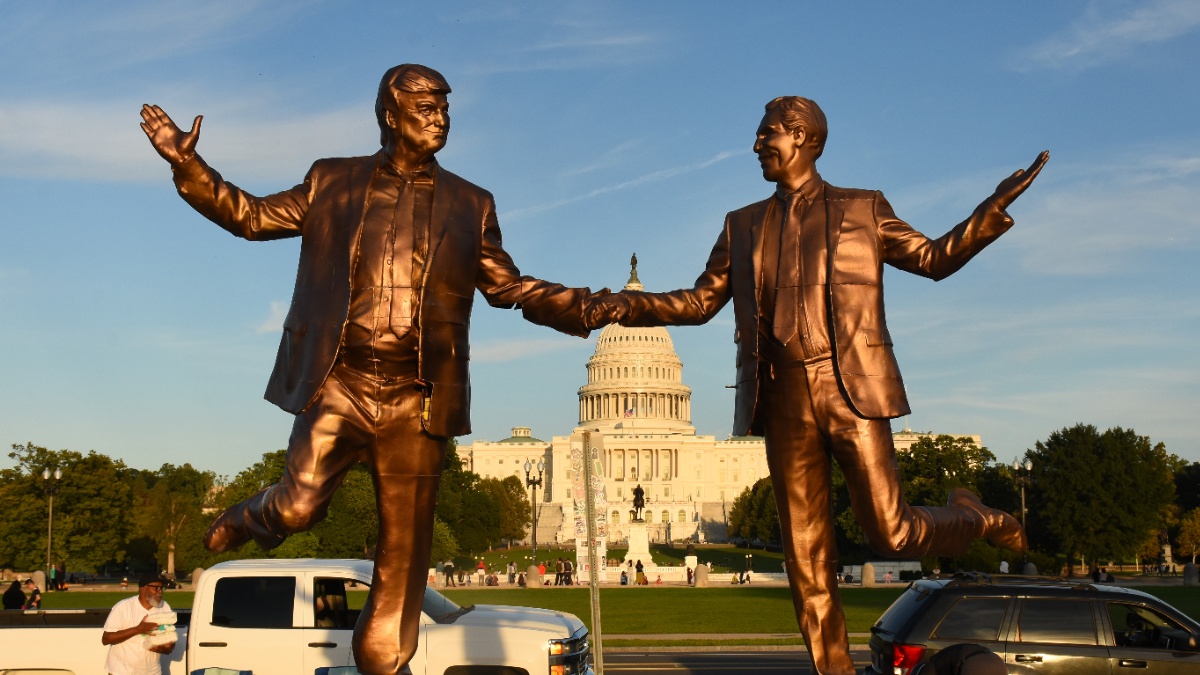

The Justice Department has reportedly withheld a trove of Epstein files linked to allegations that President Trump sexually abused a minor, and some documents mentioning the president have mysteriously vanished from the public database, as reported by NPR. This is a pretty wild development, especially since there’s a law that’s supposed to mandate their release.
Abigail Jackson, a spokeswoman for White House, stated that President Trump has been “totally exonerated on anything relating to Epstein,” and highlighted that he has “done more for Epstein’s victims than anyone before him,” pointing to the release of thousands of pages of documents, cooperation with the House Oversight Committee, signing the Epstein Files Transparency Act, and even calling for more investigations into Epstein’s “Democrat friends.”
She also questioned why Democrats like Hakeem Jeffries and Stacey Plaskett were “soliciting money and meetings from Epstein after he was a convicted sex offender.” An investigation found that more than 50 pages of FBI interviews and notes from conversations with a woman who accused President Trump of sexual abuse decades ago, when she was a minor, are among the missing files.
Lawmakers from both parties have voiced criticism over how the Trump administration has handled the release of these files
A review of multiple sets of unique serial numbers, stamped onto documents in the Epstein files database, FBI case records, emails, and discovery document logs, revealed dozens of pages that appear to be catalogued by the Justice Department but haven’t been shared publicly. The Justice Department, for its part, declined to answer questions about these specific files or why they aren’t published.
Other documents scrubbed from public view involve a separate woman who was a key witness in the criminal trial of Ghislaine Maxwell, Epstein’s co-conspirator. Maxwell is currently serving a 20-year prison sentence for sex trafficking and is reportedly seeking clemency from President Trump. Some of these documents were briefly taken down and then put back online last week, while others remain hidden, according to a comparison of initial datasets with current document metadata on the DOJ website.
The woman who directly accused President Trump in her abuse allegation claimed that around 1983, when she was approximately 13 years old, Epstein introduced her to President Trump. She alleged that President Trump “subsequently forced her head down to his exposed penis which she subsequently bit. In response, Trump punched her in the head and kicked her out.”
This specific allegation against President Trump only appears in copies of an FBI list of claims and a Justice Department slideshow, not in the broader public database. It gets more complicated because the FBI actually interviewed this accuser four times. This is according to an FBI “Serial Report” and a list of Non-Testifying Witness Material in the Maxwell case.
However, only the first interview, conducted on July 24, 2019, is available in the public database, and it doesn’t mention President Trump. A review of the files indicates there are 53 pages of interview documents and notes missing from the public Epstein database related to this accuser.
In her first interview, she discussed Epstein’s abuse and showed a cropped photo of him, explaining that she “was concerned about implicating additional individuals, and specifically any that were well known, due to fear of retaliation.” FBI agents noted it was a “widely distributed photograph” of Epstein with President Trump.
The second woman, whose mention of President Trump appeared in a Justice Department presentation, detailed in an FBI interview how Epstein took her to President Trump’s Mar-a-Lago club to meet him when she was around 13 years old. The interview report states, “EPSTEIN told TRUMP, ‘This is a good one, huh.'” She added in a 2020 lawsuit that both men chuckled, and she “felt uncomfortable, but, at the time, was too young to understand why.”
This particular interview was removed from the Justice Department’s public files after its initial publication on January 30, only to be republished on February 19. The Justice Department stated that the only reason any file has been temporarily removed is if it was flagged by a victim or their counsel for additional review.






Published: Feb 24, 2026 02:00 pm