



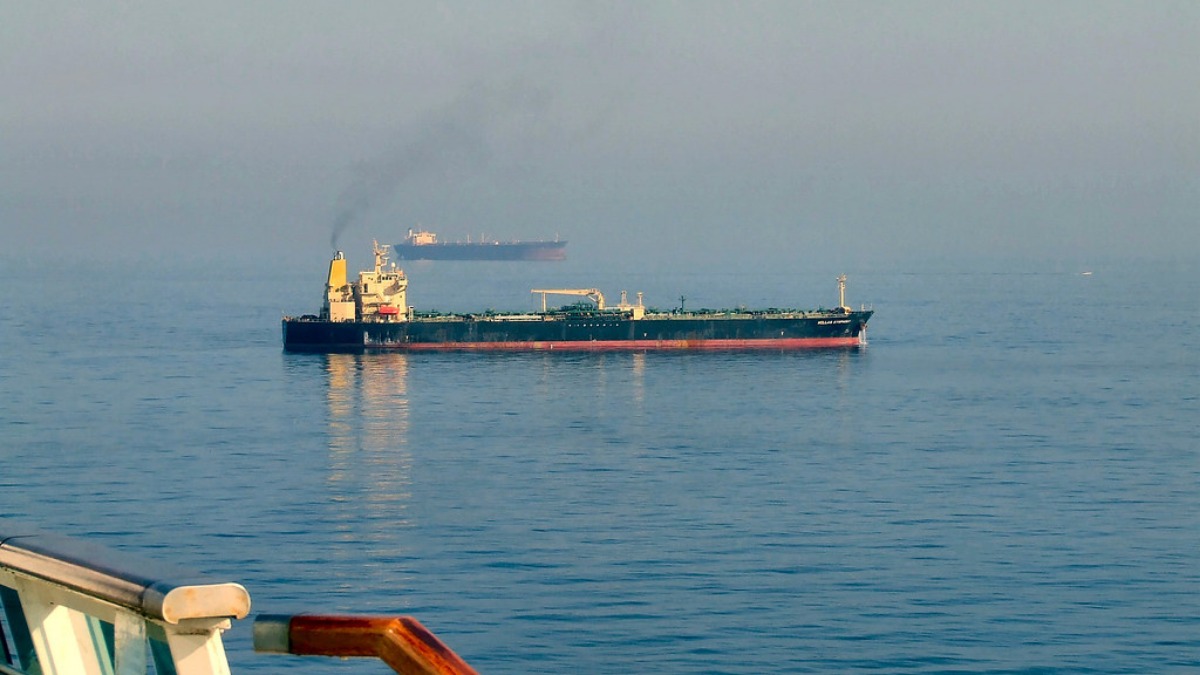

The Strait of Hormuz is officially back open, but the reality is far more complicated than President Donald Trump had suggested. While Trump spent much of the day posting on Truth Social about a complete resolution to the maritime crisis, Iranian officials are telling a very different story. Tehran has said it plans to keep limiting the number of ships allowed through the waterway and will charge tolls for those that are permitted to pass.
According to The Wall Street Journal, Iranian lawmaker and negotiator Mahmoud Nabavian made the situation clear, stating, “Only some commercial ships will be allowed to pass through the Strait of Hormuz on the condition of paying tolls.”
Ali Khezrian, a member of Iran’s National Security Commission in Parliament, added that tankers will need to coordinate directly with the Islamic Revolutionary Guard Corps before being granted passage. Iran also plans to maintain a blockade against ships from countries it considers hostile.
Iran’s contradictions expose how far apart both sides really are
On Friday, Trump posted on Truth Social that Iran had “JUST ANNOUNCED THAT THE STRAIT OF IRAN IS FULLY OPEN AND READY FOR FULL PASSAGE,” before correcting himself with the proper name of the waterway. He told USA Today in a phone call that the situation was a “great victory” and insisted that Tehran had “agreed to never close the Strait of Hormuz again” and that it would no longer be used as a weapon.
Trump also claims that Iran had agreed to stop enriching uranium. In a series of posts, he claimed the U.S. would soon take possession of what he called “Nuclear ‘Dust,'” referring to Iran’s existing stockpile of enriched uranium.
He wrote, “The U.S.A. will get all Nuclear ‘Dust,’ created by our great B2 Bombers – No money will exchange hands in any way, shape, or form.” President Trump says that Iran has “agreed to everything,” including transferring this material to the United States.
Iranian officials flatly denied these claims. Esmaeil Baghaei, the spokesperson for the Iranian Foreign Ministry, told state television that removing the uranium was “not an option.” He stated, “Iran’s enriched uranium is not going to be transferred anywhere; transferring uranium to the United States has not been an option for us.”
This is not the first time Iranian leaders have publicly pushed back against Trump’s statements, as Iran’s parliament speaker directly contradicted Trump on live TV over the terms of any potential deal. This leaves major uncertainty heading into the next round of talks, scheduled to take place in Islamabad this coming weekend.
The rest of the world is taking a much more careful approach. British Prime Minister Sir Keir Starmer and French President Emmanuel Macron announced that their countries would lead a “multinational mission” to protect global shipping in the area.
Sir Keir Starmer said the mission would be “strictly peaceful and defensive, as a mission to reassure commercial shipping and support mine clearance.” He noted that over a dozen countries have already offered resources, with a military planning conference set for London next week.
Trump did not welcome the international effort. He lashed out at NATO on social media, writing, “I TOLD THEM TO STAY AWAY, UNLESS THEY JUST WANT TO LOAD UP THEIR SHIPS WITH OIL. They were useless when needed, a Paper Tiger.”
This comes after weeks of Trump criticizing NATO for not joining the U.S. and Israel in attacking Iran since the conflict began on February 28. Trump has also clashed with other allies over military decisions in the region, including how Netanyahu reacted to Trump banning Israel from bombing Lebanon.
For now, the global oil supply route remains in an uncertain state, despite the declarations of victory coming from Washington. The conflicting statements from both sides will likely be tested during the upcoming negotiations in Islamabad this weekend.







Published: Apr 18, 2026 03:30 am