



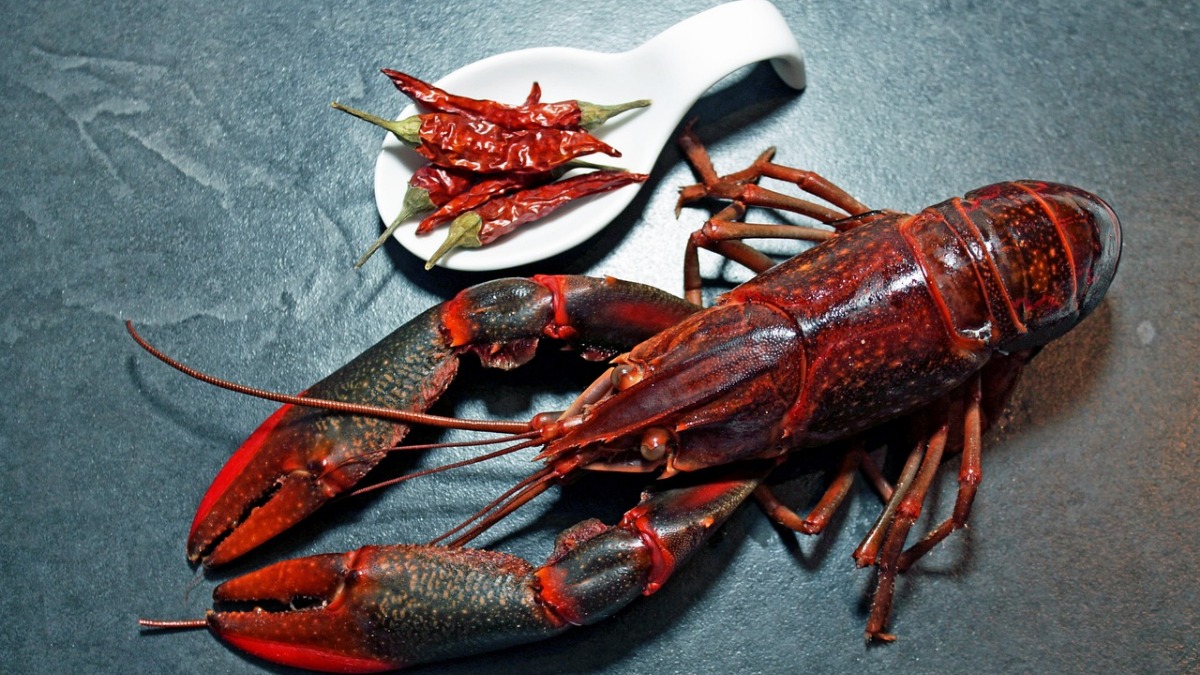

If you’ve ever found yourself at a crawfish boil, you’ve likely heard the advice to skip any crustacean that has a straight tail. This rule has been a staple of Southern culinary tradition for generations, but it’s currently sparking a massive debate online after a TikToker brought the topic to the forefront.
Jae, known on the platform as @jaesanatomy, shared a video where she explicitly warned viewers against eating crawfish with straight tails. Her video, which has now reached over 2.5 million viewers and was covered by BroBible, featured the onscreen text, “If you don’t know why this crawfish can’t be eaten, then you most likely weren’t raised in Louisiana.” She followed that up in her caption with the blunt instruction, “straight tail = throw it away.”
The logic behind this long-standing rule is that a straight tail indicates the crawfish was already dead before it hit the boiling pot. The common belief is that when a live crawfish is dropped into boiling water, its abdominal muscles naturally contract, causing the tail to curl tightly. If a crawfish is already dead, the theory goes, those muscles won’t contract, leaving the tail straight. Many people assume this means the crawfish was decaying or spoiled, making it a potential health risk.
It’s a sentiment that has been passed down through families for years
In a comment, Jae explained that she has been attending boils since she was born. She noted, “I can remember being as young as three and my dad telling me not to eat the straight ones. It’s just something we grew up knowing not to do.”
Despite the popularity of this advice, researchers at the LSU AgCenter have actually debunked the idea that a straight tail is a reliable indicator of whether a crawfish was alive or dead before cooking. Their study involved boiling crawfish under various controlled conditions, including live specimens, dead ones that had been stored in a cooler for five days, and live crawfish that were physically restrained to prevent them from curling.
The results showed no significant difference in the curl angle between the live crawfish and the ones that had been dead for five days. Furthermore, the researchers found that when live crawfish were crowded together in a pot, the lack of space often prevented them from curling naturally. This suggests that a straight tail is often just a result of overcrowding in the pot rather than a sign of a spoiled product.
Even with this scientific evidence, many people are sticking to their guns. The comment sections on social media are filled with people who refuse to ignore the old rule. One commenter stated, “It means they were boiled dead. Not alive. It sounds cruel but they can’t be eaten if they were cooked dead.”
Another person added, “I’m not from Louisiana, I know what a straight tail means.” When some users pointed out that the theory had been proven incorrect by research, many, including Jae, simply weren’t convinced. Jae responded to one such comment by saying, “It’ll always be correct for me lol. Regardless, the tails be mushy.”
For many, the physical texture of the meat serves as the real indicator. Jae agrees with this perspective, noting that in her personal experience, the straight-tailed crawfish are usually mushy and difficult to peel, which makes them taste “disgusting” to her. She acknowledged that while she understands the difference between a tail that was dead before cooking and one that simply got stuck during the process, she still avoids them out of habit and preference.
Ultimately, this debate highlights the tension between modern research and deep-rooted cultural traditions. Louisiana produces more than 100 million pounds of live crawfish annually, and the vast majority of that is consumed within the state, making the crawfish boil a vital part of the local identity. Jae believes that these traditions are about more than just science.
She said, “Louisiana is full of culture, and crawfish is a big part of that. We all cook and eat it in different ways, but I think it really comes down to traditions and sayings being passed down from generation to generation.” She added, “There’s a rule in the South: if it ain’t broke, don’t fix it. So even with all the fancy research from Louisiana State University, I think most of us are still sticking to our rules when it comes to crawfish.”
Whether or not the science supports the fear of the straight tail, it’s clear that for many, the tradition is here to stay.









Published: Apr 17, 2026 06:30 pm