



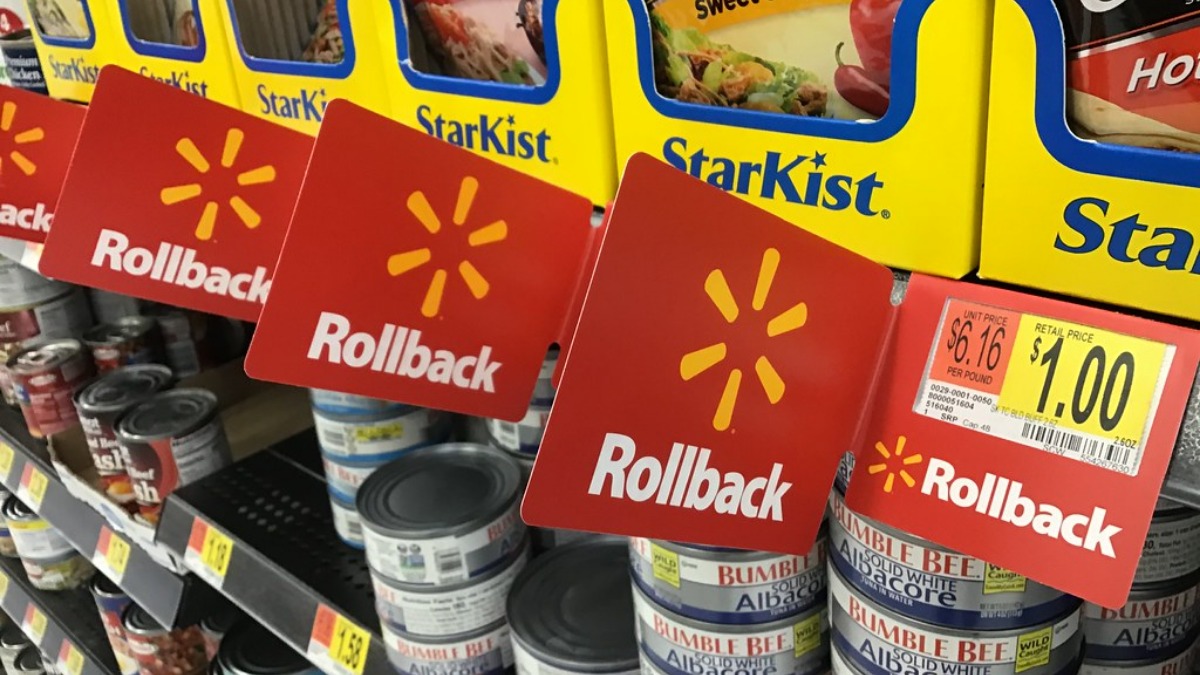

A Texas shopper recently peeled back a yellow Rollback sticker on an extension cord at a Walmart store, only to discover that the original price tag underneath was actually lower than the discounted price. This discovery was captured on video and posted under the handle @austin_adams214 on TikTok, quickly gaining significant attention online as viewers began to share their own experiences with similar pricing discrepancies.
When you see a bright yellow sticker, it is natural to assume that you are getting a deal. The marketing is designed to make you feel like you are saving money, but this recent incident suggests that you might want to look a little closer before throwing an item into your cart. One viewer who commented on the video noted that this is a widespread practice.
They wrote, “All places are doing this. When you see sales, best to go into a shop and take a photograph and date stamp it. Then go back in when it’s a sale or even Black Friday — you will see the prices are slightly higher.” Another commenter even claimed to have worked at the retail giant, stating, “When the item is marked up and you’re trying to convince buyers it’s on clearance, you’re supposed to remove the old tag and place the new one there.”
While this specific extension cord purchase was relatively minor, it is part of a much larger and more complicated history regarding how the company handles its pricing
This is not the first time the retailer has found itself in hot water over its Rollback strategy. Back in 2017, a California resident named Brenna Ceja filed a class action lawsuit that took direct aim at these practices. The lawsuit alleged that the original prices used on Rollback tags were often fabricated, which made the perceived discounts seem much larger than they actually were. Ceja even provided photographic evidence showing instances where the Rollback price was identical to the original price tag, meaning there was no actual discount at all.
In her complaint, Ceja argued that the company uses this alleged fake sale pricing to inflate its profits. She pointed out that for many items, there is no clear statement regarding the product’s original price, leaving shoppers to rely on the yellow sticker to understand the item’s value.
By creating a false impression of a bargain, the retailer is essentially inducing customers to make purchases they might not have made otherwise. The lawsuit cited both California state law and Federal Trade Commission guidance, which state that “the purchaser is not receiving the unusual value he expects” when sale pricing is based on a fictitious original price.
Beyond the 2017 lawsuit, there have been other significant legal challenges. For instance, the case known as Kukorinis v. Walmart resulted in a $45 million settlement, with payments still being processed in early 2026. That particular case focused on the company’s point-of-sale software, which allegedly inflated the registered weight of meat, poultry, and seafood products marked with Rollback tags.
While the company denied any intentional wrongdoing and settled simply to avoid further litigation costs, these events have certainly left a mark on its reputation. More recently, in late 2025, the company finalized a $1.64 million settlement with New Jersey. This was the largest fine ever issued by the state’s Office of Weights and Measures, coming after inspections at 64 locations revealed more than 2,000 instances of inconsistent pricing.
It is important to remember that these Rollback deals are typically only temporary, usually lasting between four and ten weeks. They only guarantee that the price is lower than the company’s own regular price, which does not necessarily mean it is the best deal compared to other competitors. Courts have previously ruled that it is unreasonable to expect shoppers to cross-reference every shelf price against their receipts at the checkout counter. When you trust a yellow sticker, you are doing exactly what the marketing is designed to encourage.
If you want to protect your wallet, experts like those at The Krazy Coupon Lady suggest that you should use the official app to scan any item before assuming that a sticker tells the full story. This extra step might feel like a chore, but it is the best way to ensure you are actually getting the value you expect. As for the viral video, the company has not publicly responded at the time of writing.
Whether this is an isolated error or a symptom of a larger internal process, it has certainly prompted thousands of people to start looking much more closely at the stickers they have been trusting for years.







Published: May 6, 2026 05:00 pm