



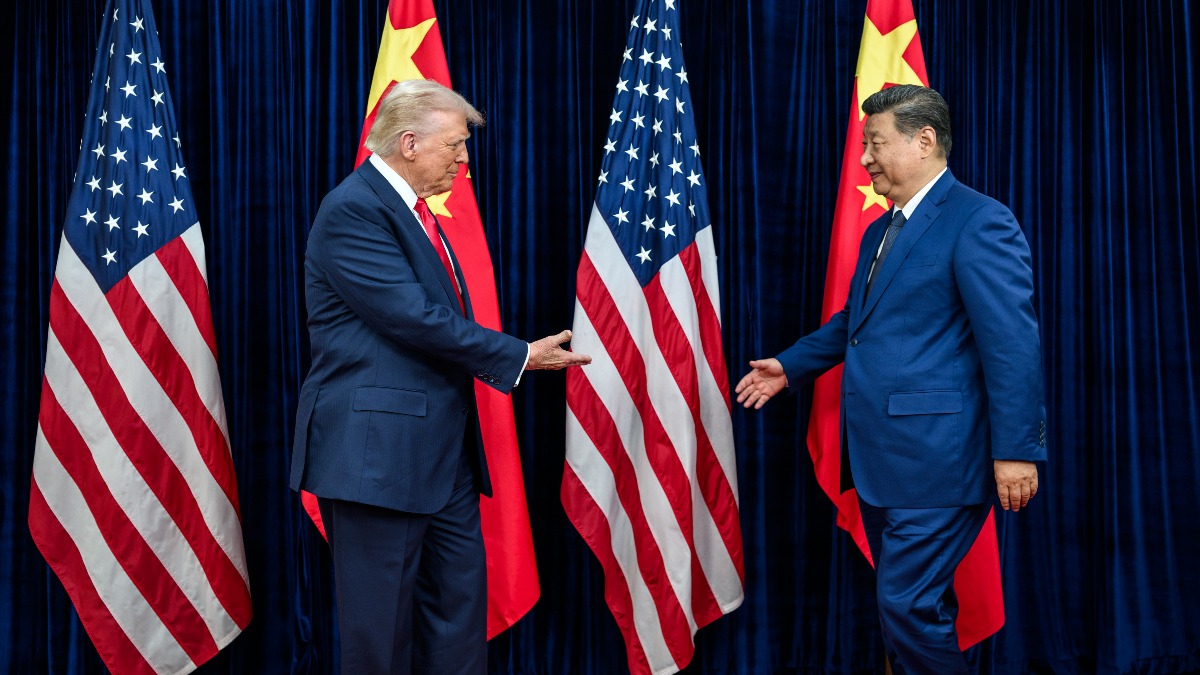

President Trump confirmed that he made no specific commitments regarding Taiwan during his high-stakes summit with Chinese President Xi Jinping in Beijing, The Hill reported. Speaking to reporters while en route to Washington aboard Air Force One, the president maintained a guarded stance on one of the most sensitive geopolitical issues currently facing the United States. When asked directly about his discussions with the Chinese leader, Trump stated, “On Taiwan, he feels very strongly, I made no commitment either way.”
This development arrives as pressure mounts from both sides of the aisle in Washington to push forward with a significant $14 billion arms sale to Taiwan. Trump noted that he would make a determination on the potential sale over the next fairly short period of time. The ambiguity surrounding his position is striking, especially given the intense focus Beijing has placed on the island.
According to Chinese readouts from the meeting, Xi Jinping explicitly warned Trump that the Taiwan question is the most important issue in China-U.S. relations. The Chinese Foreign Ministry went even further, stating that the entire relationship between the two nations would be in jeopardy if the matter is not handled well.
It is clear that Trump is playing his cards close to his chest
When reporters pressed him on whether the United States would defend Taiwan militarily, he refused to give a definitive answer. “I’m not going to say that. There’s only one person that knows that and you know who it is? Me. That question was asked to me today by President Xi. I said I don’t talk about that,” the president explained.
This approach keeps the international community guessing, but it also underscores the delicate balance the administration is attempting to strike. Secretary of State Marco Rubio, in an interview on Thursday, maintained that there has been no change in Washington’s policy, stating, “We always make clear our position, and we move on to the other topics.”
The disconnect between the American and Chinese accounts of the summit is stark. While the White House has focused on trade and economic cooperation, the Chinese Foreign Ministry has emphasized strategic stability and warnings against overstepping on territorial matters. This pattern of limited overlap was evident throughout the trip.
For instance, while the White House touted progress on curbing the flow of fentanyl precursors into the United States, the Chinese statements were notably silent on the issue. Similarly, the two sides presented different perspectives on the ongoing war in Iran. While the White House asserted that both nations agreed Iran should never possess a nuclear weapon, the Chinese statement avoided such specific language, instead focusing on the need for political settlements and dialogue.
Trade deals were another area where the narratives failed to align. Trump told Fox News on Friday that China had agreed to purchase 200 jets from Boeing, a move that would represent a significant shift in trade dynamics. Interestingly, markets reacted negatively to the news, as the figure was lower than the 500 aircraft anticipated by some analysts, causing Boeing shares to slide by more than 4 percent.
Despite Trump’s optimism, China has not officially confirmed this purchase, and Boeing itself has remained quiet on the matter. Furthermore, despite the high-profile inclusion of Nvidia CEO Jensen Huang in the delegation, there was no announcement regarding the sale of advanced AI chips to China.
The summit, which concluded at the Zhongnanhai complex, served as a platform for both leaders to project their respective priorities. While they agreed on the need for a constructive relationship and strategic stability over the next three years, the underlying tensions regarding Taiwan and regional security remain palpable.
The Taiwanese government has already weighed in, asserting that U.S. arms sales are a vital security commitment and a necessary form of joint deterrence against regional threats. As the administration evaluates the $14 billion arms package, the world will be watching to see how the president navigates these conflicting demands.








Published: May 15, 2026 03:30 pm