



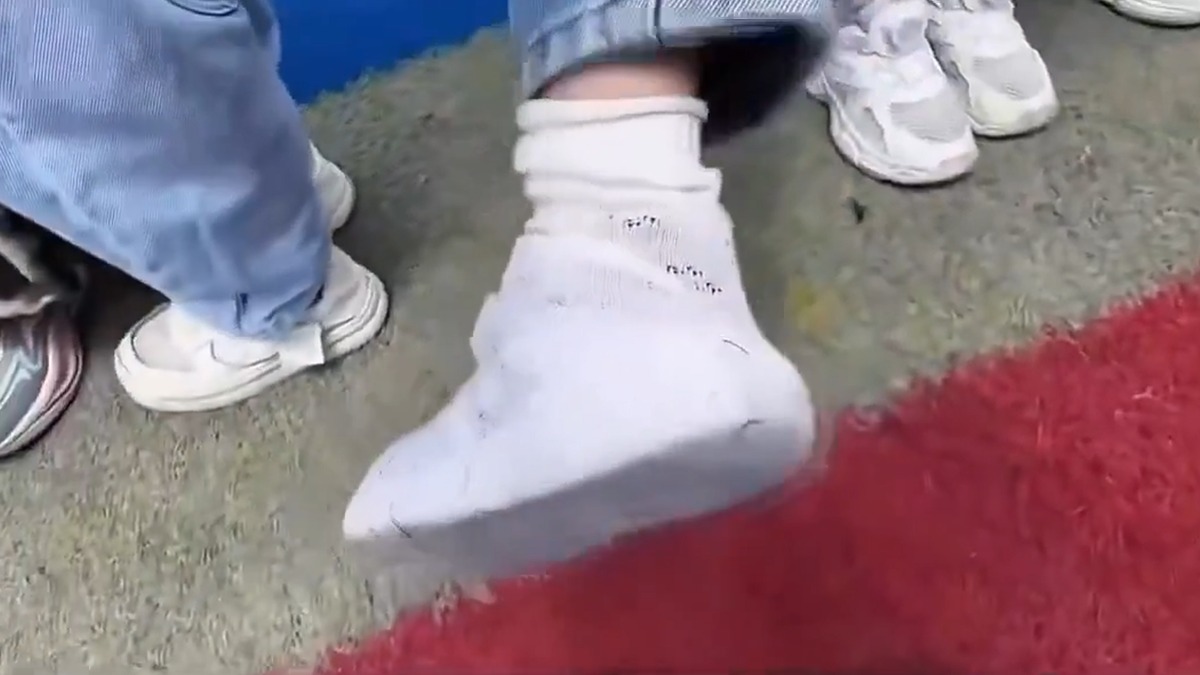

A student found an unconventional way around his school’s white shoe requirement, pulling white socks over his black sneakers to blend in with the rest of the dress code. The moment was captured on video and shared on X, and as detailed by Daily Dot, the clip shows a line of students where the boy’s disguise nearly went unnoticed entirely.
The footage, recorded at what appears to be a school event, shows the student standing among peers wearing standard white shoes. The white socks covered the dark fabric of his sneakers so well that they appeared to be part of the required uniform at first glance. The moment turns when the person filming lifts the boy’s pant leg to reveal the sock covered shoe underneath, and the student is seen laughing and stumbling along with those around him.
The video’s caption explained the motivation behind the workaround, stating that the student wore white socks over his black sneakers because white shoes were mandatory at school. The online reaction was largely supportive, with commenters calling the move resourceful and describing it as clever problem solving. It remains unclear how school administrators responded to the workaround, as the video does not show any staff reaction.
Other people say they have leaned on the same sock trick
Commenters on the video shared similar stories of their own. One person said they used black socks over sneakers to get into clubs that required dress shoes, while another described a police academy recruit who used the same method after forgetting his required footwear. Bending strict rules through creative means has shown up elsewhere online too, amid a McDonald’s ordering loophole that a TikToker recently claimed could score free food.
School dress codes remain a common feature of public education, with most districts enforcing some version of the policy, often citing safety as the justification. Critics have argued that the rules can produce uneven outcomes depending on the student population. A Government Accountability Office report found that schools with stricter dress codes are more likely to enroll higher shares of Black and Hispanic students, and that these same schools are more likely to use discipline that removes students from the classroom, including suspensions.
The same report noted that dress codes often target clothing items associated with girls, such as leggings and tank tops, along with rules about hair and head coverings that can affect students differently based on culture or religion. Some estimates cited in the report found that 60 percent of dress codes include language that involves measuring a student’s body or clothing. Disputes over how schools apply these rules have surfaced in other contexts too, amid a Georgia zoning dispute where a homeowner said local rules kept changing on him.
As of the GAO report’s September 2022 findings, the Department of Education had not released comprehensive guidance to help districts design more equitable dress code policies.







Published: Jul 5, 2026 05:00 am