




A New Jersey resident who sold their home was owed a small refund from their local internet provider after their final bill was overpaid, as per The NerdStash. The refund amounted to just 31 cents, and the person initially threw the check away without depositing it.
According to a post shared on the subreddit r/mildlyinfuriating by user Affectionate_Item_51, the internet provider kept reaching out since April, asking them to deposit the check. Eventually, they asked the provider to reissue it so they could go ahead and deposit it.
What followed was an unexpected $25 fee from their bank, Charles Schwab, after the internet provider issued a stop payment on the check right after it was deposited.
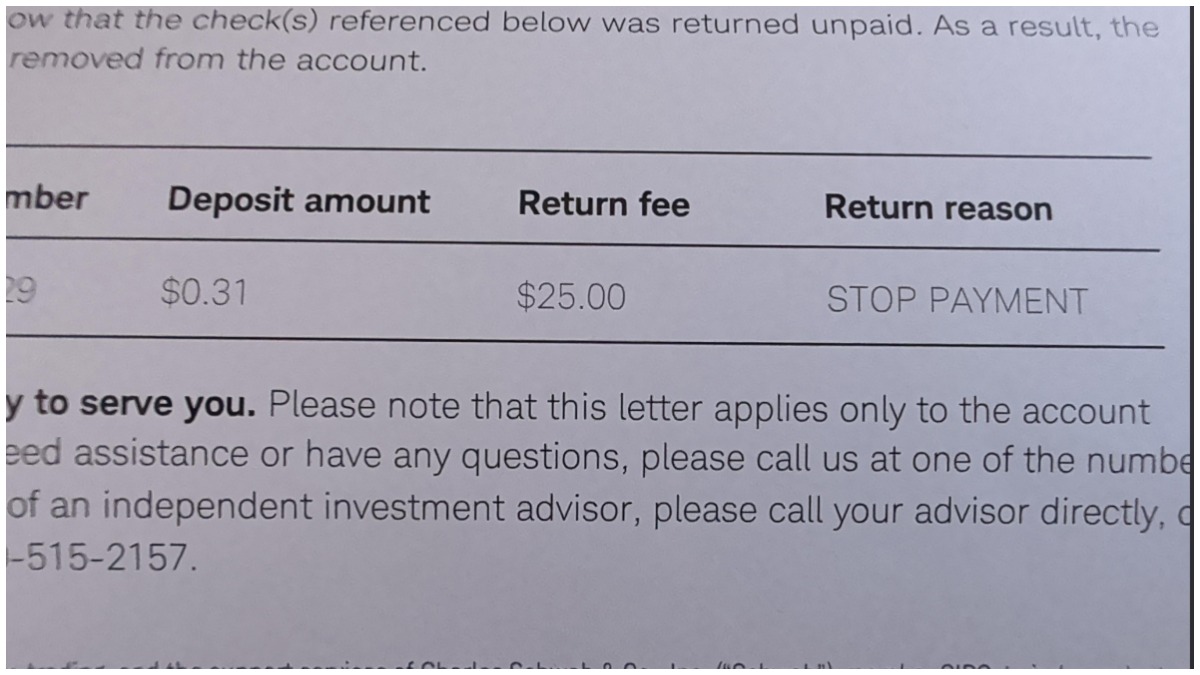
Bank statement shows a $25 return fee tied to a 31-cent deposit
A screenshot shared alongside the post shows a letter from Schwab titled “Returned Deposit(s).” The letter states that a check was returned unpaid and that funds were removed from the account as a result. A table in the letter lists the deposit amount as $0.31, the return fee as $25.00, and the return reason as “STOP PAYMENT.”
In the post, Affectionate_Item_51 explained what happened: “Immediately after depositing, the provider issued a ‘Stop Payment,’ triggering a $25 fee from my bank.” The person added that Schwab reversed the fee without any hassle, but said they expect the situation to repeat itself, joking, “I’m anticipating another 31¢ check to show up soon and restart this whole debacle.”
The post gathered 8.1K upvotes and 114 comments on the subreddit. Odd charges on bills have drawn attention elsewhere too, including a case where a restaurant receipt listed strange added fees that puzzled the customer who received it.
Many commenters reacted to the situation with jokes and disbelief. One commenter wrote, “They literally set a trap for you.” Another suggested, “If they try to get you to deposit another 31¢ check, tell them they can just mail you the three dimes and a penny instead.” A third commenter summed up the frustration by writing, “Corporate america in a nutshell.”
Some users pointed out that it was technically the bank, not the internet provider, that charged the fee. One comment read, “technically his bank is the one charging him a fee but yea.”
Other commenters offered explanations for why the check may have been stopped in the first place. One user wrote, “Usually checks go stale after ninety days – six months for some companies – and you’re forced to issue stop payments and reissue the check. This is why my company stopped issuing so many checks and went the electronic route for most payments.”
The same commenter, describing themselves as someone who has had to issue stop payments and reissue checks before, added, “please deposit it as soon as possible to avoid further hassle for yourself and the poor accountant who would rather just send you a quarter, a nickel and a penny to avoid the hassle.”
A user identifying as an accountant shared a similar point of view: “As an accountant, just deposit the check. I write a ton of small checks like this, and the majority go uncashed. There is a whole process I have to go through to pay those funds into the states unclaimed property fund. So, please just cash the little check.”
Another commenter pushed back on that advice, noting that the original poster had, in fact, deposited the check and still ran into trouble: “You’re giving accountants a bad name here. He did deposit the check, and got burned for it.”
Confusing bill charges have become a recurring theme on social media, with another example involving an unusual house fee added to a restaurant bill that included a charge for background music.
Some commenters suggested formal ways to address the issue. One wrote, “Reach out to the CFPB and file a complaint. I know they’ve been gutted by the league of extraordinary sh–heads that is this current admin, but the CFPB was still able to help me recover my $25.”
Another recommended filing a complaint through the FCC’s website, writing, “Call them and ask them to fix it. When they don’t, go here… Within a few days you will get an email from the FCC letting you know they’ve given the complaint to your ISP. Your ISP will then call you to fix it.”
Several users shared their own experiences with small, uncashed checks from companies. One person wrote, “I recently got a $0.01 certified check when I closed a bank account. I physically took it over to my other bank and deposited it at the counter.” Another said, “I get a check for 6 cents once a year from a mortgage company. Not worth the effort to deposit. But they can keep wasting money trying to send it to me.”
One commenter offered a lighter take on the ordeal, writing, “Just let them keep reaching out. It’s costing them way more money to bother you.”





Published: Aug 18, 2026 10:15 am