



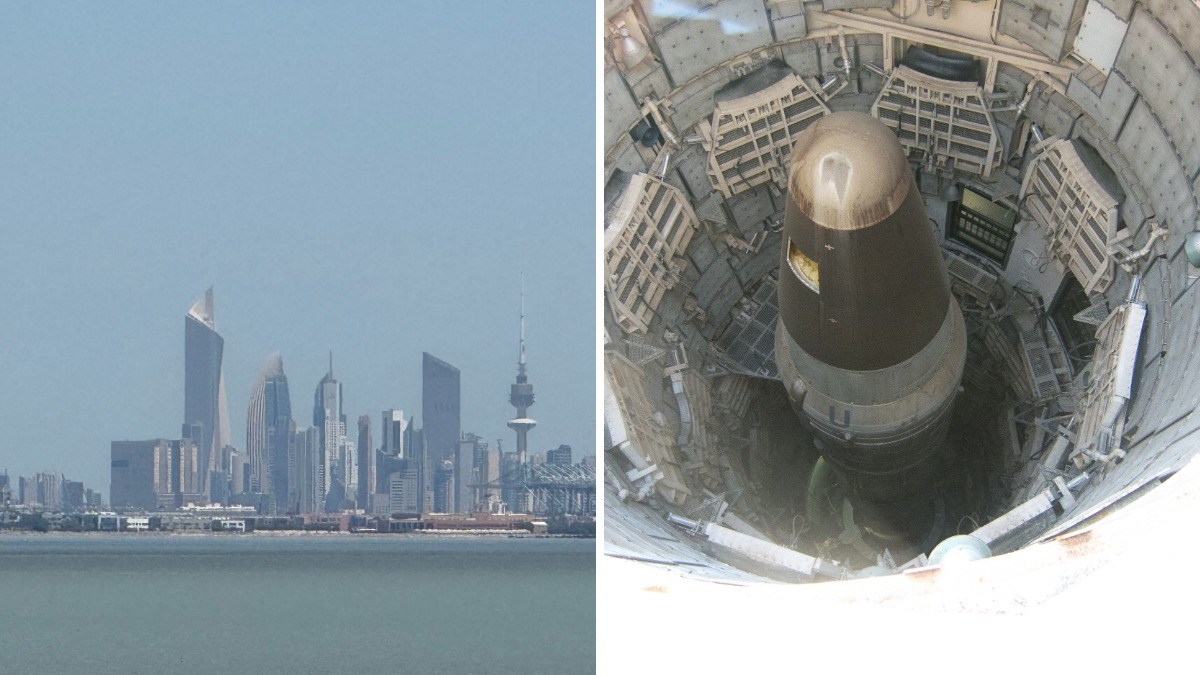

Air-raid sirens sounded across Kuwait early Thursday as Iran launched a coordinated barrage of missiles and drones toward the country, the latest escalation in a war between Washington and Tehran that has now run past six months. Kuwaiti military officials said their air defenses intercepted the projectiles, according to Arab News.
Kuwait hosts several major US installations, including Camp Arifjan, the Army’s regional headquarters for the Middle East, along with Ali Al Salem Air Base and Camp Buehring. Iran has repeatedly named American bases in Gulf countries as legitimate retaliation targets whenever the US strikes Iranian territory, leaving Gulf states like Kuwait hosting US forces while trying not to become a battlefield themselves.
The threat isn’t new. Satellite imagery reviewed by the Washington Post confirmed earlier damage to radomes at Camp Arifjan and Ali Al Salem, along with a power plant at Camp Buehring, from strikes earlier in the war. Thursday’s attack reads less like a new front opening than a return to an established pattern.
Iran attacked Kuwait and the US bases it hosts
The current cycle began August 30, when US forces struck Iranian Revolutionary Guard rocket launchers on Larak Island near the Strait of Hormuz. CENTCOM said Iran had been preparing to use the launchers to lay mines in the shipping lane. Iran retaliated against American forces in Jordan, and President Trump promised a stronger response.
On September 1, the US launched one of its largest strikes on Iran since fighting quieted in July, hitting radar systems, IRGC air-defense positions, communications sites and mine-laying capabilities, CENTCOM said. Iran’s Ministry of Health says 18 people were killed and 108 wounded in that round, including four people killed and dozens wounded when a strike hit a wedding celebration in the coastal town of Kuhestak. However, CENTCOM says it does not deliberately target civilians, and Iran has since asked for an international investigation into that strike.
The Strait of Hormuz is a global choke point, and Kuwait’s maritime access to international markets runs through it entirely. Brent crude snapped a three-day rally to fall to around $95 a barrel Thursday, still near a six-week high, as ship traffic through the strait has thinned sharply, with some vessels rerouting south near Oman under US protection or disabling their tracking systems altogether. Trump had ordered US forces to escort ships through Iran’s blockade earlier in the war, an arrangement Tehran said crossed a line.
Iran has also reported significant military losses in the latest exchange, including the deaths of three pilots and members of its regular armed forces and Revolutionary Guard.
Gulf governments are caught in a difficult position, trying to maintain military ties with Washington while reassuring Tehran they aren’t independently attacking Iran, a balance that gets harder to hold as long as US forces operate from bases on their soil. It’s important to note that a US official has told the Washington Post that Kuwait and Bahrain were hit especially hard earlier in the war partly because American forces had been permitted to conduct operations from their territory.
Iran had shut down the strait once before, earlier this year, ahead of a ceasefire that briefly held. Trump has said the renewed campaign won’t last long, though he’s also warned the US is prepared to keep striking if Iran doesn’t stop.





Published: Sep 3, 2026 04:15 pm