


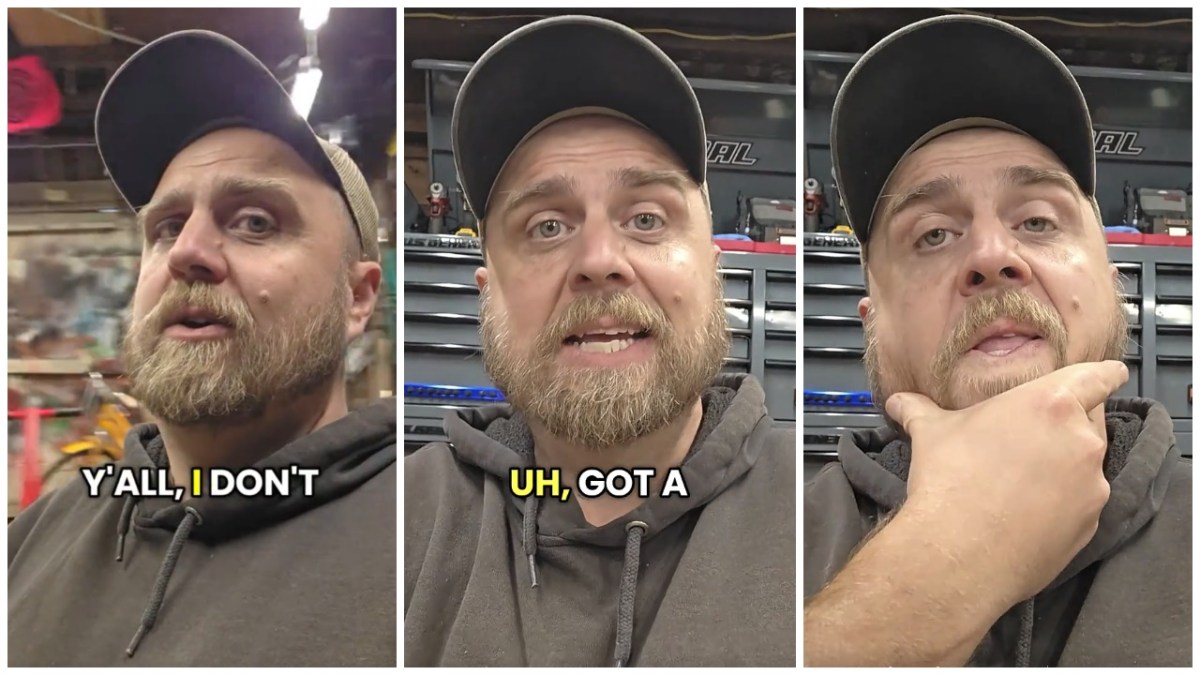

After his most recent client interaction, Micah (homesteadbandwagon) had just one question: “Is AI making people dumber or dumb people dumber-er?” In a post that drew hundreds of thousands of views on Instagram and TikTok, he explained that a customer refused to believe his tractor had a mechanical issue, despite seeing photos, because an AI chatbot told him otherwise.
In his video, filmed in a workshop, Micah said the customer brought in his tractor because it wouldn’t start. During diagnostic checks, Micah said they found that “the top end of his engine has grenaded,” with shrapnel everywhere. He sent the customer pictures of the damage along with a repair quote, but said the customer rejected it, insisted Micah fix the “real problem,” and promised to send instructions.
When the instructions arrived, Micah said they appeared to come from Grok or ChatGPT and told him to “fix the electrical system,” which had shown no problems during testing. The instructions allegedly called for replacing “non-existent electrical components” on the tractor. Micah said he tried to reason with the customer and pointed to the pictures, only to be told the customer had already fed them into his chatbot, which said “we have an electrical issue.”
Micah said the customer refused to budge
Micah said that when he pointed out that he could not install parts that don’t exist, the customer got upset and decided to take the tractor elsewhere to find someone who would follow the AI instructions. Micah summed up his frustration by saying, “We’ve arrived at the Mount Everest of stupidity.”
His viewers answered Micah’s question with humor. One user said they believed those people were always there, noting that “the Internet has given them a voice, and AI has given them authority.” Another said they couldn’t imagine telling a professional “no to the experience a PROFESSIONAL has.”
A user who identified as a software developer said “non-software developers tell me what an AI told them” all the time. An HEC study on “algorithm appreciation” found that people often trust AI more than humans, even when they know the AI makes mistakes.
A Harvard Business School working paper also found that AI models can be highly persuasive. When challenged, the paper noted, AI may “double down” on its errors rather than admit them, using tactics like flattery or false confidence to convince users it is right.
Bad AI advice has carried real costs before, including for a farmer who lost 25 acres after following AI advice. On TikTok, one user pointed to the same pattern, claiming that “if AI cant find an answer it makes an answer up.”
Attack of the Fanboy was unable to independently verify the customer’s side of the story, as this account comes solely from Micah’s Instagram and TikTok posts.







Published: Oct 30, 2026 12:00 pm