



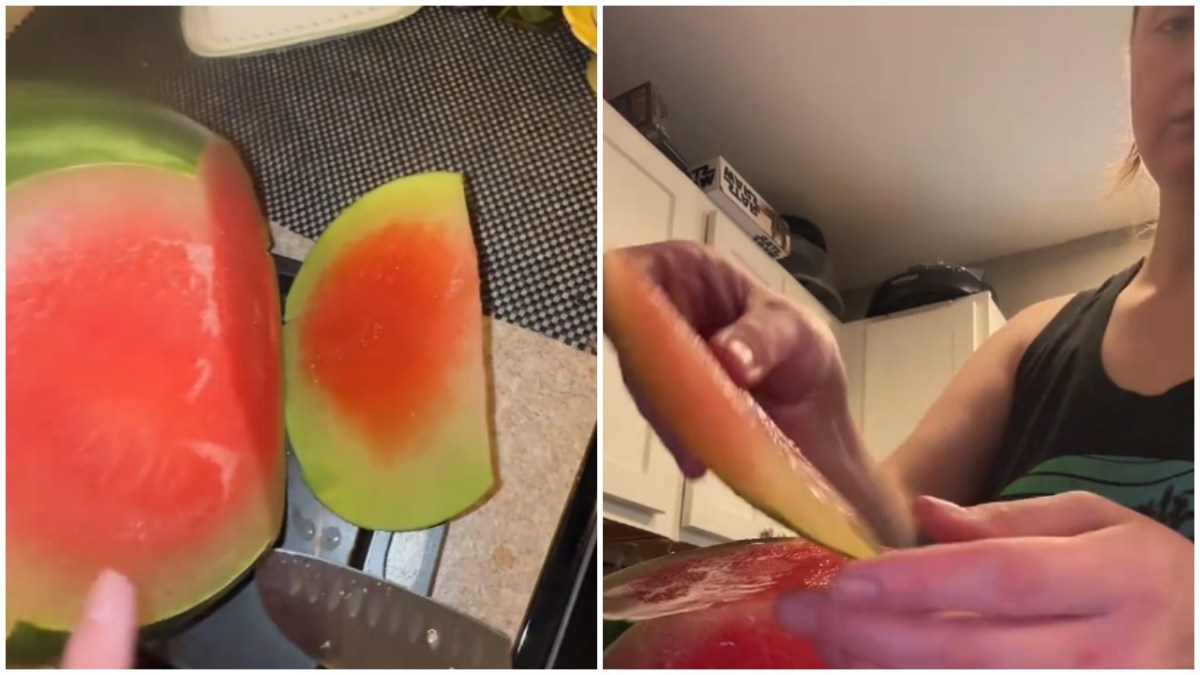

A TikTok creator cut into a watermelon and held the slices up to the camera after she said a web search left her unsure whether the fruit was safe to eat. Audrey Ann, who posts as @the_audreyann, said in the video that she bought it at Walmart the day before. The clip has gained 1.2 million views.
In the kitchen clip, she appears with dark hair and a black tank top, with a cut watermelon resting on a baking sheet. She pointed at a slice and said, “Google says that this isn’t safe to eat, and I don’t think it is either, but I just kind of wanted to show you guys.” She then asked, “Am I going crazy?”
The caption on the post read, “3D printed or just over ripe?” In an edit, she wrote that she got the fruit from Walmart, brought it home to cut up, and did not put it in a freezer or fridge. She added, “This was straight from Walmart.”
A glassy slice and how seedless watermelon is produced
Audrey Ann said the flesh was “clear, kind of,” and that she did not know how else to describe it. She cut another piece off the top with a large kitchen knife and turned the slice so both the red flesh and the green rind faced the camera. She said, “I don’t- maybe the camera isn’t doing it justice. Maybe it’s the flash.”
She picked the slice up again and asked, “You see that?” She said it “smells normal” and that “the inside feels normal.” She said she was not going to eat it and added, “but I guess the deer will enjoy it.”
According to a BBC report on 3D printed food, the machines use software to build objects from digital designs, and edible “inks” made into gels, pastes, liquids, and powders are pushed through nozzles in layers. Hod Lipson, a professor of innovation at Columbia University, told the BBC that his lab has printed dough, meat, vegetables, sweets, and chicken, and has also cooked some of it with lasers.
The report also said a recent Zion Market Research forecast put the global 3D food printing market at $1.65 billion by 2030. It also said printers are already used by some bakeries, chocolate makers, and restaurants, while a home-style machine aimed more at commercial use was described as costing about €6,000 and about the size of a microwave.
Lynette Kucsma, co-founder of printer maker Natural Machine, told the BBC that appliances that can both print and cook are still in development, and she put that timeline at 10 to 15 years.
As for the seedless fruit, Watermelon.org explains that watermelon accounts for about 92 percent of watermelon sales in the United States, with seeded fruit at about 8 percent. The site says a seedless watermelon is a sterile hybrid made by crossing a plant with 22 chromosomes per cell with one that has 44, so the resulting seed has 33.
It says that the process is cross-breeding, not genetic modification. The site also says the white coats often seen inside are places where a seed did not fully mature, not the black mature seeds, and that those coats are safe to swallow. Viewers on the post offered their own explanations for the clear flesh. One commenter wrote, “Frozen and thawed.” Another focused on what was missing from the slice and wrote, “Why is there no seeds.”
One commenter pushed back on the caption’s 3D-printing suggestion and wrote, “Why do people think we have the technology to 3D print an ENTIRE watermelon.” Another wrote, “I dont trust American food.” Concerns about the safety of American food are not unique to this watermelon, as documented in a TikTok video showing semi-solid juice from a rubbery watermelon and plasticky cheese.
A further commenter tied the look to temperature and also questioned the plan to leave the fruit outside. They wrote, “It just looks like cold damage. Pretty sure it’s still safe but its probably not as good tasting. Also why would you feed the deer with it if you don’t think it’s safe to eat????”




Published: Oct 5, 2026 03:30 pm