



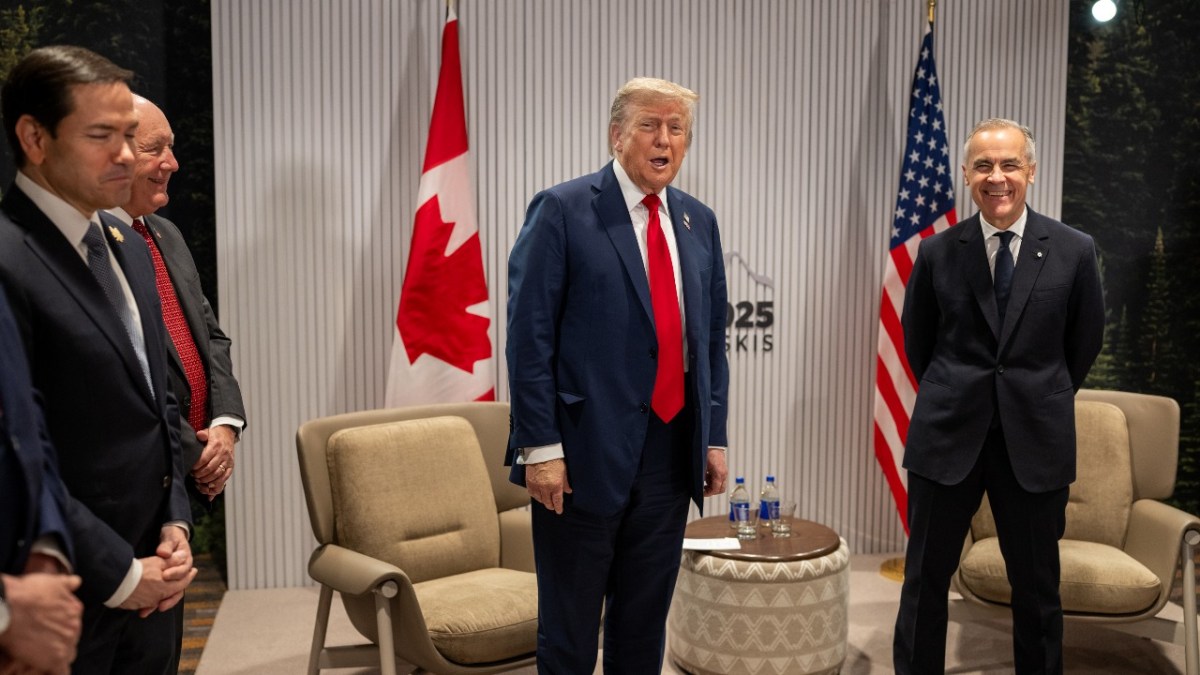

Ursula von der Leyen, president of the European Commission, put forward a plan Wednesday for Canada to become the European Union’s first “associate member.” She made the remarks in her State of the Union speech in Strasbourg, France. Canadian Prime Minister Mark Carney was present as a guest.
According to CNN, President Donald Trump answered later the same day. He said the United States could impose “heavy tariffs” on the European Union if he judges a new Canada deal to be a “hostile act.” Speaking to reporters, Trump said, “If it’s a good intention, that’s fine. If it’s a bad intention, we’ll put very heavy tariffs on Europe, which is a possibility.”
Canada remains in a trade dispute with the United States, its largest trading partner. Trump has also said more than once that Canada should become the 51st U.S. state. Carney has turned that idea down.
Officials have discussed trade, energy links and mobility without a formal membership path
Von der Leyen told the audience that “in this new world we must urgently reimagine our partnerships and build global coalitions for our resilience and democracies.” She also said, “In short, we want to bring the relationship with Canada to the highest level possible.” She described the effort as “not a partnership against anyone else, but for our common strength.”
Carney has described Canada’s goal as a “unique alliance with the European Union.” Lawmakers gave him a standing ovation when he attended the speech. He is set to speak to European lawmakers on Thursday.
Full EU membership is closed to Canada because the country does not sit within Europe. Canada does share a tiny land border with Denmark on Hans Island near northwestern Greenland, and the French islands of Saint Pierre and Miquelon lie about 20 kilometers off Newfoundland. Joining the bloc still requires a lengthy accession process and a yes vote from each of the 27 member states. Nine countries already stand in the candidate line.
Tinatin Akhvlediani, who leads EU enlargement work at the Center for European Policy Studies, said, “Associate membership does not exist.” She pointed out that Ukraine, Moldova and Georgia hold association agreements that demand alignment with EU law, a step she said Canada is unlikely to accept.
The Wall Street Journal reported that talks have covered lower trade barriers, undersea cables between Europe and Canada, pipelines that would send Canadian gas to Europe, new AI and tech projects, and even visa-free living and working rights for Canadians in Europe. Von der Leyen listed joint work on intelligent manufacturing, technology, defense, cybersecurity, artificial intelligence, energy, critical minerals, and batteries.
Goods and services trade between the two sides hit €130.8 billion last year, the European Commission said, a rise of more than 80 percent in ten years. Much of the Comprehensive Economic and Trade Agreement has been applied since 2017, but ten EU countries, among them France, Italy, and Poland, have not yet ratified it.
Finnish President Alexander Stubb once called a Canada-EU match “a marriage made in heaven.” He also asked, “Wouldn’t it be lovely if Canada was the 28th state of the European Union rather than the 51st state of the United States?”
French Foreign Minister Jean-Noël Barrot has suggested Canada might one day sign up. Germany has asked whether “associate member” is the right phrase, though a spokesperson said Berlin is willing to talk about new partnership models.
Abacus Data found this month that about 80 percent of Canadians want closer EU work on foreign policy, defense, and the economy. The debate over Canada’s international alignment comes amid escalating trade tensions, as when Trump threatened 50 percent tariffs on Canadian cars, auto parts, and steel.
56 percent said Canada shares more with EU countries than with the United States. Forty-nine percent said they would back joining the EU. Opposition Conservative leader Pierre Poilievre called Carney’s approach “out of touch” and wrote, “We will NEVER be the 51st U.S. state. And we will NEVER be the 28th EU state.”







Published: Sep 17, 2026 10:15 am