


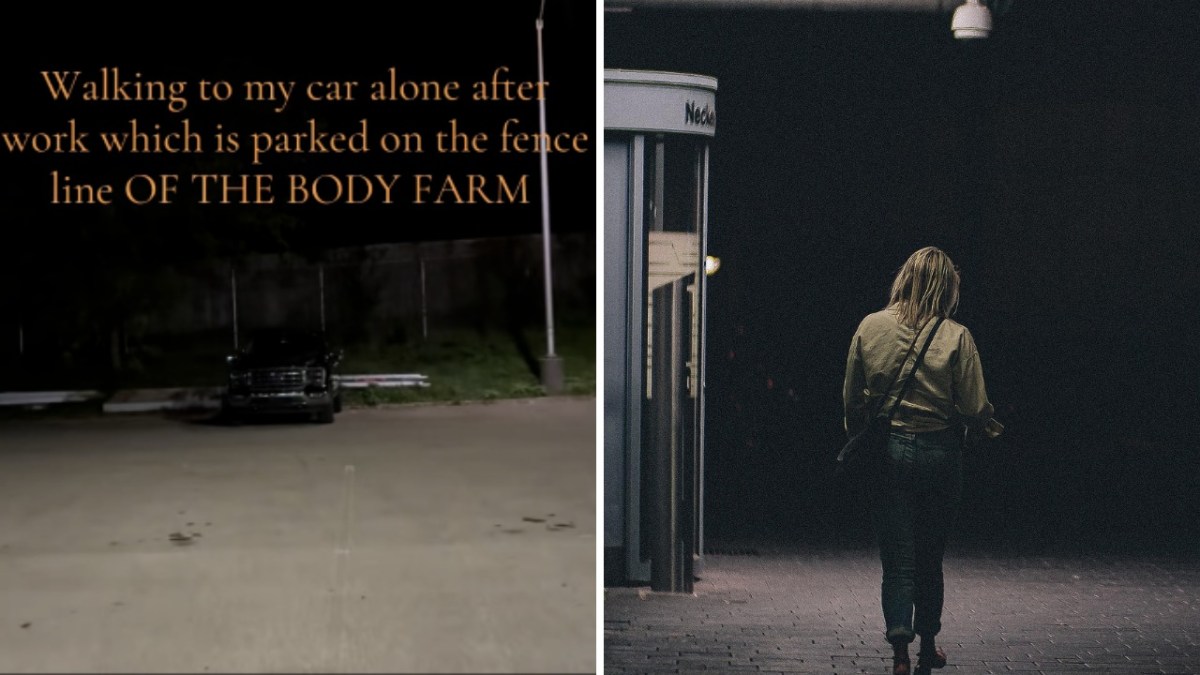

A Tennessee nurse said she had to walk to her car alone after a late shift, only to realize it was parked right on the fence line of a “body farm.” Michaela Meier wrote in the overlay text of a TikTok, “Walking to my car alone after work which is parked on the fence line OF THE BODY FARM,” as reported by BroBible.
She followed up in the caption, “Yes you heard me. THE BODY FARM.” Meier said being a “mid shifter” often means there’s no parking when you arrive, leaving you with an empty lot and a long walk when you leave.
At a body farm, people who donated their bodies to science are placed in specific conditions, such as in cars, under water, or in shallow graves, and their decomposition is studied for forensics. Learning how long bodies have been exposed to different elements helps investigators and pathologists understand crime scenes, and it teaches law enforcement how to handle human remains at various stages of decomposition.
That is not a walk most people would want to take at night
Meier is in Tennessee, so she is likely referring to the University of Tennessee’s Anthropology Research Facility in Knoxville, where scientists study human decomposition in a controlled environment. The local community hasn’t always welcomed it. When a parking lot was built next to the facility in 1985, a local activist group protested, and the university eventually put up privacy fences to isolate it.
That parking lot is still there, so workers who park in it can still find themselves walking back to their cars next to the facility late at night. Late hours are a familiar part of the job for many nurses, including a California operating room nurse who started a midnight DoorDash shift after work.
Tennessee isn’t the only state with one of these facilities. Similar facilities operate in Texas, North Carolina, Colorado, Michigan, and Florida, where researchers place donated human bodies in all sorts of environments. The FBI has sent investigators to these sites for training to help them learn how to recover human remains from outdoor crime scenes.
TikTok users were intrigued by Meier’s experience. One commenter wrote, “I worked at the body farm last summer… oh the stories i have,” while another said, “I’d love to donate my body to the body farm. Not only would it help science, but I’d also get my wish of decaying in nature and feeding the land.”
Once the bodies have finished decomposing and testing is complete, the remains are usually collected, cleaned, and added to a research collection for further study. The University of Tennessee’s facility does not offer public tours or viewings, a policy that helps protect donors’ anonymity and keeps the research intact.



Published: Nov 14, 2026 12:15 pm