



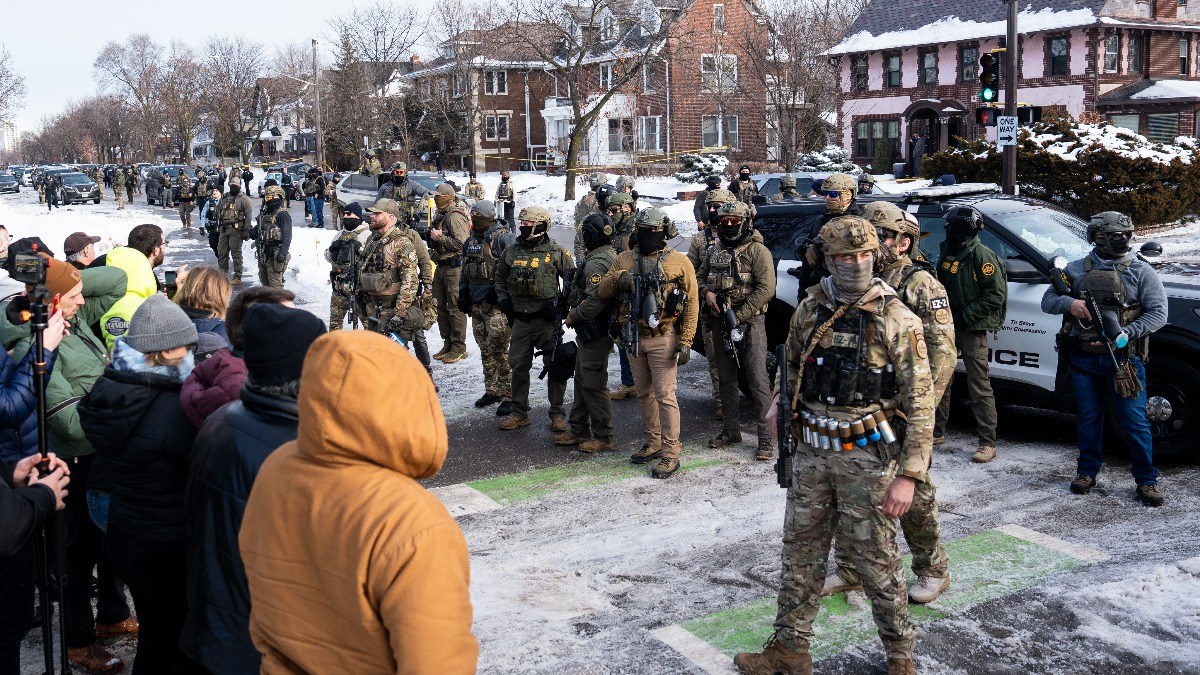

An ICE official who ran the office that screened new recruits said last summer’s hiring push led the agency to skip steps. He wrote that the Trump administration was rushing through people he called unqualified and “improperly vetted.” His memo pointed to an “unprecedented lowering of standards” and warned that the shortcuts put ICE work at “grave national security risks.”
The official served as a unit chief over more than 100 staff members who reviewed thousands of applications. He sent a whistle-blower complaint to the Department of Homeland Security Office of Inspector General and asked that an outside investigation be opened. Investigators from that office interviewed him twice, and the issues he raised are now part of an audit of how ICE vets applicants, The New York Times reported after obtaining the complaint through a public records request.
The man spent 17 years at ICE and spoke to the Times only if his name was withheld because of the sensitive claims. He left the agency in July. “We chose as an agency to be more convenient rather than thorough,” he said. “By doing so, there was a potential to put lives at risk and to jeopardize national security.”
Hiring surge changed how recruits were screened and trained
In the earlier system, a recruitment team sent fingerprints and a long security form to a unit in ICE’s Office of Professional Responsibility. That unit then checked names against law enforcement databases and looked for serious problems. Polygraph tests were used when issues came up. Contractors later ran a full background investigation, sometimes while the person was already in training. The first round of checks usually took seven to 10 days.
During the surge last summer, staff were instructed to decide on applicants without the complete security form, fingerprints, or polygraph exams, according to the former unit chief and a former federal official who knew the process.
Recruits were therefore sent to training before their identities or criminal records had been confirmed, the unit chief said. Training itself was shortened from about 10 weeks to six. People with earlier law enforcement jobs could take online classes instead of attending in person and received still less review.
Lawmakers set aside $30 billion so ICE could add 10,000 agents and more than double its deportation officer force. A former federal official said that by spring, hundreds of people hired in that push had already been taken off the job. ICE later said in July that it had stretched academy training again and required earlier graduates to return for more instruction.
An ICE spokesperson said the agency “diligently applies the proper personnel vetting regulations, including guidelines for national security, and evaluates all available information for every applicant based on these factors.” Officials would not discuss the whistle-blower or the complaint.
Ryan Schwank, who worked as an ICE lawyer at the training academy, left the agency earlier this year and spoke publicly. He called the training “deficient, defective and broken.” He told an interviewer that staff feared the agency might hire “a loose cannon or somebody who was just mentally unfit for the role.” He also said the chance that organized crime could get inside the agency “kept some of the other instructors up at night.”
Schwank said several trainees were pulled out of the Georgia academy last fall after officials concluded they were tied to a criminal gang. An ICE spokesperson said the agency “has received NO credible evidence that any of its trainees were linked to a common criminal gang.” He added that roughly half his students failed after the hiring rush, something that had been uncommon before. Tests were made open book, he said, and students were no longer failed for making fatal mistakes in enforcement drills.
Attention to hiring grew after Johan Sebastián Durán Guerrero was fatally shot on July 13 in Biddeford, Maine. Two former wives of ICE agent David Brouillette, who was hired during the surge, have said he was abusive. In a December 2019 request for a protection order, one wrote that he kicked in her door, wrecked her property, and threw her clothes off a bridge.
They also said he had post-traumatic stress disorder from his time in Afghanistan. A local official told The Portland Press Herald that the Hallowell Police Department turned him down in 2024 because there were “too many red flags.” Tom Homan, the White House border czar, said a DHS review would look at whether the agent had been properly screened.
The unit chief wrote that political appointees got special handling and received security clearances even after background checks turned up problems. He named Corey Lewandowski and described a memo from the DHS security chief that alleged Lewandowski had earlier been paid by a Chinese government agency.
That claim has not been confirmed outside the memo. Lewandowski said he was never vetted by ICE and stated he had “never worked for the Chinese Communist Party – Full Stop.” His spokesperson said any claim that he “received favorable treatment in connection with his security clearance is categorically false.” These concerns about oversight extend to how ICE incidents are reviewed, as the FBI will no longer investigate ICE shootings and will instead handle them internally.
A lawyer from the department’s Office of General Counsel, not the inspector general, contacted the unit chief 10 days after the complaint was filed and asked to meet at a field office in Texas. The meeting lasted four hours, and the lawyer took his laptop, the former official and his attorney said. Kevin Owen, the whistle-blower’s lawyer, said his client thought the talk was meant to check the disclosure. “Instead they threatened him and put him on leave.”
DHS kept him off the job for 10 months over “allegations of serious misconduct” that were never spelled out, the unit chief and Owen said. He was later returned to work with no finding against him and retired at once. The inspector general’s office first called him in February, about six months after he filed the complaint, and spoke with him again in April. The office said furloughs delayed some of its work and that it opened an audit in April on how political appointees receive security clearances. It said it never gave the whistle-blower’s name to anyone outside its own staff.
The former official said he is a longtime Republican who voted for Donald Trump in 2020 and 2024. He said he still backed ICE’s mission but was disturbed by the rushed screening. “It’s a betrayal of the public trust and everybody’s trust,” he said. The vetting process has faced broader criticism, as Tom Homan said an ICE officer in a fatal Maine shooting should have never cleared vetting, and the process is under review.






Published: Sep 5, 2026 09:00 am