



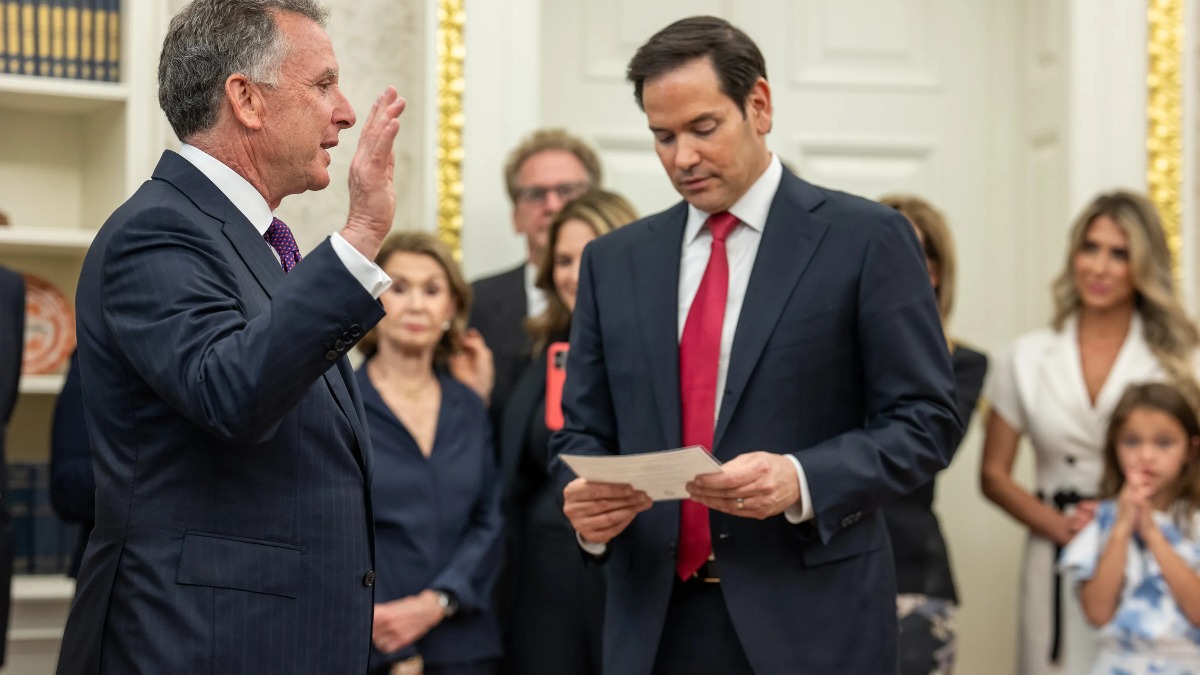

Secretary of State Marco Rubio and Middle East envoy Steve Witkoff faced many questions from lawmakers during the first wide-ranging congressional briefings about the Iran deal signed by President Donald Trump. These calls took place more than a week after the president completed the agreement. The briefings showed both bipartisan doubt and technical problems as the administration tried to defend its approach.
According to Politico, during the afternoon session with House members, the conversation grew tense. Rep. Debbie Wasserman Schultz went back and forth with Rubio and Witkoff about the lifting of oil sanctions. The call ended suddenly when the administration officials cut it off. An administration official later said the call ended because of technical problems, not because of the questions being asked.
The sessions had other tense moments too. Rep. Madeleine Dean raised concerns about the business interests Witkoff holds in the Middle East while serving as the lead negotiator with Iran. This question led Rubio to strongly defend Witkoff. Meanwhile, Rep. Darrell Issa pushed the officials for details on what would happen to Iran’s stockpile of near bomb-grade uranium.
Officials repeat earlier assurances on uranium and future talks
In response, Witkoff and Rubio repeated assurances they had already given to certain lawmakers in smaller briefings held earlier. They said the administration plans to negotiate a final deal that would stop Iran from keeping its highly enriched uranium. According to people familiar with the private remarks, the memorandum of understanding that Trump signed earlier this month is meant to be the starting point for these future talks.
Witkoff said a technical team is currently traveling from Switzerland to Qatar, where talks between the United States and Iran are set to happen on Tuesday. Former President Barack Obama has his own doubts about the deal, questioning whether it improves on the 2015 nuclear agreement.
The administration is working to address concerns about the money involved in the deal. Officials told lawmakers again that Iran has not received any funds under the current memorandum, and stressed that no money came directly from American sources. They also discussed the $300 billion reconstruction fund, which has become a major concern for Senate Republicans who worry it could help fund Iran’s military and its allied groups in the region.
Senate Minority Leader Chuck Schumer gave a harsh review of the process after a separate call with senators. He said the officials “confirmed to me that Iran will reap billions in oil revenue while retaining dangerous leverage over the Strait of Hormuz.”
Schumer called for more transparency, saying, “If this is the administration’s defense behind closed doors, Secretary Rubio should make it under oath, in public, before the Foreign Relations Committee.” He called the briefing “delayed, deficient, and devoid of details.”
An administration official disagreed with Schumer’s description, pointing out that Schumer had already received a briefing on the deal as part of a group of top leaders focused on national security. The official said Schumer had plenty of chances to ask follow-up questions during the Senate call.
Officials also faced questions about the slow reopening of the Strait of Hormuz, a shipping route that matters greatly to the global economy. Both Rubio and Witkoff said more mine removal work is needed before the route can fully reopen, even though Trump had earlier announced the strait’s reopening alongside a ceasefire.
Witkoff also said Iran had already broken the terms of the deal by launching a drone attack on a passing ship over the weekend. Sen. Steve Daines described the Senate briefing as a productive conversation, though the repeated questions suggest the administration still has more work to do to gain support for its approach to Iran.






Published: Jun 30, 2026 08:15 am