



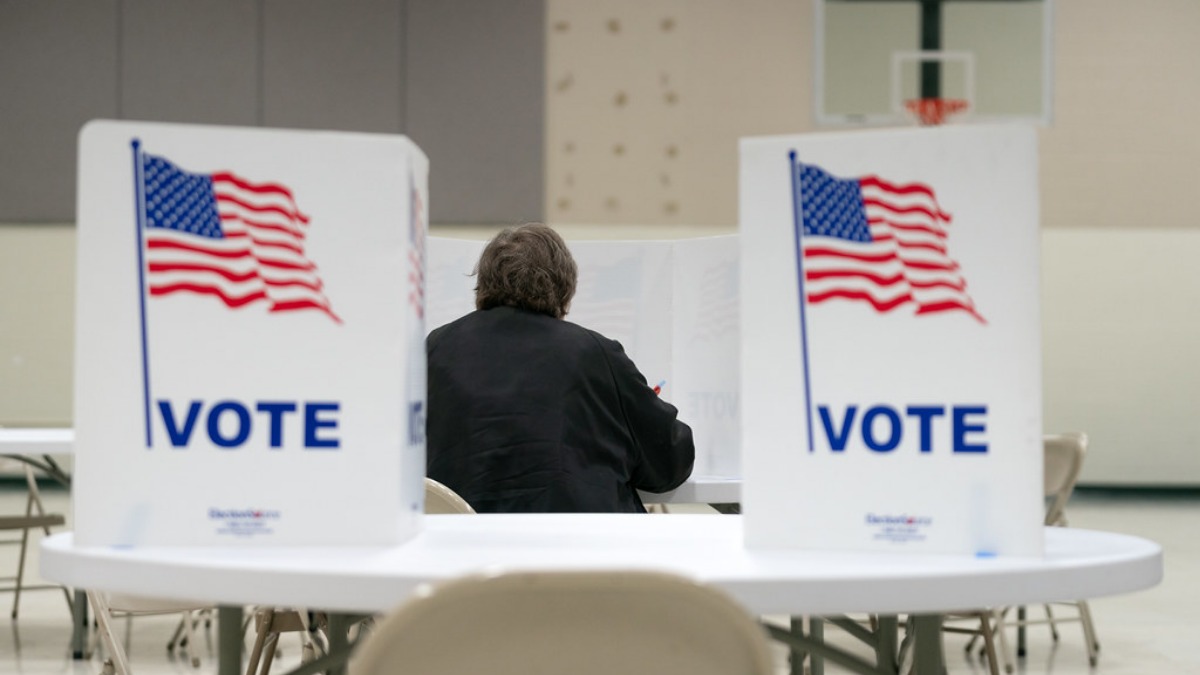

President Donald Trump did not rule out declaring a national security emergency to gain more control over the 2026 midterm elections, according to a new interview. His comments add to a series of signals suggesting he may try to intervene in the elections before votes are even cast.
According to CNN, the remarks came during an interview with Wayne Allyn Root of Real America’s Voice. Root raised the idea after noting that the Senate has not passed Trump’s proposed elections bill, known as the “SAVE America Act.”
Root told Trump that declaring a national security emergency for elections would give him powers that could not easily be challenged, and could lead to changes such as photo ID requirements, proof of citizenship for voter registration, and limits on mail-in ballots.
Trump did not confirm or deny the possibility
Root explained to Trump that a national security emergency declaration “can only be overturned by a two-thirds vote by both houses of Congress.” He suggested that using this option within the next month could result in new voting rules.
Trump did not directly answer whether he would take this step. Instead, he responded, “Let me just say that stranger things have happened, OK? I’ll leave it at that.”
It is not clear whether such an emergency declaration would hold up legally. CNN has asked the White House for more details on what Trump meant by his comment. Reports have also surfaced about plotting a national emergency declaration among Trump allies ahead of the midterms.
Trump often avoids ruling out hypothetical scenarios, even extreme ones, when they are raised to him. Because of this pattern, his response does not necessarily confirm that he plans to take this specific action.
Still, other developments point to Trump’s interest in having more influence over how elections are run. The Trump administration has threatened to stop the US Postal Service from delivering mail ballots in states that refuse to hand over their voter lists. Several states, including some led by Republicans, have declined this request, citing privacy concerns.
Since Democratic voters use mail ballots more often than Republican voters, limiting mail-in voting could benefit Republicans. Trump has repeatedly linked mail ballots to claims of widespread fraud, though these claims remain unproven.
The administration has also taken other steps tied to Trump’s fraud claims, including seizing 2020 ballots in Fulton County, Georgia. Last month, Trump gave a primetime address on election security that focused heavily on alleged interference from China, despite what the report describes as limited evidence supporting that claim.
Ty Cobb, who served as White House counsel during Trump’s first term, said he saw the speech as laying groundwork. Cobb described it as a “predicate that he needs to declare an emergency.”
Trump has made similar comments in the past about wanting more federal control over elections. In February, he called on his party to “take over the voting in at least 15 places,” and said, “The Republicans ought to nationalize the voting.” Around the same time, he also spoke about setting up an election integrity army for 2026.
The Washington Post also reported in March that pro-Trump activists were circulating a draft executive order. The draft reportedly claimed that Chinese interference in the 2020 election gave Trump emergency powers over the 2026 election.
Legal experts have raised doubts about whether Trump could actually take control of elections in this way. According to earlier CNN reporting by Marshall Cohen and Michael Williams, the Constitution places election administration mostly in the hands of individual states, and courts have consistently upheld that principle.
Presidents typically have wider authority to act without Congress when national security is involved, which is part of why the mention of China in Trump’s speech was seen as significant. However, some legal experts remain skeptical that this argument would hold up if challenged in court.
Trump’s continued push for the “SAVE America Act,” even though it has not gained traction in the Senate, has also been viewed by some as part of a broader effort to justify more direct action later on.









Published: Aug 12, 2026 09:45 am