



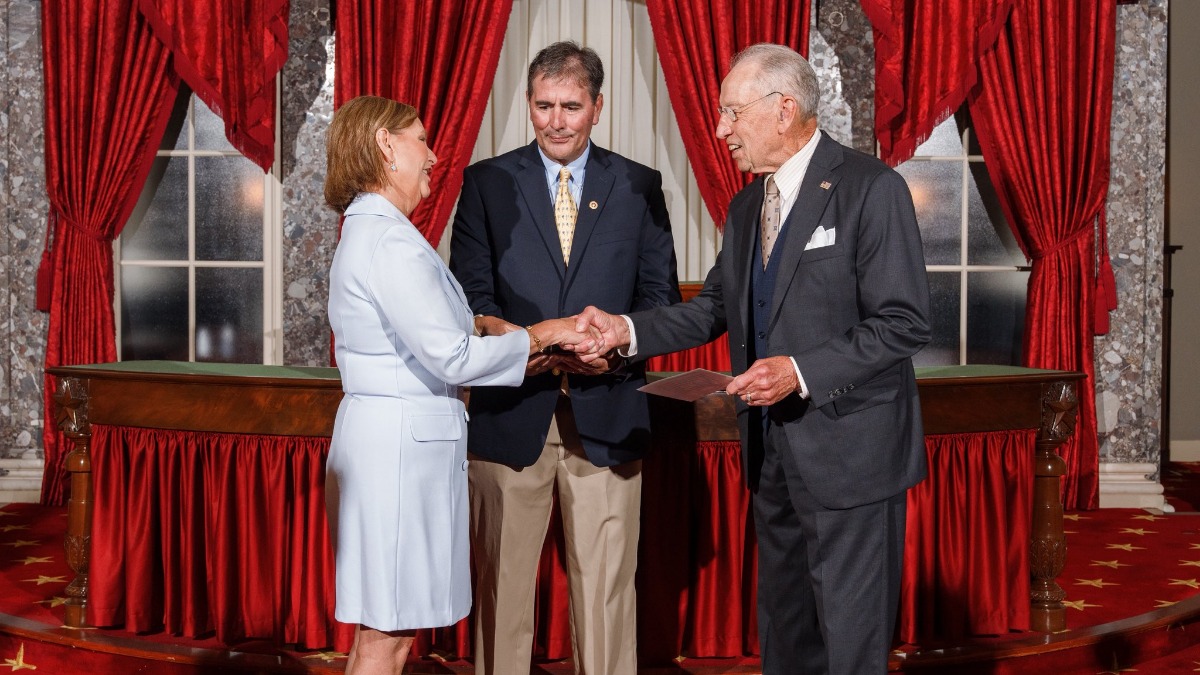

Senator Darline Graham Nordone says she does not believe she was handed her late brother Lindsey Graham’s Senate seat, even though South Carolina Governor Henry McMaster appointed her to the position. She made the comments during a Tuesday interview with NewsNation’s Ryan Noble.
According to The New Republic, Noble asked Graham what she would say to people who feel the seat was simply given to her. Her response has drawn attention as South Carolina holds a special primary election on the same day to choose the Republican candidate for the seat.
Graham was appointed to the Senate the day after her brother’s death in July and later launched a campaign for the full term after President Donald Trump endorsed her.
Graham responds to questions about being appointed to the seat
When asked about people who think she was handed the Senate seat, Graham said, “I don’t see it that way, I’m not being handed this seat. I realize that I have to earn voters, so I’m working hard to do that. Like I said, I want to spend the next two weeks getting out to as many places as I can. You know, Lindsey was amazing, I will never fill his shoes. No one can ever fill his shoes, and I don’t just expect it to be handed to me.”
Graham was expected to serve as a caretaker for the seat rather than run for a full term. Last month, some conservative commentators criticized her decision to run, with some calling her “idiotic” and one of the “worst congressional creatures.”
Some Republicans have also questioned whether Graham has the political background for the role. Her only political donation on record went to a South Carolina state senator who helped block an abortion ban, and she did not vote in the 2024 presidential primary or the 2016 general election.
Trump’s endorsement has not led South Carolina Republicans to unite behind Graham. According to The Washington Post, none of the candidates in the special election is expected to win more than 50 percent of the vote, which would trigger a runoff. Turnout is also expected to be low, drawing mostly the most politically active voters.
John McGrath, chair of Berkeley County’s Republican Party, told ABC News in early August that some Republicans feel uneasy about how Graham became the party’s preferred candidate.
“There’s a little bit of uneasiness about that whole process,” McGrath said. “Because at the end of the day, ultimately the people who are going to decide who the nominee is are the people of South Carolina, not D.C., not the consultants that run these big money [political action committees], organizations.”
Graham has described herself as a political outsider and said that her background helps her connect with voters. She has said she plans to focus more on domestic issues and affordability than her brother, who focused heavily on national security and foreign affairs. She has also said she supports ending the Senate’s legislative filibuster, a position that differs from her brother’s, who supported keeping it.
“I’m not a politician. I’m not a millionaire. I understand the average struggles of the American family,” Graham said during a debate in early August.
Graham has held several positions in South Carolina state government, including commissioner of the South Carolina Commission for the Blind and a member of the South Carolina State Workforce Development Board.
She has also worked with Clemson University, the South Carolina Department of Employment and Workforce, and the South Carolina Department of Vocational Rehabilitation. Her brother’s sudden death came with no known prior health issues, which set off the rapid series of events that led to her appointment.
Graham has said she would support President Trump’s agenda in the Senate, including on issues such as the Iran war and voting legislation. “I completely support the president’s agenda. I’m 100% behind him,” she said during the same debate.
Chase Meyer, a political science professor at the University of South Carolina, told ABC News that Trump’s endorsement could help Graham because voters do not know much about her yet. “Without that endorsement, it would be hard to tell how well she would do at all in this race,” Meyer said. Trump also spoke about her brother’s legacy at his funeral, where he pushed back on a claim made during the eulogy.
Graham has not drawn sharp contrasts with other candidates in the race, including Representatives Ralph Norman and Russell Fry, both of whom have also emphasized their support for Trump while running against his endorsed candidate. Other candidates include former South Carolina Governor Mark Sanford and businessman Mark Lynch, who ran against Lindsey Graham in June and received about 30 percent of the vote.
If no candidate wins more than 50 percent of the vote, the top two finishers will compete in a runoff election on August 25.
The winner of the Republican primary or runoff will face Democratic candidate Annie Andrews in November. Andrews, a pediatrician, previously ran in 2022 for South Carolina’s 1st Congressional District and won the Democratic Senate primary in June. “No matter who emerges from the primary, my mission remains the same: lowering costs, protecting health care and fighting for South Carolina families,” Andrews said in a statement to ABC News. “We have spent more than a year building a statewide grassroots campaign, and we are ready for November.”






Published: Aug 12, 2026 08:45 am