



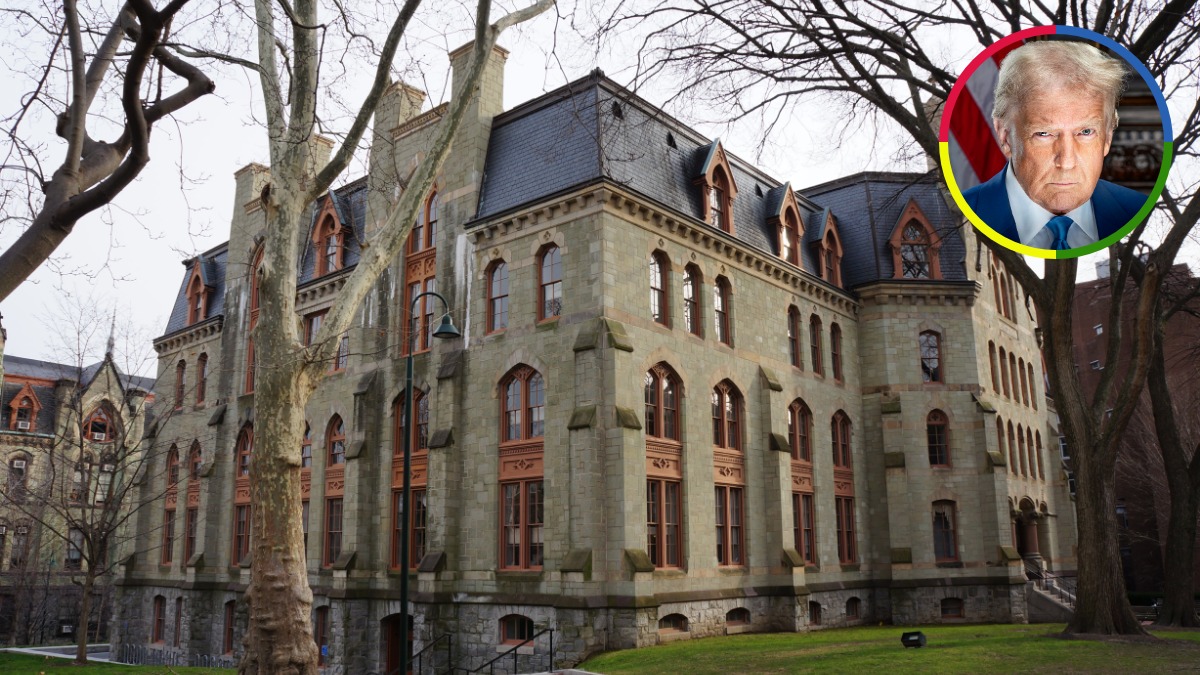

A judge recently ruled that the University of Pennsylvania must hand over contact information for its Jewish faculty and campus organizations to the Trump administration, sparking immediate concern among various advocacy groups, as reported by The Hill. This decision comes as part of an ongoing antisemitism investigation into the university by the U.S. Equal Employment Opportunity Commission (EEOC).
President Trump’s administration says collecting this information is a necessary step to assist its investigation into antisemitism at the university. EEOC Chair Andrea Lucas defended taking the information demand to court in November, explaining that the commission “remains steadfast in its commitment to combatting workplace antisemitism and seeks to identify employees who may have experienced antisemitic harassment.”
Lucas added that an employer’s obstruction “undermines the EEOC’s ability to investigate harassment,” and they will “seek court intervention to secure full cooperation.” However, the University of Pennsylvania isn’t exactly thrilled about this.
The school plans to appeal the decision, stressing that it doesn’t even keep the kind of detailed religious membership information the administration is asking for
Penn stated that while it acknowledges the EEOC’s role in investigating discrimination, it also has “an obligation to protect the rights of our employees.” The university believes that “requiring Penn to create lists of Jewish faculty and staff, and to provide personal contact information, raises serious privacy and First Amendment concerns.”
Many Jewish advocacy groups are sounding the alarm, arguing that the government is using their community as a smokescreen to advance policies against higher education and restrict free speech on campuses.
Eli Williams-Szenes, director of advocacy and political affairs for Bend the Arc Jewish Action, voiced a strong opinion on the matter. He said that people are thinking “this administration, no matter what they say, has no plan to prevent or end antisemitism whatsoever.” Williams-Szenes believes its policies “actively harm Jewish people by using our legitimate fears of antisemitism and our legitimate need for reassurances for safety as a smoke screen to advance unpopular anti-democratic policies exactly like this.”
Williams-Szenes pointed to other administration policies, like screening foreign students’ social media accounts before approving visas, as evidence of what he sees as impure motives. He also mentioned that the administration has arrested and is attempting to deport multiple students who engaged in pro-Palestinian protests or activism since 2024.
He feels the Trump White House is “constantly investigating and creating practical and legal boundaries for students who have anything to say other than exactly what this administration thinks is the only acceptable thing to say about the actions of the state of Israel.” Anyone who disagrees, he added, is characterized as “actively engaged in dangerous antisemitism that poses a threat to their Jewish neighbors, colleagues.”
The administration has made accusations of antisemitism a common tool against colleges and universities, previously freezing billions of dollars in federal funding which was later released only under judges’ orders or once a particular school agreed to policy changes. The Department of Justice also recently announced new antisemitism lawsuits against Harvard University and the University of California, Los Angeles.
Jonathan Feingold, a law professor at Boston University and a member of Concerned Jewish Faculty & Staff, finds the demand “incredibly chilling.” He explained that there’s “a very reasonable expectation that there’s nothing good faith about the desire to do that.” Feingold worries this could mean “people will be less likely to engage in all sorts of membership-based organizations and community spaces that are often critical in order to create institutions in which everyone belongs and is able to find communities.” Penn Hillel also shared its concern, stating that “subjecting faculty to such disclosures without their consent undermines the very civil rights these investigations seek to uphold.”
However, not everyone agrees with these concerns. Liora Rez, founder and executive director of StopAntisemitism, believes this is a necessary step to hold schools accountable. Rez clarifies that there isn’t “a ‘list of Jews,’ but rather a record of Jewish students and faculty who voluntarily filed Title VI complaints after experiencing antisemitism and discrimination.” She stated that “turning over this information is a necessary step to ensure those complaints are fully investigated and not buried.”
Judge Gerald Pappert, who was appointed by former President Obama, issued the ruling on Tuesday. He firmly stated that the EEOC has the constitutional right to collect the contact information. He also dismissed suggestions that there were safety issues with the request, writing that “comparing the EEOC’s investigation into antisemitism at Penn with Nazi Germany is counterproductive, as counsel acknowledged by attempting to backtrack from such analogies.”
The university has until May 1 to turn over the information. It’s important to note that the ruling doesn’t require Penn to include a person’s membership with specific Jewish organizations.









Published: Apr 3, 2026 04:00 pm