



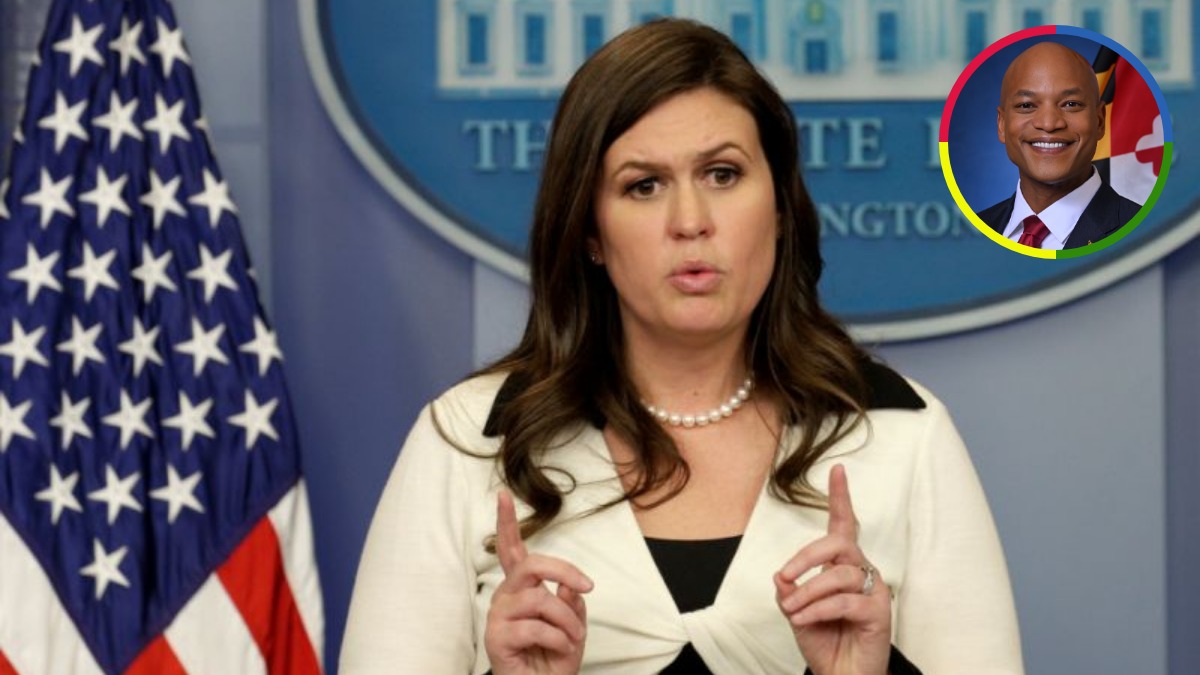

Arkansas Governor Sarah Huckabee Sanders and Maryland Governor Wes Moore appeared together on Sunday to highlight the critical need for bipartisan cooperation to fix gaps in maternal healthcare. The two leaders, who have both served as governors since January 2023, spoke on Mother’s Day about the urgent work required to ensure mothers across the country have better access to the care they need.
According to the Centers for Disease Control and Prevention, nearly 80 percent of pregnancy-related deaths are preventable. While the mortality ratio for expectant mothers in the United States dropped to 16.6 per 100,000 in December compared to 33.2 per 100,000 in 2021, the current rate is still significantly higher than the 11.3 per 100,000 reported three decades ago. The situation is even more dire for Black mothers, who face a mortality rate of 46.3 per 100,000, a figure that is far higher than their White, Hispanic, and Asian counterparts.
Governor Sanders, a mother of three, pointed to the Healthy Moms, Healthy Babies Act as a cornerstone of her state’s approach. Signed into law last year, this legislation directs roughly $45 million annually toward maternal health and includes provisions for presumptive Medicaid eligibility for pregnant women. Sanders emphasized that the goal is to provide consistent support from the start of a pregnancy through to delivery and beyond.
Addressing these disparities is clearly a massive undertaking that requires both innovation and sustained bipartisan focus
“If we can see these women and help them and support them from the very beginning of their pregnancy all the way through, then we can help address some of these problems and we can change maternal health,” Sanders told the program host. “Not just in our state, but across the country. We’re already seeing the positive impact by raising that awareness and opening up a lot of access.”
Sanders also highlighted a new statewide campaign launched earlier this week by the Arkansas Department of Health. The initiative focuses on helping mothers access care close to home. She noted that every one of the 75 counties in Arkansas currently has a health unit where women can receive services for free. To bridge gaps in service, she touted the 10:33 Initiative, which she launched in October to connect individuals in poverty with community and faith leaders.
“For us we say, ‘No wrong door.’ No matter where you show up to us, our system, we have a technology platform that is integrated,” Sanders said. “So, if you come and you’re looking for maternal care, no matter where you show up on our doorstep we have connectivity to our nonprofit world, to our faith communities so that we can help provide those services.”
Maryland Governor Wes Moore, a father of two, is taking a slightly different but equally vital approach by focusing on the intersection of government, private sector, and community organizations. Moore announced that his administration has entered a partnership with the Bridge Project to provide direct cash assistance to new mothers. The Bridge Project currently operates in 10 cities, counties, or regions across the country, offering financial support and community resources to mothers during pregnancy and for the first several years of their child’s life.
“It’s going to happen for 150 families in the … areas of Maryland that you’ve had concentrated poverty being a long-term challenge,” Moore explained. He also highlighted the ENOUGH Initiative, an acronym for engaging neighborhoods, organizations, unions, governments, and households. This is the nation’s first place-based, state-led anti-poverty initiative, and it is part of a broader effort that includes the reestablishment of the Governor’s Office for Children.
When it comes to the racial disparities in maternal mortality, Moore emphasized the importance of diversity in the medical field. He argued that the healthcare system must strengthen the pipeline for physicians and nurses of color to ensure that patients are treated and supported by people who represent them. It is a logical and necessary step to improve trust and outcomes in the healthcare system.
“We need to make sure that our physicians and our nurses are trained up,” Moore said. “But also, what we’ve got to do is we’ve got to strengthen the pipeline to get more physicians and nurses of color who are actually in there to increase the probability that when a person comes in they’re going to have someone who’s going to be treating them and supporting them who looks like them, who represents them.”








Published: May 11, 2026 02:45 pm