



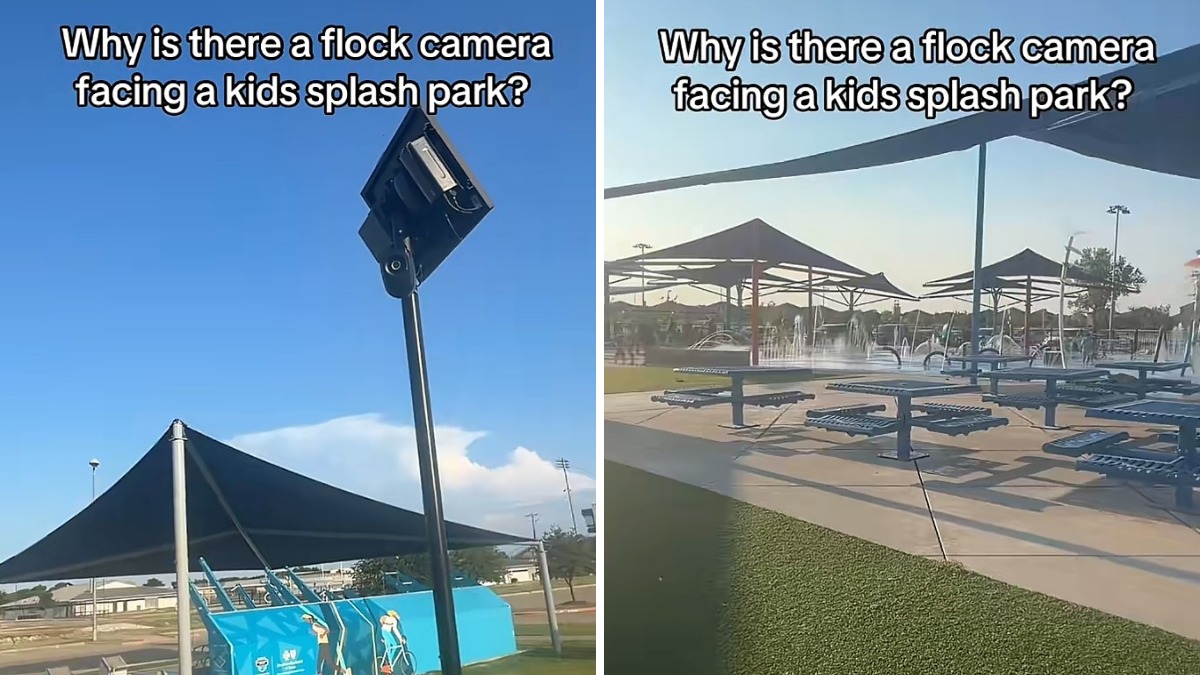

A viral video showing eight Flock cameras pointed directly at a children’s splash park in Anna, Texas, has ignited a fresh wave of public concern regarding the reach and placement of these controversial surveillance devices, The Nerd Stash reported. The footage, which was uploaded to TikTok by user marztrip.kira, captures the cameras installed at Slayter Creek Park. Instead of monitoring traffic or capturing license plates as they were originally intended, these devices appear to be aimed right at the playground area where children typically play in their swimsuits.
The hardware is turned toward a space where families change into swimming gear and children spend their afternoons. The TikTok user behind the video clearly asks, “Why does Anna have a Flock camera literally facing the kids’ splash pad?” and adds, “I just don’t understand why do you need a Flock camera facing kids?” This specific installation has struck a nerve with many people, especially given the history of privacy concerns that have followed these devices since they started appearing across the country.
If you’ve driven around North Texas or other parts of the country lately, you’ve likely noticed these black cameras attached to solar panels. They are designed to be easy to install because they don’t require being hardwired into a city’s power grid. This convenience allows them to crop up almost overnight in neighborhoods, often with little public input.
The core of the issue for most people is how the data is stored and who has access to it
While police departments frequently argue that these devices are invaluable tools for solving crimes, the rapid expansion of the network, which now includes more than 120,000 cameras operating in every state except Alaska, has left many residents feeling like they’re living under a microscope.
These cameras are linked by a searchable, national network that can be accessed by law enforcement agencies. As noted by Fernando Alfonso III, the Texas editor for The New York Times, this creates a situation where a significant amount of power is placed in the hands of individual officers. He has pointed out that with just a few keystrokes, an officer could potentially track the license plate of a family member, a former coworker, or a romantic partner.
We’ve already seen real-world examples of how this power can be abused. There have been documented cases where officers used the system to track romantic partners, which has led to termination and disciplinary action in several instances.
In one notable case in Texas, a Sheriff used the network to track a woman suspected of self-administering an abortion across state lines. These incidents have fueled a growing movement of people who are simply tired of being constantly surveilled. In cities like Houston and Oakland, some residents have even taken matters into their own hands, with reports of cameras being shot, painted over, or cut down entirely.
The comments section on the viral video from Slayter Creek Park reflects this widespread frustration. Many users are pointing out that this isn’t the first time they’ve seen these cameras in places where vehicles aren’t the primary focus.
One user noted a similar situation where a camera was placed inside a ballet studio for children, prompting the question, “Ask yourself who’s monitoring this f— and why.” Another commenter claimed, “It’s actually been reported that some officers have been caught stalking women and kids through the Flock cameras, but remember guys they’re JUST plate readers.”
The situation in cities like Dayton, Ohio, and Los Angeles shows that even local governments are starting to push back. Both cities have suspended their contracts with the company to prevent immigration authorities from accessing their data, with Dayton officials going as far as covering the cameras with trash bags.









Published: Aug 12, 2026 06:30 pm