



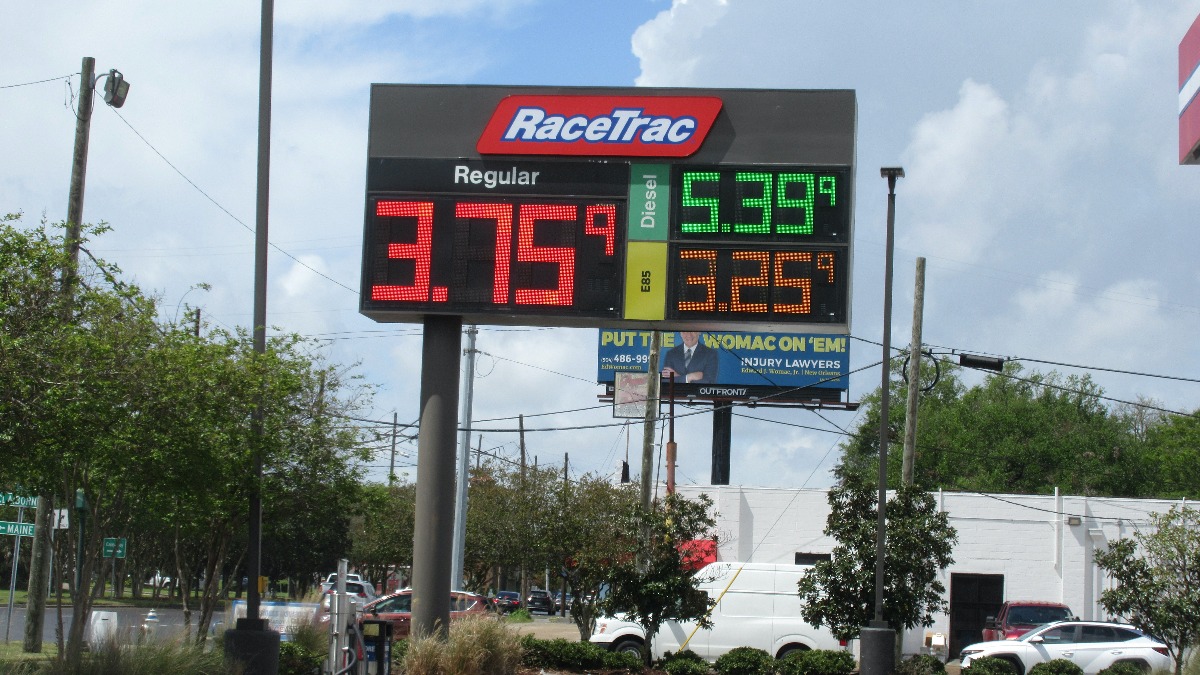

President Donald Trump gave two very different answers about gas prices in the lead-up to the midterm elections, both to the same interviewer, just four days apart. In a Wednesday interview with Mornings With Maria host Maria Bartiromo, Trump said gas prices will be “much lower” before the November elections, directly contradicting what he said earlier that week.
During the Wednesday interview, Bartiromo asked Trump if higher tax returns would be enough to offset rising gas prices. According to Mediaite, Trump replied, “It will be, ’cause gasoline is coming down very soon and very big.” When asked if prices would be lower before the midterms, Trump said, “I think they’ll be much lower, before midterms? Much lower.”
But just four days earlier, in a separate interview with the same host, Trump gave a much less certain answer. “I mean, I think so,” he said. “It could be [lower]. It could be. Or the same. Or maybe a little bit higher. But it should be around the same. I think this won’t be that much longer.” This clearly conflicts with his “much lower” claim made on Wednesday, and no clear explanation has been given for the change in tone.
Trump’s gas price promises are tied directly to how the Iran conflict ends
Trump offered some explanation during his recent interview, saying fuel prices will drop once the Iran conflict is “settled.” He said, “On the assumption that we have that settled, hopefully long before that, hopefully very soon, but when that’s settled gas prices will go down tremendously in gasoline and gas prices cost per barrel, fill up your car per gallon, anyway you look at it, numbers are gonna go down.”
In an interview with Fox Business Trump said the war was “very close” to being over, pointing to a two-week ceasefire agreement between the U.S. and Iran. However, experts have raised concerns about Trump’s authority to enforce ceasefire-related tariffs on Iran’s arms suppliers, which he threatened just hours after declaring the ceasefire. He also warned that Iran would need to be rebuilt for 20 years if the U.S. pulled out now, suggesting the conflict is far from fully resolved.
The Iran conflict began on February 28th, when the U.S. and Israel launched coordinated strikes against Iran, killing Supreme Leader Ayatollah Ali Khamenei and effectively dismantling the Islamic regime. Thirteen U.S. service members and thousands of others across the Middle East have been killed in the conflict. Trump has frequently claimed that U.S. forces have “decimated” Iran’s military capabilities.
Over the weekend, Vice President JD Vance and senior White House officials held talks with Iranian officials in Pakistan about Tehran’s nuclear program and enrichment plans. The negotiations produced no clear breakthrough, though Vance said on Monday that “a lot of progress” was made and that Iran holds the deciding hand in what comes next in the conflict.
Trump justified entering the conflict by saying it was necessary to stop Iran from getting a nuclear weapon. “I had to divert because if I didn’t do that, right now, you’d have Iran with a nuclear weapon. And if they had a nuclear weapon, you’d be calling everybody over there ‘sir,’ and you don’t want to do that,” he said.
Some critics have gone further in their concerns about Trump’s decision-making, with questions about whether Trump is fit to serve as president being raised even by a former CIA director. With the midterms approaching, gas prices remain a key issue that voters are watching closely.






Published: Apr 15, 2026 01:00 pm