



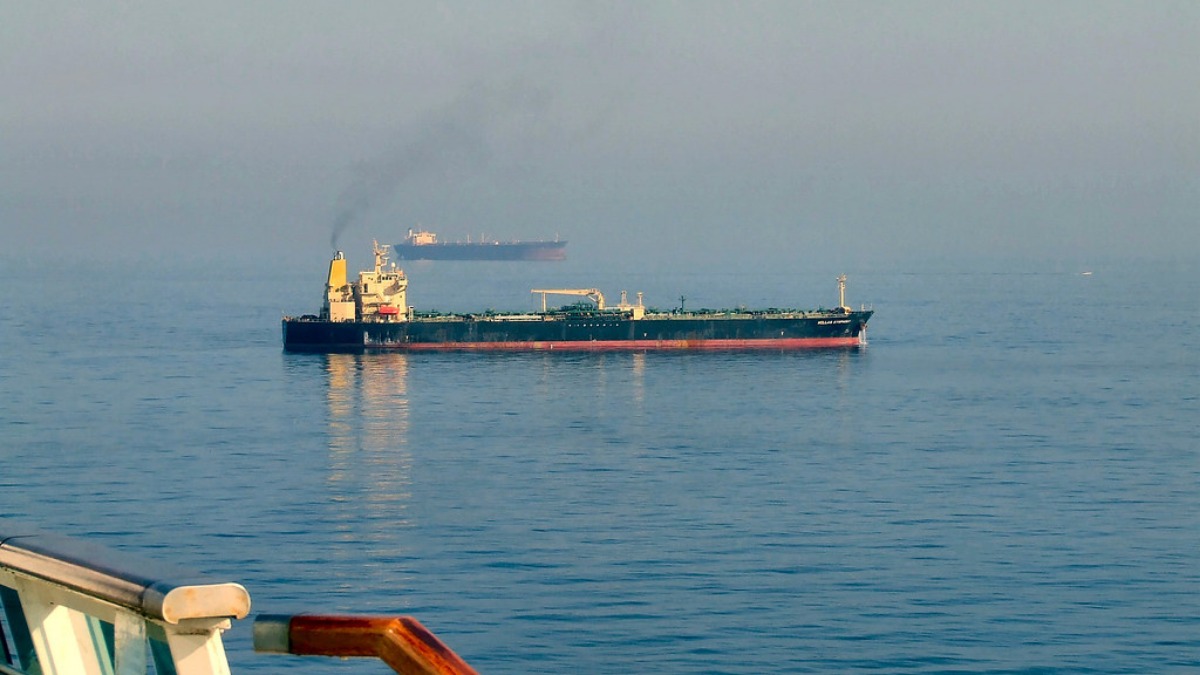

Iran abruptly reversed course on the Strait of Hormuz on Saturday, April 18, 2026, declaring it had returned the waterway “to its previous state” and would maintain “strict control” unless the United States ended its blockade of Iranian ports. The reversal came less than 24 hours after Iran had declared the strait open to commercial traffic.
As detailed by The New York Times, the brief window of openness had followed the start of a cease-fire between Israel and Lebanon. Maritime data firm Kpler noted a slight uptick in activity during that period, with 19 ships passing through on Friday and early Saturday. Analyst Dimitris Ampatzidis of Kpler said that following reported attacks on commercial shipping, the risk environment had “clearly intensified.”
The U.K. Maritime Trade Operations organization, overseen by Britain’s Royal Navy, recorded two separate incidents of vessels being struck. In the first, gunships operated by Iran’s Islamic Revolutionary Guards Corps fired at a tanker without prior radio warning, though the ship’s captain confirmed the crew were safe. The second incident involved a container ship that was struck by an unknown projectile, causing damage to some of its containers.
Iran’s reversal is already having real consequences for global shipping
India’s Ministry of External Affairs confirmed on Saturday that it had summoned Iran’s ambassador, conveying the country’s “deep concern” over shooting incidents involving two Indian-flagged ships in the strait. The ministry noted that Iran had previously allowed safe passage to Indian merchant vessels. TankerTrackers.com corroborated this, stating that Revolutionary Guards forces had compelled two Indian-flagged vessels to turn back while transiting the waterway.
Kpler’s data showed one Indian-flagged container ship owned by French company CMA CGM had reversed course as it approached Larak Shari, an Iranian island that serves as a checkpoint. Three additional CMA CGM vessels also reversed course on Saturday; the company declined to comment. Amid the war powers resolution for Iran narrowly failing in the House last week, the standoff in the strait has only added pressure to an already volatile diplomatic environment.
Major shipping companies are now adjusting their operations. Danish shipping giant Maersk announced its vessels would not transit the strait until it is deemed safe, stating it had followed the guidance of security partners in the region who had recommended avoiding the waterway. The International Maritime Agency, an arm of the United Nations, reported that at least 20 vessels have been attacked in recent weeks.
Maritime analysis firm Signal reported that in the last seven days, an average of only one ship per day successfully navigated the strait. Senior market analyst Maria Bertzeletou said the strait is “still in a danger zone,” adding that the next 72 to 96 hours of actual tanker transits would determine whether confidence returns or remains constrained.
The stakes for global trade are significant. The strait is a narrow passage connecting the Persian Gulf to the Gulf of Oman, just 29 nautical miles wide at its tightest point, with two 2-mile-wide shipping channels. In 2025, an average of 20 million barrels per day of crude oil and oil products transited the waterway, representing roughly 25% of the world’s entire seaborne oil trade.
Countries including Iran, Iraq, Kuwait, Qatar, and Bahrain rely on the strait for the vast majority of their oil exports. While Saudi Arabia and the UAE have some alternative pipeline routes, their combined available bypass capacity is estimated at 3.5 to 5.5 million barrels per day, far short of what flows through the strait. Iran’s Jask oil terminal, inaugurated in 2021 with a reported capacity of 1 million barrels per day, remains effectively non-operational.
Natural gas trade faces similar exposure. Almost all liquefied natural gas exports from Qatar and the UAE transit the strait, representing nearly 20% of global LNG trade. Qatar, the world’s second-largest LNG exporter, shipped over 112 billion cubic meters in 2025, while the UAE exported 7 billion cubic meters. There are no viable alternative export routes for these volumes.
A sustained disruption to LNG flows would constitute a major supply shock. Countries like Bangladesh, India, and Pakistan imported almost two-thirds of their total LNG supplies via the strait in 2025, and natural gas accounts for a substantial share of their electricity generation. The Strait of Hormuz blockade’s effect on Iran’s economy has also drawn scrutiny, with analysts questioning whether the standoff can produce a durable resolution. Inadequate LNG supply would drive electricity shortages and production curtailments in gas-intensive industries, with knock-on effects for global spot LNG prices.








Published: Apr 18, 2026 02:00 pm