



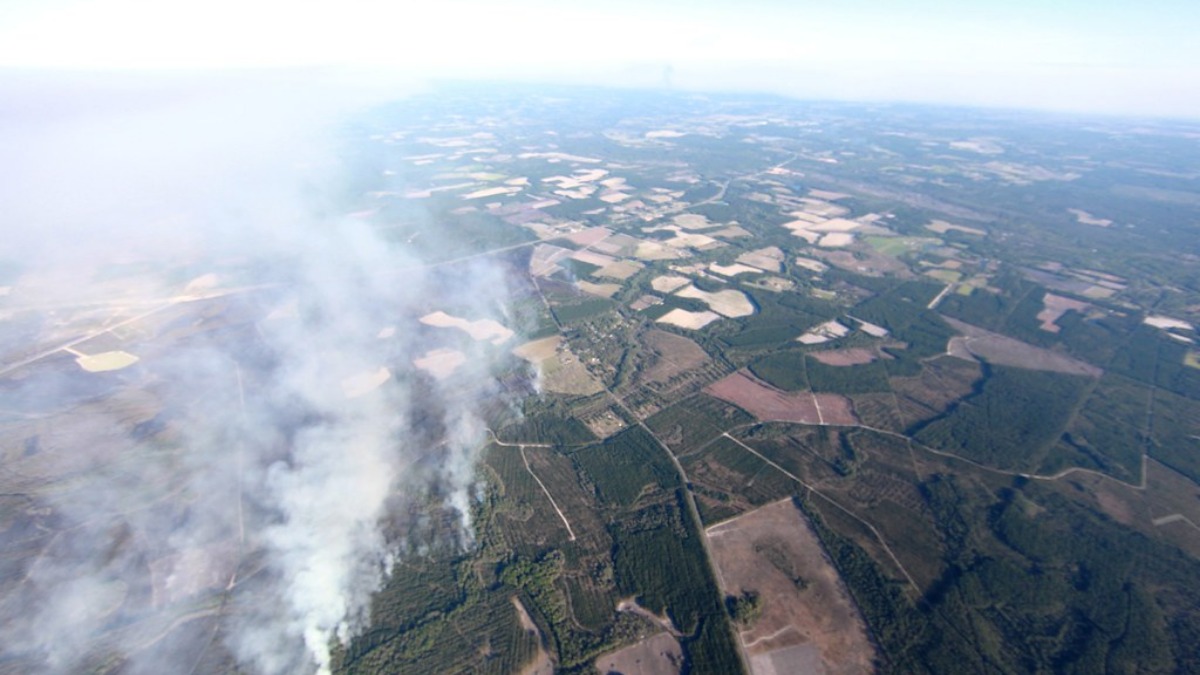

Georgia officials confirmed that a metallic party balloon is the suspected cause of a wildfire that has destroyed more homes than any blaze in the state’s recorded history. The Highway 82 fire, burning in rural Brantley County, has scorched over 7,500 acres and ruined 87 homes and other structures. Gov. Brian Kemp explained Friday that the balloon likely landed on a power line and triggered an electrical arc, which ignited the surrounding dry vegetation.
The destruction extends well beyond Brantley County. As detailed by The New York Times, across southern Georgia and northern Florida, dozens of wildfires have been burning throughout the week, fueled by extreme drought conditions. Gov. Kemp reported that more than 120 structures have been lost across two major wildfires alone.
In addition to the Highway 82 fire, the Pineland Road fire in Clinch and Echols Counties has burned more than 31,000 acres and destroyed 35 homes. As of Friday morning, that blaze was only about 10 percent contained.
The drought has turned the landscape into a tinderbox
A severe, long-running drought is the defining factor behind the fires’ rapid spread. Because swamps and waterways that would normally act as natural firebreaks have dried up, there is little standing between the flames and populated areas. Andy Snyder, a fire meteorologist with the U.S. Wildland Fire Service in the Southeast, noted that the fire activity is entirely fuel-driven, with precipitation deficits reaching 16 to 20 inches over the past year. In many cases, fires are burning beneath the surface of the soil, meaning minor rainfall will not be enough to extinguish them.
According to the U.S. Drought Monitor, 96.83 percent of the Southeast is currently experiencing moderate to exceptional drought conditions. The current drought in Florida is the worst since tracking began in 2000, and Georgia is seeing conditions that rival the severe droughts of 2000 and 2007. The lack of rain since July 2025 has created an environment where even small sparks can lead to catastrophic damage.
Gov. Kemp declared a state of emergency on Wednesday, prompting evacuations in several communities and leading officials to announce the state’s first-ever burn ban, amid broader concerns about government agencies managing overlapping crises, not unlike a DHS misconduct investigation that has drawn scrutiny this week. Smoke from the Georgia fires has already drifted as far as West Virginia.
The weekend outlook offers little relief. Gov. Kemp warned that high fire activity is expected to persist and that the region desperately needs a change in the weather. Alex Boothe, the lead forecaster at the National Weather Service office in Jacksonville, cautioned that an approaching cold front could bring thunderstorms with lightning that may ignite additional fires, with forecasts predicting only a quarter-inch of rain or less in most areas.
Agricultural conditions across the region have also deteriorated sharply. Soil moisture is critically low, and reports indicate the ground is too dry for planting, with many farmers forced to feed hay to livestock since last fall. With temperatures expected to remain high and evaporative demand increasing, short-term rainfall is unlikely to reverse conditions. The atmosphere is effectively unable to hold enough moisture to provide meaningful relief.
Approximately 1,000 homes remain at risk as firefighters focus on containment. Officials warn that without sustained, soaking rain, conditions across the Southeast will remain highly dangerous.







Published: Apr 24, 2026 06:45 pm