



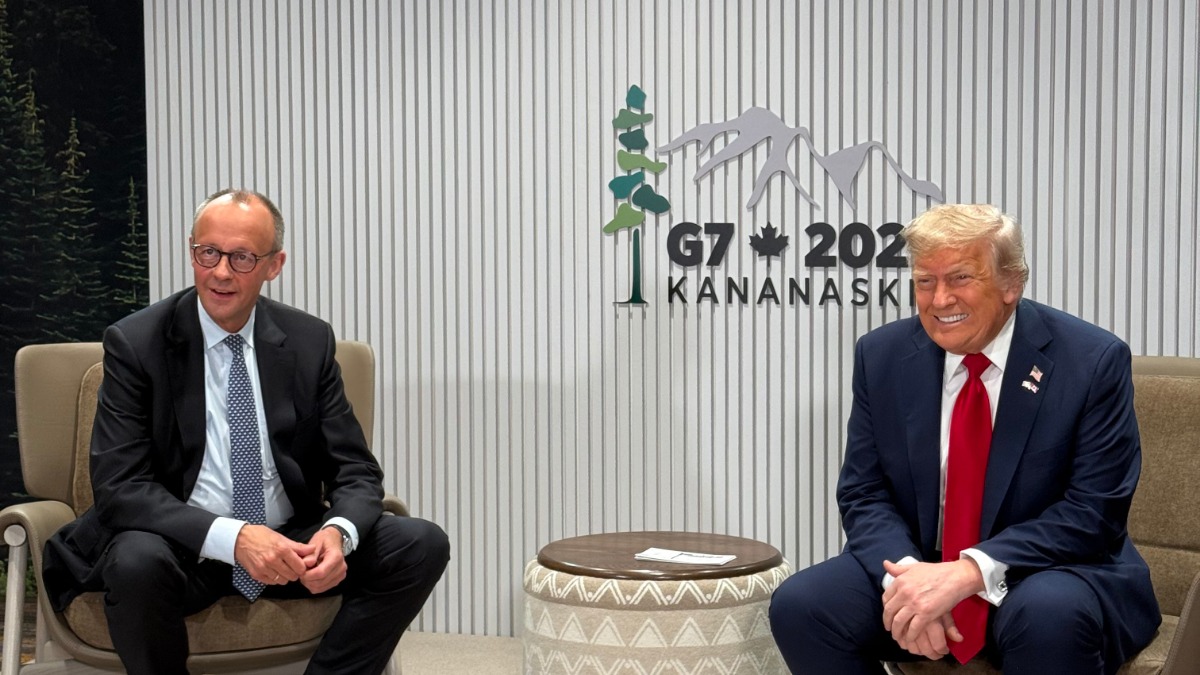

President Donald Trump lashed out at German Chancellor Friedrich Merz on Truth Social after Merz publicly said the United States had been “humiliated” by Iran. Trump’s response was direct and left little room for debate, as he accused the German leader of being completely out of touch.
“He doesn’t know what he’s talking about!” Trump wrote on Truth Social, according to Politico. “If Iran had a Nuclear Weapon, the whole World would be held hostage. I am doing something with Iran, right now, that other Nations, or Presidents, should have done long ago. No wonder Germany is doing so poorly, both Economically, and otherwise!”
Merz had triggered the clash on Monday when he said the U.S. had been “humiliated” by Iranian leadership. The exchange marks another low point in the already strained relationship between the U.S. and its European allies, as tensions over the ongoing conflict in Iran continue to grow.
The U.S.-Europe divide over the Iran conflict is getting harder to ignore
The war in Iran has seen major escalation in recent weeks. Iran has effectively shut down the Strait of Hormuz, a key waterway through which roughly 20 percent of the world’s oil passes. This has forced Europe to secure oil and gas supplies from producers outside the Middle East, such as the U.S. and Norway.
Trump has been frustrated with European leaders over their reluctance to take part in the war. Germany’s defense minister has called the conflict a “catastrophe,” and British Prime Minister Keir Starmer has described it as a “war of choice” that the U.K. was not consulted on beforehand. Reports have also emerged that Vice President Vance has been privately questioning the Iran war’s progress, raising further doubts about the administration’s internal alignment on the conflict.
The tension between Trump and Merz is not new. Back in February, Merz told an audience at the Munich Security Conference that the U.S. could no longer be relied upon to uphold the global world order, and that Trump’s leadership had created “a deep divide” between Europe and the United States.
“The leadership claim of the U.S. is being challenged, perhaps already lost,” Merz said at the conference. “In the era of great powers, our freedom is no longer simply guaranteed. It is under threat.” Iran has also put forward a new offer to reopen the Strait of Hormuz as oil prices surge, but only if the U.S. lifts its blockade of Iranian ports and the war ends. The proposal has sparked debate, with some seeing it as a step toward peace and others viewing it as a delay tactic by Tehran.
Former NATO chief Jens Stoltenberg, who now serves as Norway’s finance minister, told CNBC that the risk of further escalation remains very real while peace talks are stuck. He warned that an escalation would cause enormous human suffering and economic damage far beyond what the world has already seen.
“I worry most about the fact that, of course, wars are dangerous,” Stoltenberg said. “We have a war in Iran, the Middle East, and then we have a full-scale war in Europe, in Ukraine, and of course, wars are unpredictable. They can escalate, and if that happens, it will be first and foremost about human suffering, but it will have even bigger economic consequences than the consequences we have seen so far financially.”







Published: Apr 29, 2026 08:30 am